US taking move to recognize Vietnam as market economy a welcome sign: MoFA
US upgrading of Vietnam to market economy status would improve economic and trade relations, bringing tangible benefits to the businesses and people of both countries.
Vietnam welcomes the latest move by the US Department of Commerce to hold a public hearing on the decision to upgrade the country to market economy status.
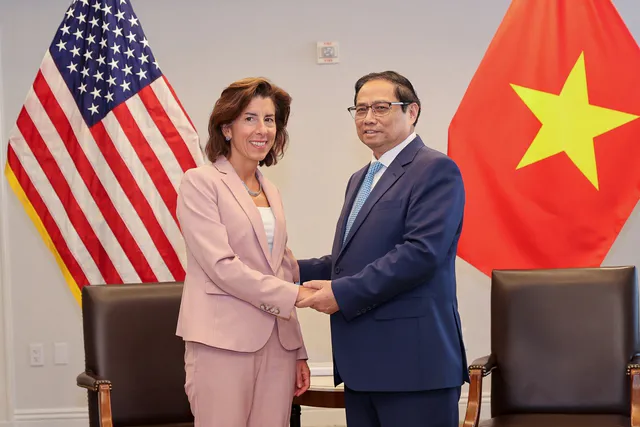
| Prime Minister Pham Minh Chinh and US Secretary of Commerce Gina Raimondo during the former's visit to Washington last September. Photo: Nhat Bac |
Spokesperson of the Ministry of Foreign Affairs Pham Thu Hang stressed the view during a regular press briefing held on May 9.
"This is a significant step in the process of evaluating Vietnam's request for market economy status," stated Hang.
During the hearing, Vietnam presented arguments, information, and data in support of the country’s claim to be a market economy, and even emphasized that Vietnam's economy fares even better than many economies that have already earned market economy status, Hang informed.
To date, 72 countries have recognized Vietnam as a market economy, including major economies such as the UK, Canada, Australia, Japan, and South Korea. Vietnam has participated in 16 bilateral and multilateral free trade agreements with over 60 partners.
"The recognition by the US of Vietnam's market economy status would contribute to the concrete realization of the commitments made by the top leaders of the two countries, strengthen the Comprehensive Partnership between Vietnam and the US and thereby boost economic and trade relations, bringing tangible benefits to the businesses and people of both countries," remarked the Ministry of Foreign Affairs spokesperson.
Indeed, the upgrade would result in lower import tariffs on many Vietnamese products entering the US. For instance, the current tariff on Vietnamese frozen shrimp is 25.76%, while the same product from Thailand—a market economy—faces a tariff of only 5.34%.
US steel companies and shrimp producers oppose the upgrade. However, retailers and many other business groups support it.
On May 8, the US Department of Commerce listened to arguments from both sides in an online hearing in Washington. This is part of an evaluation process that is expected to be completed by the end of July.
Last year, US President Joe Biden visited Vietnam. The two countries upgraded their Comprehensive Strategic Partnership. During that meeting, Prime Minister Pham Minh Chinh also urged US Treasury Secretary Janet Yellen to quickly grant Vietnam market economy status.
The US Department of Commerce relies on a set of criteria to determine whether an economy qualifies as a market economy. These include a freely convertible currency, wages set through negotiations between labor and employers, openness to investment, and resource allocation.
They also take into account factors such as government control over the means of production or intervention in resource distribution or prices, and output.
After 30 years of establishing diplomatic relations, US-Vietnam trade turnover has increased nearly 300-fold, reaching nearly $111 billion by the end of 2023. The US is currently Vietnam's largest export market.
According to a report by the Ministry of Industry and Trade, in the first four months of the year, the US continued to hold this position, with a turnover of over $34 billion, accounting for nearly 28% of the country's total export turnover and increasing by 19% compared to the same period last year. The US is also a leading market for imports, with $4.5 billion recorded by the end of April.