US tariffs prompt Vietnam firms to diversify export markets
Vietnam’s wide network of trade relationships offer vital opportunities for businesses to reduce reliance on any single market.
THE HANOI TIMES — Many Vietnamese companies are developing strategies to respond to US tariffs, with exporters prioritizing efforts to access new markets, according to the 2025 Business Confidence Report released by the Private Sector Development Research Board (Board IV).
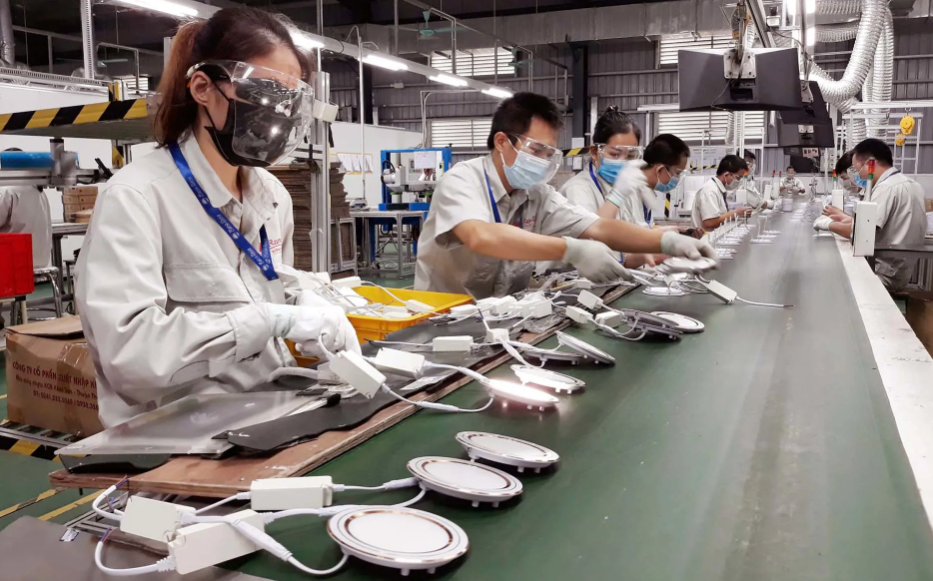
Export production at Rang Dong Light Source and Vacuum Flask Joint Stock Company. Photo: Hoai Nam/The Hanoi Times
The findings, based on a June survey of more than 1,500 enterprises conducted with VnExpress, reveal that 51.6% of exporting companies plan to enter new markets to mitigate tariff impacts. Among domestic-oriented producers and service providers, 34.9% are considering the same strategy.
Other responses include boosting localization of supply chains (20.8%) and sourcing alternative raw materials (14.3%).
In contrast, businesses focused solely on the domestic market remain more cautious, with only 24.4% exploring diversification options.
The report highlights that tariff risks affect not only exporters but also domestic manufacturers, many of which are embedded in supply chains already facing structural constraints. Manufacturing, processing, services, agriculture, forestry, and fisheries firms are the most inclined to pivot away from the US market.
Construction companies, meanwhile, are adopting a wait-and-see approach, prioritizing supply chain localization over market expansion. Few respondents view raising export prices to the US or boosting imports from the US as viable solutions.
Several Vietnamese companies have already begun implementing diversification plans. Since April, SK Foods, a rice-based products manufacturer, has been working to expand exports to the EU, South Korea, Japan, Singapore, and the UAE. Similarly, Thanh Cong Textile and Garment Corporation is seeking new markets to navigate global uncertainties and stay aligned with its business plan.
Survey data show significant tariff impacts across industries, with serious or very serious effects reported by nearly 64% of manufacturing firms, 65.8% of service companies, 62% of construction businesses, and 61.2% of agriculture and aquaculture enterprises.
Despite these challenges, Vietnam’s extensive trade network offers room for maneuver. The country has signed 17 free trade agreements (FTAs) covering more than 60 countries and territories and maintains 70 bilateral cooperation frameworks.
Industry groups such as the Vietnam Association of Seafood Exporters and Producers (VASEP) are urging businesses to capitalize on FTAs like the EVFTA, CPTPP, and RCEP to broaden market access. While the US accounts for about 13% of global imports, Vietnamese exporters still have the remaining 87% of the global market to target for diversification.
To support this shift, businesses are calling on the government to intensify trade promotion efforts and negotiate additional FTAs. They also seek more practical guidance on leveraging existing agreements to secure preferential tariffs.
Firms have recommended bolstering supporting industries to reduce dependence on imported inputs and proposed policy measures such as credit support, temporary corporate income tax cuts, and subsidies to lower input costs. An early warning system for potential trade disputes and tariff policy shifts in key markets is also seen as critical for timely responses.
|
The Ministry of Industry and Trade on August 1 confirmed that the US is set to impose a 20% countervailing duty on imports from Vietnam. It said both countries will continue discussions and follow-up actions to reach a reciprocal trade agreement. Data from US Customs shows that bilateral trade between the two countries reached US$149.7 billion in 2024. Of this, Vietnam exported goods worth $136.6 billion and imported $13.1 billion, resulting in a trade surplus of $123.5 billion. Vietnam ranked third among countries with the largest trade surpluses with the US, following China and Mexico. In the first five months of 2025, bilateral trade rose 36.5% to $77.4 billion, with Vietnam’s exports totaling $71.7 billion, up 37.3%, while imports stood at $5.7 billion, an increase of 30.7%. Vietnam’s trade surplus with the US during this period rose to $64.8 billion, a 29% increase year-on-year, placing it fourth among countries with the highest trade surpluses with the US, after China, Mexico, and Iceland. |