Vietnam's agricultural exports strive to meet safety standards
Failure to comply with phytosanitary and food safety regulations for exports has resulted in significant losses for local businesses.
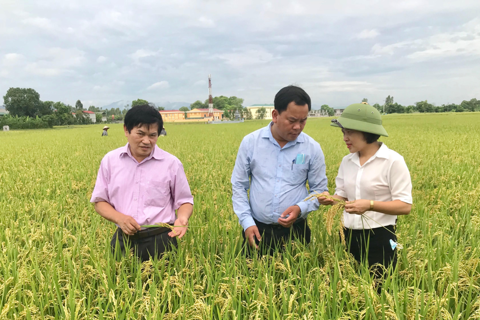
Vietnamese agricultural products are expanding their brand recognition as they gain access to markets in almost 200 countries and territories. While navigating the competitive global landscape, Vietnam is addressing the challenge of meeting food safety standards set by importing countries, in order to strengthen the reputation of its agricultural exports.
Ongoing inspections and penalties
| A farmer works at a high-tech agricultural facility in Dong Anh District. Photos: Trong Tung/ The Hanoi Times |
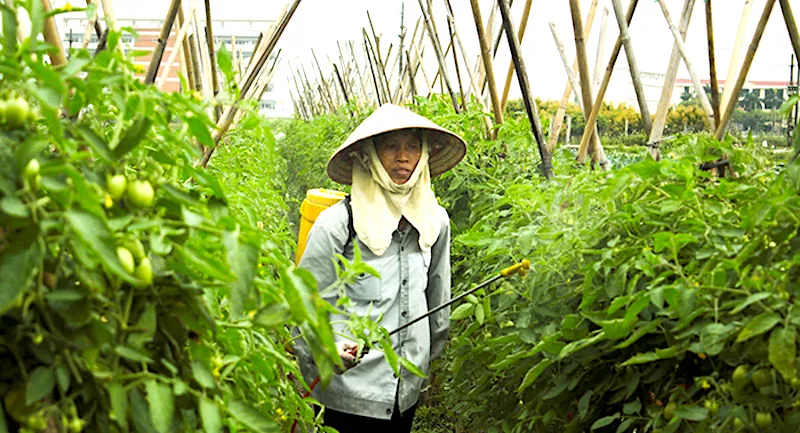
In recent years, the Ministry of Agriculture and Rural Development (MARD) has been working with other ministries and local authorities to gradually standardize production to create safe growing areas for export.
The ministry has carried out two projects "Ensuring Food Safety, Improving the Quality of Agricultural, Forestry and Fishery Products in the Period 2021 - 2030" and "Piloting the Establishment of Agricultural and Forestry Material Areas Meeting Standards for Domestic Consumption and Export in the Period 2022 - 2025" in order to develop a supply chain of safe and high-quality agricultural and food products.
According to Nguyen Nhu Tiep, Director of MARD's Department of Quality Management, Processing and Market Development, the country has established 2,510 value chains; nearly 226,000 hectares of crops have been certified with Vietnamese Good Agricultural Practices (VietGAP); and over 16,000 farms and enterprises have been certified.
The total area of aquaculture certified with VietGAP is nearly 11,000 hectares with 759 certified farms; more than 4,100 farms and livestock households are also certified with VietGAHP, he added.
Vietnam's food safety has made significant progress, with 99.4% of agricultural, forestry, and fishery production and business establishments currently satisfying safety criteria well or sufficiently. However, there is still work to be done, as around 7% of establishments nationwide have yet to sign a commitment to ensure food safety, he said.
"Food safety remains a major concern for the agricultural industry, he underlined.
In particular, in the first six months of 2024, MARD's units conducted inspections on more than 8,700 agricultural inputs and agricultural, forestry, and fishery production and business establishments. Through this monitoring, 901 enterprises (representing 10.2% of the total inspected) received administrative fines of VND11.2 billion (US$443,158).
Addressing export non-compliance issues
| Applying advanced technologies in planting moth orchids in My Hung Commune, Thanh Oai District. |
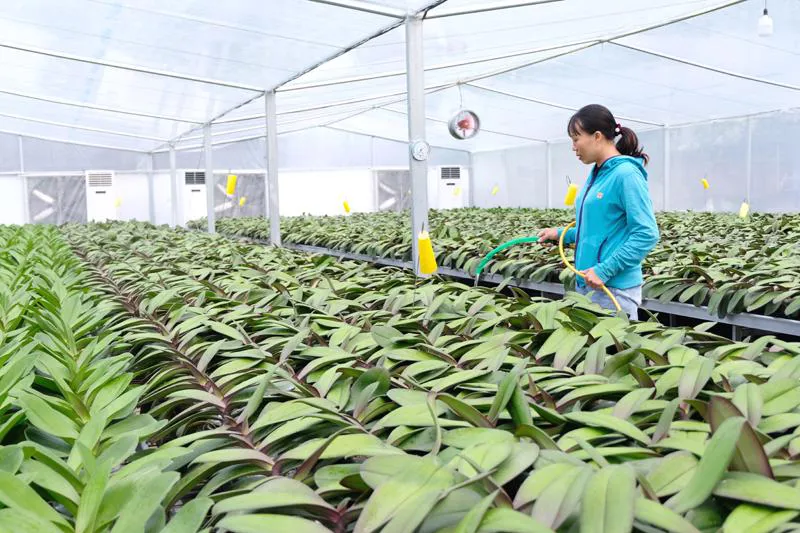
According to MARD's Plant Protection Department, there are still numerous shipments of Vietnamese agricultural products that have been warned, returned or even destroyed and temporarily banned from import for failing to meet technical and food safety requirements.
Vice Chairman of the Vietnam Fruit and Vegetable Association Nguyen Dinh Tung admitted that non-compliance with plant quarantine and food safety regulations during export has caused significant losses for businesses.
"However, the government and industry are working diligently to address these issues and safeguard the good reputation of Vietnamese agricultural products in global markets," he stressed.
Sharing the same perspective, local agricultural expert Nguyen Dang Nghia said that Vietnam is expected to be a reliable source of safe and traceable agricultural and food products. Therefore, it is crucial to address food safety issues in the agriculture, forestry and fishery sectors.
Deputy Minister of Agriculture and Rural Development Hoang Trung confirmed that the department has instructed plant quarantine units at border gates to strengthen inspection and control of goods, as well as information on growing areas and packaging facilities related to shipments.
He added that this has enabled the detection and handling of non-compliant shipments, with the ministry refusing to issue phytosanitary certificates for such consignments.
The Deputy Minister urged local authorities to establish mechanisms and conduct regular monitoring of processing and selection of goods to ensure the absence of harmful organisms in approved packaging facilities, he stressed.
Trung said initial inspections for growing areas and packaging facilities need to be more rigorous, along with increased monitoring of issued codes.
The Deputy Minister emphasized the importance of establishing effective supply chain coordination from growing areas to packaging facilities, phytosanitary facilities and export companies to ensure compliance with importer requirements and protect the interests of all parties involved.