Vietnam emerges as top ASEAN market for Japanese firms: JETRO
This positive business climate has pushed the share of Japanese companies operating in Vietnam that expect to post profits in 2025 to 67.5%, the highest level since 2009.
THE HANOI TIMES — The share of Japanese firms planning to expand their business in Vietnam over the next one to two years reached 56.9%, the highest in ASEAN for the second consecutive year.
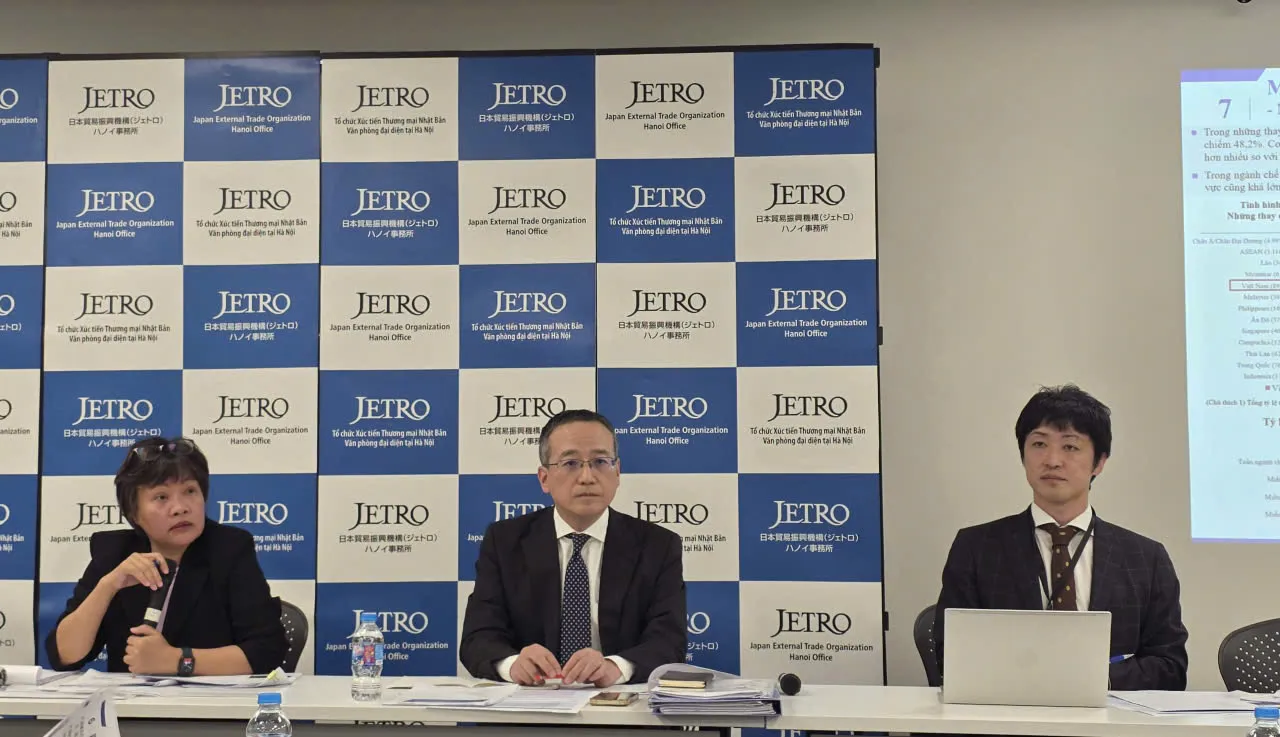
Chief Representative of JETRO Hanoi Ozasa Haruhiko (center) during the event. Photo: Ngoc Mai/The Hanoi Times
Chief Representative of JETRO Hanoi Ozasa Haruhiko made the remarks today [January 26] at the launch of the Japanese agency’s latest survey, covering more than 5,000 Japanese companies operating in the country.
According to Ozasa, many firms said their decision to expand business was driven by rising exports and growing demand in the domestic market. He highlighted that the leading advantages of Vietnam’s investment environment included market size and growth potential at 68.4%, low labor costs at 55.2% and political and social stability at 53.2%, all of which recorded increases from the previous year.
This positive business climate has pushed the share of Japanese companies operating in Vietnam that expect to post profits in 2025 to 67.5%, the highest level since 2009. “This is also the first time in five years that the figure has exceeded the ASEAN average of 65.3%,” Ozasa said.
Meanwhile, the share of companies that said they plan to scale back operations in Vietnam stood at 4.2%. Although this was up 1.4 percentage points from the previous year, it remained among the lowest levels in Asia and Oceania, he noted.
Looking at profit prospects for 2026 compared with 2025, 47.6% of firms said their performance is expected to improve. Another positive sign is the local procurement ratio, which rose to 38.1%, up 1.5 points from a year earlier. This reflects improving capacity among domestic suppliers in Vietnam.
Within this figure, procurement from local enterprises reached 18.3%, the highest level since the survey began in 1987. The share of companies that plan to expand stable local procurement stood at 49.4%, Ozasa said.
On investment risks, Ozasa said Japanese firms expressed concern about complex administrative procedures, an incomplete legal framework and rising labor costs.
To continue attracting investment in the new phase, Vietnam needs to further improve administrative and investment procedures to strengthen competitiveness with other countries in the region, which are also stepping up reforms, he continued.
According to Ozasa, this is especially important for Vietnam to move beyond its role as a manufacturing base and become an investment destination for high-quality technology projects and R&D development, thereby contributing to sustainable growth and the realization of the country’s long-term development goals.
He said the decision of foreign firms to invest in Vietnam depends largely on the investment environment. Among Vietnam’s key advantages, he highlighted political and social stability. However, legal stability and predictability are equally critical for businesses.
“If companies cannot predict the stability and sustainability of the legal framework, it is difficult for them to make major investment decisions,” Ozasa said.
In this context, he called for closer consultation with businesses to design policies that are more stable and predictable. This would allow companies to better assess the quality of the investment environment and make long-term commitments to Vietnam as an ideal investment destination.
“JETRO is committed to working closely with the Vietnamese government to support these reforms,” Ozasa stated.