Log in
Business

Vietnam focuses on chip development for national security, digital transformation

Chipmakers should connect with researchers, policymakers and tech enterprises to drive core technology self-reliance, ensuring Vietnam’s sustainable digital transformation and long-term competitiveness.

THE HANOI TIMES Vietnam is fast-tracking its domestic semiconductor industry, aiming to produce key chips for civilian, defense and security use by 2027, government and industry experts have said.

Speaking at a scientific workshop in Hanoi last week, Tran Kim Chung, Chairman of CT Group, said that semiconductors are no longer just a trade commodity but a strategic asset essential to national security and technological sovereignty.
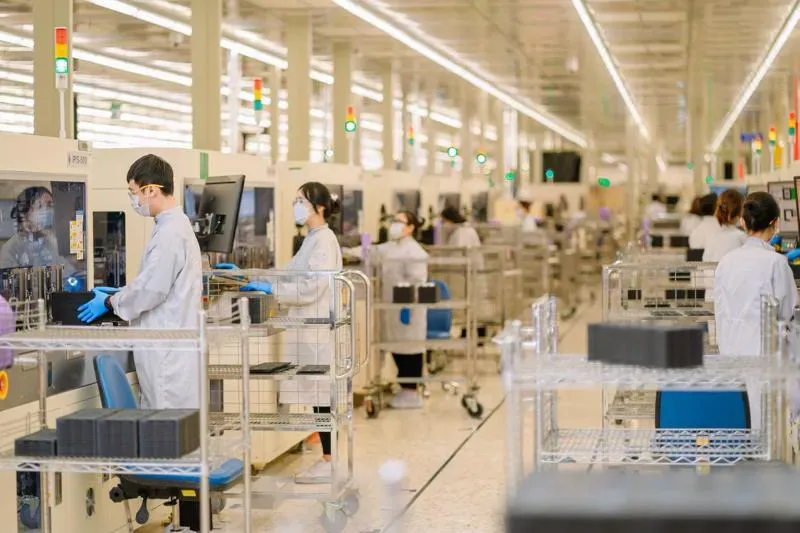
The electronic semiconductor assembly and testing plant of Intel Products Vietnam Co., Ltd. Photo: IPV

He said that it takes more than two years on average to develop a standard chip.

Chung urged government agencies to act decisively to ensure Vietnam meets its 2027 target, keeping pace with rapid digital transformation and global competition.

Regarding chip development, the specialist warned about malicious codes embedded in the hardware.

These pose a growing global security threat, capable of bypassing conventional defenses, Chung said.

Such vulnerabilities could cause national data leaks or disrupt emergency responses, he added.

“Vietnam must look beyond short-term needs and take ownership of core semiconductor technologies, from design to commercialization,” said Chung.

Creating “Made in Vietnam” chips will help Vietnam become Southeast Asia’s new semiconductor hub, and serve both domestic and global markets, he added.

Thai Truyen Dai Chan, member of tech developer CT Group's Science Council, said that control over semiconductors is no longer a trade issue but a geopolitical contest. 

Without mastering integrated circuits, there are high risks for every nation in supply chain disruptions, economic instability, and weakened defense systems, he said.

Imported chips, he cautioned, may even contain backdoors threatening sovereignty.

Vietnam should target practical segments aligned with domestic needs as it is no longer suitable to compete head-on in ultra-advanced semiconductors requiring decades of know-how and billions of dollars in investment, according to the experts at the workshop.

Le Hai Trieu, Director of the Electronics Engineering Department at the Institute of Science and Technology under the Ministry of Public Security, said that Vietnam has designed quality circuits but still relies on foreign production, which carries cost and security risks.

Given domestic demand for ID card and passport chips, which rely on technologies holding 95% of the global market share, local firms should prioritize these products.

He revealed the ministry is drafting a 2025 proposal to master semiconductor technologies for defense and security.

At the early-August meeting of the National Steering Committee on the Development of the Semiconductor Industry, Prime Minister Pham Minh Chinh said that Vietnam aims to master chip design and manufacturing  by 2027, guided by a clear roadmap, coordinated efforts, and strong government leadership.

Reactions:
Share:
Trending
Most Viewed
Related news
Coherent expands semiconductor investment in Vietnam

Coherent expands semiconductor investment in Vietnam

29 Jul, 15:50

The new semiconductor plant, which specializes in producing silicon carbide substrates, optical glass, and advanced photonics components, sits in Nhon Trach Commune in the southern province of Dong Nai.

Vietnam to tighten biometric authentication for new bank cards next year

Vietnam to tighten biometric authentication for new bank cards next year

Bank card issuers must conduct a face-to-face meeting and match the biometric data of individual customers or the legal representative of organizational customers with their identity documents.

Make in Vietnam forum spotlights breakthroughs shaping digital future in the country

Make in Vietnam forum spotlights breakthroughs shaping digital future in the country

Vietnam will host the seventh National Forum on Vietnamese Digital Technology Enterprises on December 25 in Hanoi, highlighting policy directions, strategic technologies and progress under the “Make in Vietnam” initiative as the country pushes toward a stronger digital economy.

Hanoi and Moscow seek new economic momentum as partnership marks 75 years

Hanoi and Moscow seek new economic momentum as partnership marks 75 years

At the Moscow–Hanoi Business Forum, leaders from both capitals said 75 years of Vietnam–Russia ties provide a strong foundation to deepen economic and investment cooperation, especially in technology, trade and urban development.

Vietnam manufacturing maintains strong momentum despite storms disrupting supply chains

Vietnam manufacturing maintains strong momentum despite storms disrupting supply chains

Vietnam’s manufacturing sector continued to expand in November, marking the fifth straight month of improvement, even as severe storms caused supply-chain delays and slowed production, according to S&P Global.

Techfest 2025 returns to Hanoi, spotlighting Vietnam’s vibrant startup community

Techfest 2025 returns to Hanoi, spotlighting Vietnam’s vibrant startup community

Hanoi’s Hoan Kiem pedestrian street will host Techfest Vietnam 2025 from December 12 to December 14, welcoming entrepreneurs, investors and the public to explore emerging technologies and celebrate the country’s growing culture of innovation.

Vietnam expands major entrepreneurship program to unlock opportunities for women nationwide

Vietnam expands major entrepreneurship program to unlock opportunities for women nationwide

The Vietnam Women’s Entrepreneurship Support Program has surpassed nearly every target set for 2017–2025, empowering more than 118,000 women to launch new ventures and laying the groundwork for a stronger, more inclusive entrepreneurial ecosystem in the next decade.

HHTIP accompanies businesses in efficient energy use for sustainability

HHTIP accompanies businesses in efficient energy use for sustainability

As green transition becomes a decisive factor shaping future growth, Hanoi is intensifying efforts to push energy efficiency across its industrial zones. The city’s management board is building a development model centered on clean energy, responsible production and sustainable operations.

Vietnam launches Semiconductor Alliance to build skilled workforce, strengthen global industry ties

Vietnam launches Semiconductor Alliance to build skilled workforce, strengthen global industry ties

The newly launched Semiconductor Alliance in Vietnam seeks to develop skilled professionals, foster collaboration between universities and businesses while preparing the country to play a more active role in the global semiconductor industry.