Vietnam GDP growth projected at 7.5% this year: UOB
UOB has raised its forecast for Vietnam’s GDP growth in 2025 to 7.5% and expects credit expansion to reach 19%–20%.
THE HANOI TIMES — Singapore’s UOB has revised up its full-year forecast for Vietnam’s GDP growth to 7.5% from 6.9%, driven by stronger public investment.
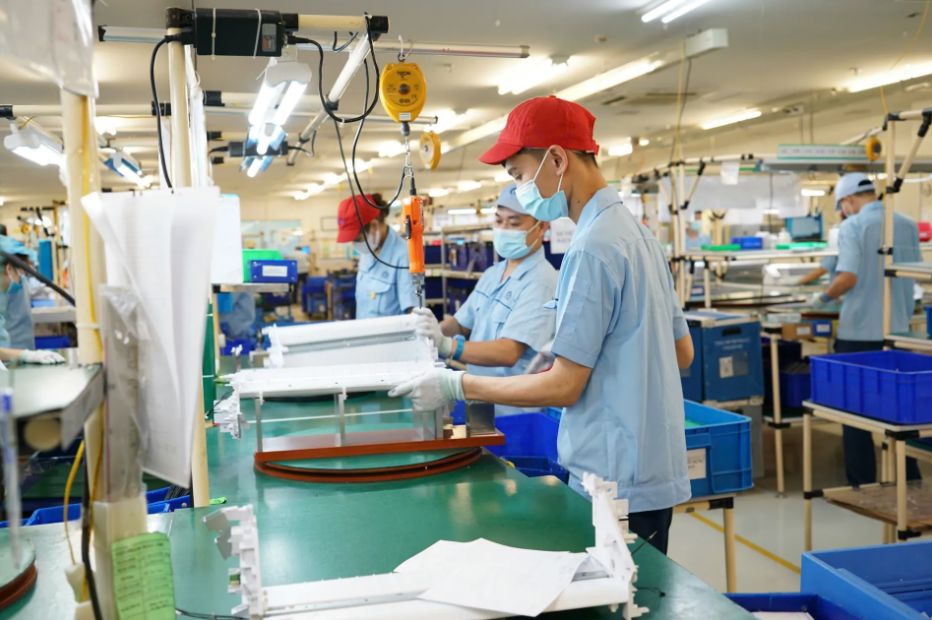
Production at Hoa Lac Hi-tech Park. Photo: Pham Hung/The Hanoi Times
The upgrade comes after the economy expanded 7.5% in the first half of 2025, but fell short of the government’s 8.3%–8.5% target.
In the second quarter, Vietnam’s real GDP rose 7.96% year on year, beating earlier projections. Growth for the first six months of 2025 reached 7.52%, the highest first-half rate since 2011.
This strong momentum was largely driven by a 14% year-on-year rise in exports, following improved market sentiment after US President Donald Trump temporarily cut the “reciprocal” tariff rate to 10% for a 90-day period.
Trade tensions eased further in the second half of 2025 after the US finalized country-specific tariffs by August 1, setting Vietnam’s rate at 20%.
Despite risks from shifting tariff policies, UOB analysts noted that Vietnam’s economy has demonstrated resilience and dynamism. Export performance has been particularly strong, although potential risks remain if US demand weakens under tariff pressure.
Suan Teck Kin, Head of Research and Global Economics at UOB, suggested that annual growth averaging about 7% during 2026–2045 is achievable for Vietnam.
“This will become reality if current reforms and openness are maintained and supported by investment and trade,” he said.
Kin stressed that Vietnam’s ambition to become a high-income economy by 2045 will require consistent reforms.
The UOB’s expert added that recent government measures, such as reducing administrative complexity, consolidating provinces, and giving greater authority to the private sector, are steps in the right direction.
He also pointed to the Politburo’s Resolution 68 on private sector development as timely, supporting domestic enterprise development and the emergence of “national champions.”
On inflation, the indicator has yet to show a clear downward trend. By July, cumulative headline inflation stood at 3.3%, compared with an average of 3.6% in 2024 and 3.26% in 2023.
Given Vietnam’s positive growth outlook for the second half of 2025 and continued pressure on the dong’s exchange rate, UOB expects the State Bank of Vietnam (SBV) to keep the refinancing rate unchanged at 4.5%, limiting the scope for monetary easing.
Since late 2024, central banks worldwide have been cutting interest rates to stimulate growth and job creation amid ongoing global challenges and persistent inflationary pressure.
Dinh Duc Quang, Head of Global Markets at UOB Vietnam, said Vietnam’s macroeconomic picture remains broadly stable, with high growth, inflation under control, steady interest rates, and an exchange rate fluctuation of around 4% so far this year.
In UOB’s view, with annual inflation averaging about 4% and economic growth targets of 8% or higher in the coming years, current market rates are appropriate. Deposit rates for the dong hover around 5%, short-term lending rates at 6%–7%, and medium- to long-term lending at 8%–9%.
“We also forecast that with the current interest rate environment, system-wide credit growth could reach 19%–20% in 2025,” Quang said.
He added that the central bank is likely to maintain policy rate stability in the short term and will only consider rate cuts once the US Federal Reserve’s easing cycle becomes clear.
The US could cut rates three times in 2025, totaling 0.5 percentage points – 0.75 percentage points, bringing the federal funds rate down to about 3.75% by year-end.
If this scenario materializes, UOB expects the SBV may consider trimming dong rates by 0.25% – 0.5% toward the end of 2025 to support momentum into 2026.