Vietnam offers 50% subsidy for initial investment costs in AI and semiconductors
Support measures include training and manpower development costs, R&D expenses, fixed asset investment, high-tech product manufacturing costs, and infrastructure development expenses.
The Vietnamese Government has issued a decree allowing enterprises with R&D projects in the semiconductor and AI industries to receive up to 50% support for initial investment costs.
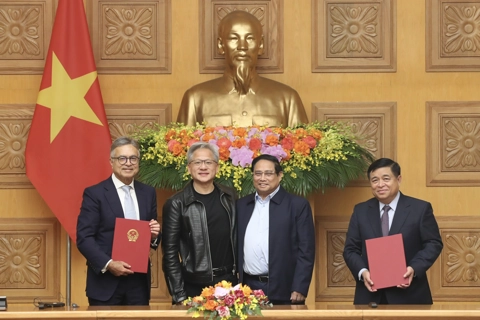
| Prime Minister Pham Minh Chinh and CEO of NVIDIA Jensen Huang during the latter's second visit to Vietnam. Photo: Nhat Bac |

This incentive is outlined in Decree No.182, issued on December 31, 2024, regarding the establishment, management, and use of the Investment Support Fund. To qualify, enterprises must have no outstanding tax or budget debts. Additionally, R&D center investment projects must have a positive impact on the innovation ecosystem and foster the development of groundbreaking technologies and products for the nation.
In addition, the enterprise’s R&D center project must fall under the prioritized high-tech categories and have a minimum investment capital of $125 million, with at least $42 million disbursed within three years from the date of investment approval. In addition to targeted support for the semiconductor and AI sectors, other technology enterprises will receive general support. Eligible entities include high-tech enterprises, those with projects involving the manufacture or application of high-tech products, and enterprises investing in R&D centers.
Support measures include training and the costs of manpower development, R&D, high-tech product manufacturing, infrastructure development, fixed asset investment, and other cases determined by the government.
The Investment Support Fund is a national fund established by the government and administered by the Ministry of Planning and Investment. Operating on a non-profit basis, its mission is to receive, manage, and allocate funds from the state budget and other legal sources to support enterprises.
The decree came into effect on December 31, 2024, and covers the 2024 fiscal year.
Prior to this decree, Vietnam missed out on several multi-billion-dollar investment projects from global "giants." The Ministry of Planning and Investment (MPI) had previously noted that Vietnam's investment incentive policies were not aligned with new global contexts, such as the introduction of the Global Minimum Tax initiative, which promotes multilateral cooperation. Specifically, Vietnam's policies lacked diversity and relied heavily on income-based incentives (e.g., tax exemptions and reductions) and land rent rebates without offering cost-based incentives.
In a 2024 report on the drafting of the decree, the MPI highlighted that many major corporations had explored investment opportunities in Vietnam but relocated their projects due to the lack of specific regulations. For example, Intel proposed a $3.3 billion chip manufacturing project and requested 15% cash support from Vietnam but eventually moved the project to Poland. Similarly, Austria's semiconductor company AT&S considered investing in Vietnam but opted for Malaysia due to insufficient cost-based incentives and a lack of skilled high-tech labor.
In addition to relocation, some large-scale high-tech projects have been stalled and are awaiting favorable policy adjustments. For instance, LG paused its plans for a new $5 billion electronics manufacturing project, citing the absence of adequate support policies.