Vietnam pledges deeper reforms: Prime Minister
The government is transitioning from a passive management approach to an active service delivery model to optimize conditions for both citizens and enterprises.
THE HANOI TIMES — Vietnam is undergoing bold reforms to foster a more dynamic, people- and business-oriented approach.
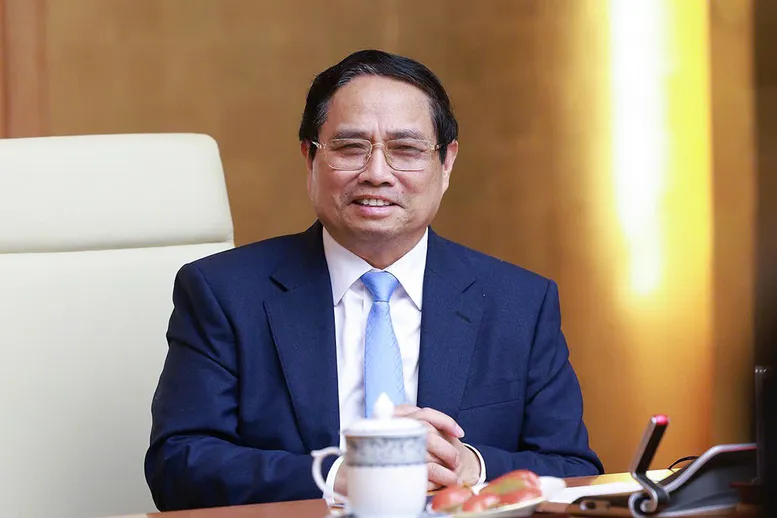
Prime Minister Pham Minh Chinh during the meeting on July 11. Photos: VGP
Prime Minister Pham Minh Chinh conveyed this message during a meeting with a US-ASEAN Business Council (USABC) delegation visiting Vietnam on July 11.
The delegation included representatives from corporations such as Abbott, Amazon, Apple, Boeing, Brunswick, Citibank, Exxon Mobil, Ford, Google, IBM, Intel, Manulife, Meta, UPS, Warburg Pincus, Odgers Berndtson, and Zuellig Pharma.
The prime minister reaffirmed Vietnam's accelerated reforms and a supportive environment. "The government is placing people and businesses at the center of governance, transforming from a supervisory to a service-oriented state."
He also pledged to ensure equal access to resources for both domestic and foreign companies while facilitating areas such as visas, labor, and food safety.
Since establishing diplomatic ties in 1995, Vietnam and the US have strengthened their partnership, elevating it to a Comprehensive Strategic Partnership in September 2023.
Over the past two decades, the US has consistently been one of Vietnam’s largest export markets, and Vietnam has become the US's 8th largest trading partner. In the first half of this year, the two countries' total trade volume reached nearly $80 billion.
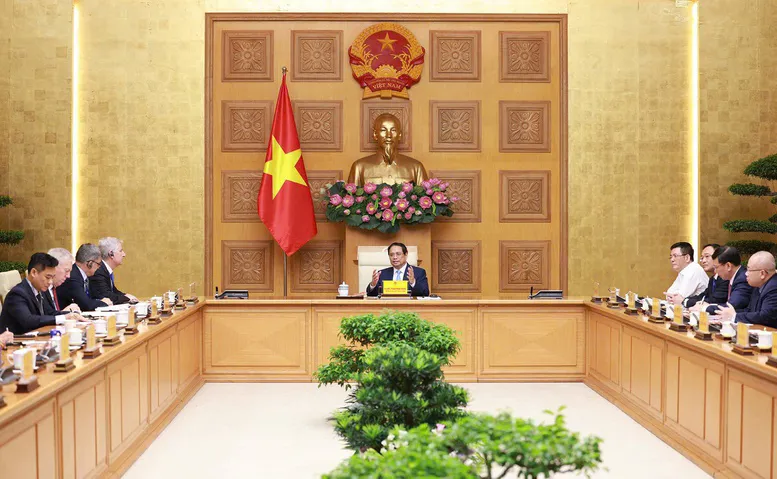
Overview of the meeting between the prime minister and US firms.
The United States has invested approximately $12 billion in Vietnam through nearly 1,500 projects, placing it 11th among countries and territories investing in Vietnam. Most major US corporations are operating effectively in the country.
At the meeting, Ted Osius, former US ambassador to Vietnam and current Senior Vice President and Regional Managing Director of the US-Vietnam Business Council (USABC), emphasized that US firms have confidence in Vietnam and are not concerned about the country's market economy status.
Delegates highlighted Vietnam’s increasingly favorable investment climate, praising its strong commitments, strategic vision, and the government's efforts to streamline administrative structures.
They pledged to continue cooperating with Vietnam in the long term and offered several recommendations to strengthen bilateral relations.
Since late 2024, the prime minister has met twice with USABC delegations and held two roundtable discussions with US companies. He regularly engages with US corporations, both bilaterally and at multilateral forums.
Regarding investor proposals, the prime minister instructed agencies to thoroughly resolve issues, following the principle of “clear responsibilities and clear actions.”
He also urged ministries to foster continued cooperation with US businesses, particularly in emerging sectors such as science and technology, innovation, digital transformation, and artificial intelligence.
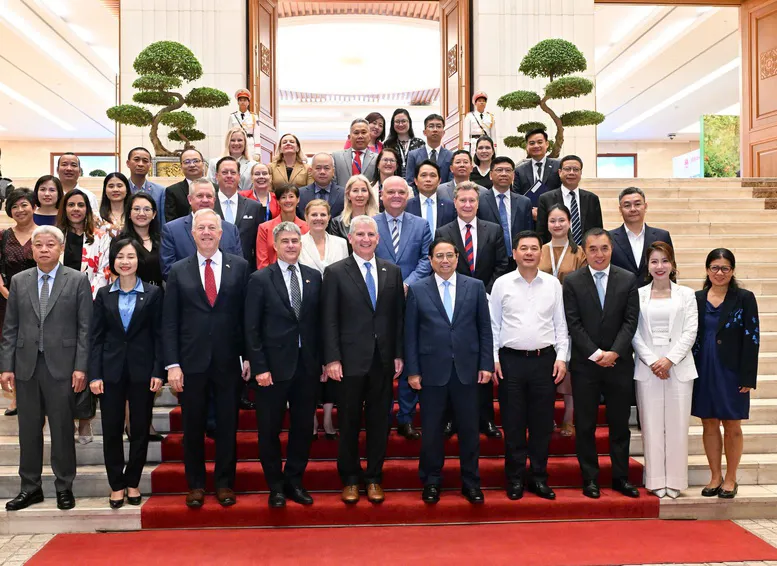
The prime minister and representatives of US corporations.
Vietnam and the US have also been negotiating tax policy frameworks. Chinh noted that the government has implemented a comprehensive and coordinated political, diplomatic, and economic approach. The two negotiating teams have reached basic consensus on a Joint Statement for a mutually beneficial, fair, and balanced trade agreement framework.
"This framework will create a foundation for promoting stable and sustainable bilateral trade and economic growth, benefiting both our peoples and businesses," he stated.
Prime Minister Chinh expressed gratitude to US corporations for supporting bilateral negotiations, investment cooperation, and business relations. He urged US businesses to advocate for the swift establishment of appropriate tariff policies for specific product categories.
Chinh also encouraged US businesses to invest more in Vietnam, transfer advanced technologies, improve corporate governance, and support workforce training for Vietnamese companies. He encouraged them to allow Vietnamese enterprises to participate more deeply in their global supply chains.
"These efforts are intended to lower compliance and operational costs and help businesses operate more efficiently and sustainably in Vietnam," he said.