Vietnam reduces import duties on selected cars
THE HANOI TIMES — The Most Favored Nation (MFN) tariff, a preferential import duty for WTO members, was reduced from March 31 for certain goods, including automobiles, timber, liquefied natural gas (LNG) and agricultural products such as chicken legs, cherries and apples.
The move followed the issuance of Government Decree 73 on March 31, which revised the MFN tariff rates for certain goods, effective immediately. The MFN tariff applies to countries within the World Trade Organization (WTO).
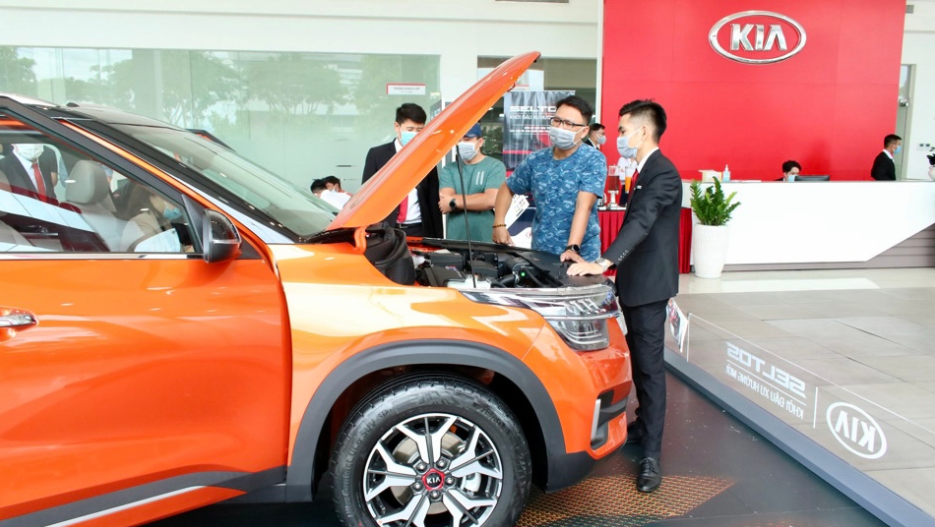
Locals at a car showroom. Photo: Tran Dung/The Hanoi Times
Lower tariffs will apply to three car segments: passenger cars with shared cargo space and 2,000-2,500 cc sport utility vehicles (SUVs), 2,000-2,500 cc sedans, and other four-wheel-drive vehicles, supporting the development of the domestic auto industry.
Vietnam's automotive market has an annual volume of approximately 510,000 vehicles, of which 338,000 are domestically produced or assembled and the remaining 173,000 are imported, mostly from ASEAN countries, which enjoy a 0% tariff under free trade agreements (FTAs).
According to the Ministry of Finance (MoF), Vietnam's automotive market remains relatively small compared to its regional peers. By 2030, domestic demand is expected to reach 1-1.1 million vehicles per year, and to meet it, the local industry will have to double its current production capacity within five years.
Domestic automakers focus mainly on small displacement vehicles (less than 2,000cc) aimed at mainstream consumers, while larger displacement models are mainly imported. Most imports of the three affected vehicle segments come from countries benefiting from special preferential tariffs, such as Thailand under the ASEAN Trade in Goods Agreement (ATIGA) and Japan under the Comprehensive and Progressive Agreement for Trans-Pacific Partnership (CPTPP).
The tariff cuts are expected to reduce government revenue by VND220 billion ($8.81 million), based on import volumes subject to MFN tariffs in 2024. However, this shortfall could be offset if MFN-sourced imports increase due to the new tax benefit and supply shifts away from ASEAN.
Aside from automobiles, adjusted MFN tariffs on other imports will benefit exporters from various markets, including the US. Vietnam has established Comprehensive Strategic Partnerships - the highest level of diplomatic relations - with 12 countries: the US, France, Russia, China, India, Japan, South Korea, Australia, New Zealand, Malaysia, Indonesia, and Singapore.
Of these, 11 already benefit from FTAs with Vietnam that grant them preferential tariff rates. Despite signing a bilateral trade agreement in 2001, the US does not have an FTA with Vietnam, meaning that its exports remain subject to the standard MFN tariffs applied to all WTO members.
The Ministry of Finance emphasized that the reduction of MFN tariffs for selected products ensures fair treatment among Vietnam's strategic partners. The adjustment also increases Vietnam's flexibility to respond to global economic changes and helps balance trade with key partners.
The ministry stated that the updated tariffs will support imports of goods that are either in short supply or not yet produced domestically. To ensure that the revised MFN tariffs remain higher than the lowest rates under Vietnam's current FTAs, adjustments were also made for high-value imported goods.