Vietnam’s two-digit growth ambition demands higher productivity, decisive policy execution
As Vietnam targets two-digit GDP growth from 2026, economists caution that success will depend on higher productivity, stronger private sector confidence, consistent policy execution and sustained macroeconomic stability rather than speed alone.
THE HANOI TIMES — The year 2026 will mark the first time Vietnam targets two-digit economic growth, while many international organizations view a 10% GDP increase as highly ambitious. The challenge ahead lies in achieving faster growth with higher quality, stronger private sector confidence and a stable, transparent policy environment to support Vietnam’s transition toward more sustainable development.
Assoc. Prof. PhD. Nguyen Huu Huan from the University of Economics Ho Chi Minh City speaks with The Hanoi Times about existing foundations, emerging challenges and key policy priorities for the period ahead.
In your view, how should Vietnam build on the positive outcomes and address the shortcomings of 2025 to lay the groundwork for this goal?
The year 2025 was a pivotal period for Vietnam’s economy, reflecting progress in growth indicators and a transition in institutions and the development model. The most important achievement was the preservation of macroeconomic stability amid global uncertainty. Inflation stayed under control and financial markets remained stable, helping reinforce confidence.

Nguyen Huu Huan, Associate Professor and PhD at the University of Economics Ho Chi Minh City. Photo courtesy of the interviewee.
Entering 2026, the 10% GDP growth target remains challenging yet achievable if Vietnam mobilizes growth drivers effectively and implements policies decisively.
Maintaining macroeconomic stability, raising incomes and improving the quality of goods and services will allow the domestic market of nearly 100 million people to remain a core growth pillar. Tourism and e-commerce can further ease pressure on exports.
However, 2025 also revealed internal weaknesses. Growth relied heavily on public investment and the foreign-invested sector, while the domestic private sector recovered slowly and remained fragile.
Labor productivity and innovation capacity among local enterprises stayed limited. The financial system continued to depend largely on bank credit, while medium- and long-term capital channels played a modest role. Institutional reform progressed, yet uneven implementation continued to limit reductions in business compliance costs.
Overall, 2025 delivered macroeconomic stability while exposing key bottlenecks in the current growth model.
In your view, what is the most important policy priority to sustain growth in the period ahead?
Sustaining high growth will become more difficult amid slow global recovery, rising geopolitical tensions, stronger protectionism and unstable supply chains, especially for a highly open economy like Vietnam.
In this context, the top priority remains safeguarding macroeconomic stability and maintaining key economic balances to strengthen confidence among investors and consumers.
For public investment, the 2026 focus should center on quality, progress and efficiency of ongoing projects and their timely completion, rather than launching new projects that risk delays or cost overruns.
Public investment should prioritize digital and green infrastructure alongside institutional improvement. Despite a high investment-to-GDP ratio, private investment has lagged, reflecting limited confidence and uneven policy implementation.
Simplifying procedures, reducing policy uncertainty and improving execution will help domestic and foreign enterprises expand production and mobilize resources with greater confidence.
For the foreign-invested sector, policy orientation needs to shift decisively toward quality, with stronger linkages to domestic firms, development of supporting industries and substantive technology transfer.
Alongside traditional drivers such as exports, investment and consumption, the economy needs additional momentum from digital and green sectors and higher labor productivity. Annual productivity growth of about 8%-9% will be critical for sustained expansion.
How do you assess the prospects of new growth drivers?
In 2025, early shifts emerged toward a growth model based on science, technology, innovation and digital transformation across both public and private sectors. According to the World Bank, development of the digital economy can add 1.5%-3% to growth through higher productivity and more efficient resource use.
Vietnam needs controlled pilot mechanisms for new economic models, together with a complete legal framework for artificial intelligence, digital transformation and the green transition.
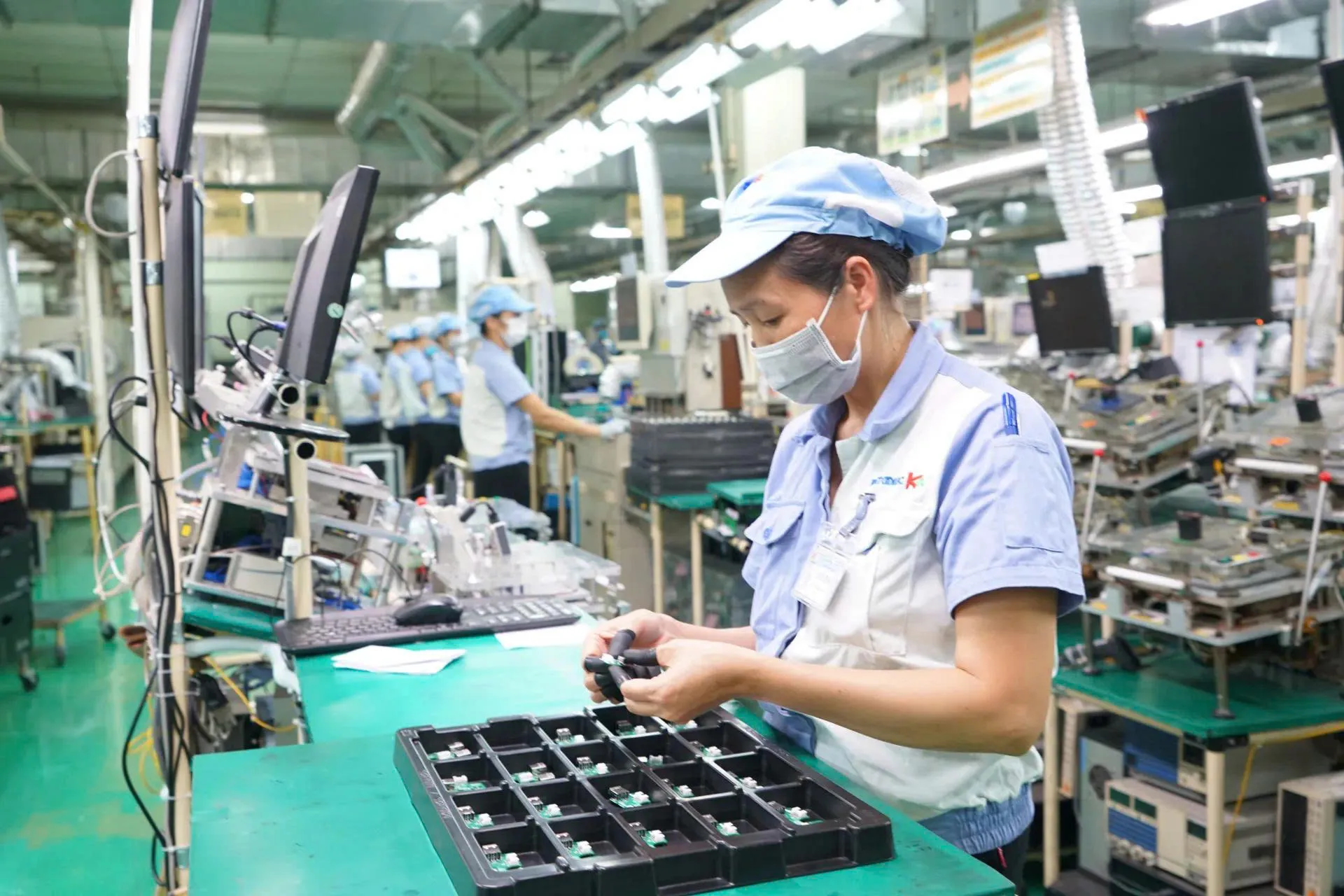
Electronics manufacturing for export at Quang Minh Industrial Park in Hanoi. Photo: Pham Hung/The Hanoi Times.
As science, technology and innovation become core drivers, international financial centers, carbon markets, blockchain pilots and new frameworks for bonds, smart cities and digital assets will gradually take shape, creating a new development ecosystem with broad spillover effects.
Implementation of Politburo Resolution on science and technology, innovation and digital transformation, along with related laws passed by the National Assembly, marks progress in policy direction. However, translation into practice has remained slower than expected.
To achieve average growth of around 10% during 2026-2030, Vietnam must significantly raise labor productivity, with annual gains of about 8.5% and total factor productivity contributing roughly 5.5% to 6%.
This task remains difficult due to an incomplete industrial ecosystem, limited mastery of core technologies such as artificial intelligence, semiconductors and fifth-generation networks and a persistent shortage of high-quality human resources.
As Vietnam enters 2026 with persistent inflation risks, how can high growth be pursued without placing excessive pressure on prices?
Keeping inflation at 3.31% reflects more effective coordination of monetary and fiscal policies. Amid global uncertainty and ongoing risks of imported inflation, price stability strengthens confidence and preserves policy space for the coming years.
Room for further monetary easing remains limited, while high growth requires interest rates to stay stable and reasonable. Policy management therefore needs stronger coordination, better risk control and more effective credit transmission. Capital flows should support production, business activities and projects that generate real cash flows, while avoiding asset speculation.
Fiscal policy will continue to play a leading role through faster public investment disbursement, accompanied by budget discipline and higher efficiency in fund use. At the same time, development of the bond market and financial centers will help diversify capital channels and reduce reliance on bank credit.
Above all, institutional reform and removal of bottlenecks related to land, investment and capital markets will unlock constrained resources and support growth without adding inflationary pressure.
Thank you for your time!