Vietnam seeks stronger support from UNESCO to restore Kinh Thien Palace
Vietnam is a model for managing world heritage sites and integrating cultural heritage into development goals.
THE HANOI TIMES — General Secretary To Lam called for continued support from UNESCO in restoring the Kinh Thien Palace within the Thang Long Imperial Citadel, a UNESCO World Heritage Site.
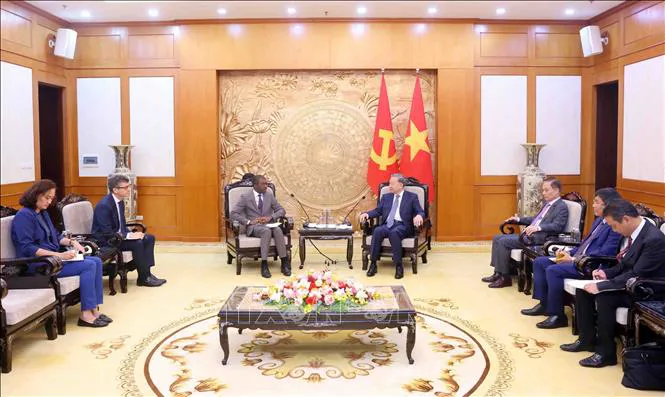
General Secretary To Lam meets Lazare Eloundou Assomo, Director of the UNESCO World Heritage Center, on May 20. Photo: Vietnam News Agency
"The restoration of the Kinh Thien Palace holds deep cultural and historical significance. It is where traditional rituals will be recreated and national history brought to life, rekindling the converging spirit of a thousand years and uniting our people in a new era,” To Lam told Lazare Eloundou Assomo, Director of the UNESCO World Heritage Center, during their May 20 meeting.
The General Secretary also requested UNESCO’s support for Vietnam's efforts to gain World Heritage Site status for the Yen Tu-Vinh Nghiem-Con Son-Kiep Bac Complex, which spans the northern provinces of Hai Duong and Quang Ninh.
The nomination will be reviewed at the 47th session of the World Heritage Committee in Paris in July 2025.
"This sacred region, the birthplace of the Truc Lam Zen sect founded by King-Monk Tran Nhan Tong, embodies the spirit of national unity and religious harmony," said Lam.
"Its enduring messages of compassion, tolerance, and peace remain relevant today. This site holds exceptional spiritual, cultural, and historical value for the Vietnamese people and humanity,” he added.
In addition, he urged UNESCO and the World Heritage Center to support Vietnam in preparing a nomination dossier for the Co Loa Ancient Citadel, so that it may become a World Heritage Site in the future.
Lam expressed his appreciation for the longstanding partnership between UNESCO and Vietnam, especially for the technical guidance provided in preserving the country's eight existing World Heritage Sites. He also thanked Director Assomo personally for his dedication and support.
"Vietnam is committed to sharing its cultural values with the world, as well as protecting and promoting heritage sites," he said.
The General Secretary added that culture is an internal strength, a spiritual foundation for sustainable national development, and a driving force for progress.
Lam said that the national cultural development program for 2025-2035 will mobilize resources to preserve heritage, absorb global cultural values, and improve quality of life, particularly in remote areas, while fostering a comprehensive Vietnamese identity for the future.
He also reaffirmed Vietnam’s commitment to multilateralism, peace, and sustainable development, as well as its willingness to share experiences and lessons learned with other countries.
“Vietnam is a reliable partner of UNESCO and will continue contributing effectively as a member of key governing bodies, including the World Heritage Committee,” he said.
Director Lazare voiced his full support for Vietnam’s heritage initiatives, including the restoration of the Kinh Thien Palace and the nominations of the Yen Tu–Vinh Nghiem–Con Son–Kiep Bac Complex and the Co Loa Citadel.
He also pledged UNESCO’s technical and institutional support for Vietnam’s heritage conservation efforts.
The director of the World Heritage Center expressed deep respect for Vietnam’s dynamic development and strategic leadership.
He said that Vietnam serves as a model for world heritage management and for incorporating cultural heritage into development goals.
Lazare lauded Vietnam as a strategic, trusted, and active partner of UNESCO. He spoke highly of the country’s efforts in reform, education, science, innovation, and digital transformation.
The UNESCO official also expressed his honor in visiting Vietnam on the occasion of the 135th birth anniversary of President Ho Chi Minh – a hero of national liberation and a great man of culture.
“President Ho Chi Minh’s legacy embodies the ideals of peace, dialogue, and universal cultural values, which are also principles at the core of UNESCO’s mission,” Lazare said.
Lazare praised Vietnam’s centuries-old cultural heritage, echoing the General Secretary’s vision that culture and heritage are vital resources for inclusive, sustainable development.
He referred to Vietnam as a shining example of how a member state can collaborate with UNESCO and requested that it share its innovative heritage management models with the world.