Vietnam set to lead ASEAN economic growth in 2025: AMRO
Vietnam’s positive GDP growth forecast is backed by its strong performance in the first half of 2025.
THE HANOI TIMES — The ASEAN+3 Macroeconomic Research Office (AMRO) raised Vietnam’s 2025 GDP growth forecast to 7% from 6.5%, which makes Vietnam the fastest-growing economy in the Association of Southeast Asian Nations (ASEAN).
This adjustment contrasts with the downward revision for ASEAN, where average growth is now projected at 4.4%, down from 4.7%. These projections were revealed in AMRO’s flagship publication, the ASEAN+3 Regional Economic Outlook.
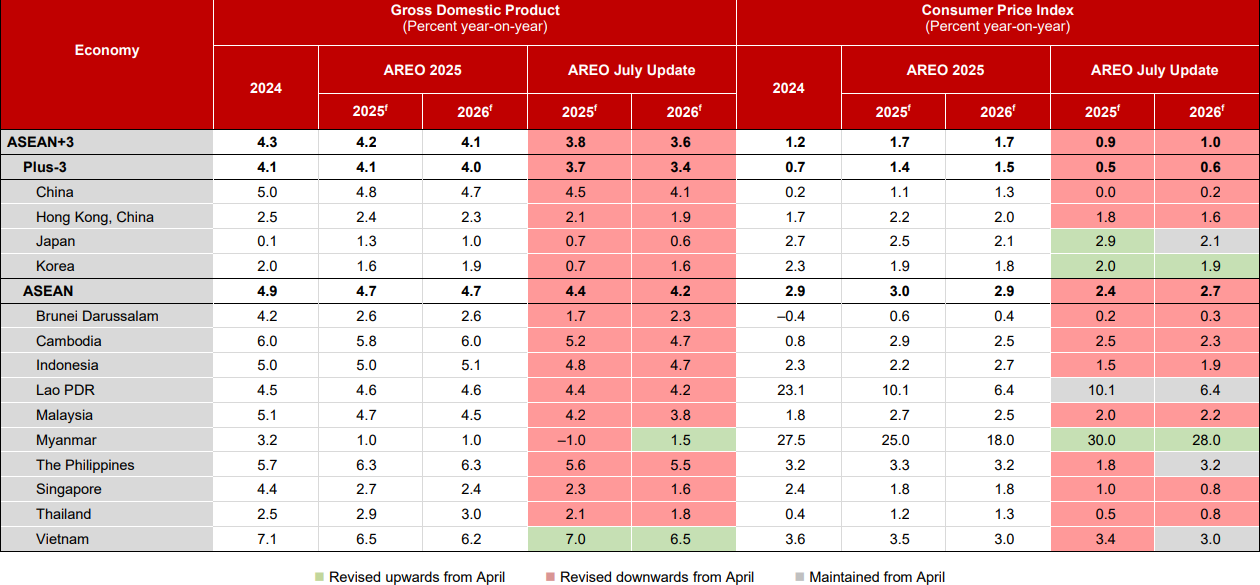
AMRO Growth and Inflation Projections, 2025–2026. Source: AMRO
AMRO Chief Economist Dong He suggested at the report launch on July 23 that the regional downgrade was driven by the impact of recent US tariff policies.
Vietnam’s upgrade is backed by its strong performance in the first half of 2025 with GDP growing by 7.52%, marking its highest first-half growth in several years, in addition to strong domestic consumption, export growth, and a robust recovery in manufacturing and services.
Additionally, Vietnam has sufficient policy space to support the economy when needed. Ongoing reforms to improve the investment climate and infrastructure are strengthening the country’s economic foundation.

Woodworking in Thanh Da craft village, Hanoi. Photo: Tung Nguyen/The Hanoi Times
While short-term gains are encouraging, he added the importance of deeper regional integration to attract more foreign direct investment.
Regarding ASEAN’s outlook, Dong He stressed that the region’s long-term resilience hinges on three factors: robust domestic demand, growing economic diversification, and flexible policies.
He also pointed out that several central banks in the region have begun to ease monetary policy while governments are providing targeted fiscal support to affected sectors.
Despite this, AMRO warns that risks remain with the biggest one is the uncertainty surrounding US trade policy. In a downside scenario where trade tensions escalate, ASEAN’s growth could fall below 3% in 2026, which would be its weakest performance since the global financial crisis, excluding the pandemic period.
This projection is based on the assumption of a 10% tariff hike on economies aligned with the BRICS group and a 25% tariff on critical sectors such as semiconductors and pharmaceuticals.
Key areas include boosting intra-ASEAN investment, improving infrastructure connectivity, and unlocking the bloc’s trade potential. Intra-regional trade currently accounts for only 23% of total exports, and investment linkages remain significantly underutilized.
Dong He stated the importance of strengthening regional cooperation while maintaining openness to the world and standing firm on rules-based multilateralism. To this end, the region can build resilience against external shocks and create new growth opportunities.