Vietnam, Singapore deepen semiconductor and electronics ties at ITAP 2025 exhibition
Vietnam and Singapore advanced their partnership in semiconductors and manufacturing at ITAP 2025, opening new opportunities for high-tech investment, innovation and regional supply chain growth.
THE HANOI TIMES — Businesses from Vietnam and Singapore are expanding collaboration in electronics, electrical equipment, semiconductors and industrial manufacturing through a new business-matching program held at the Industrial Transformation Asia-Pacific (ITAP) 2025 exhibition in Singapore.
The event, held on October 16, was co-organized by the Vietnam Trade Office in Singapore, the Vietnam Electronic Industries Association (VEIA) and the Singapore Semiconductor Industry Association (SSIA), serving as a platform for enterprises from both countries to seek opportunities in investment, technology transfer and innovation cooperation.
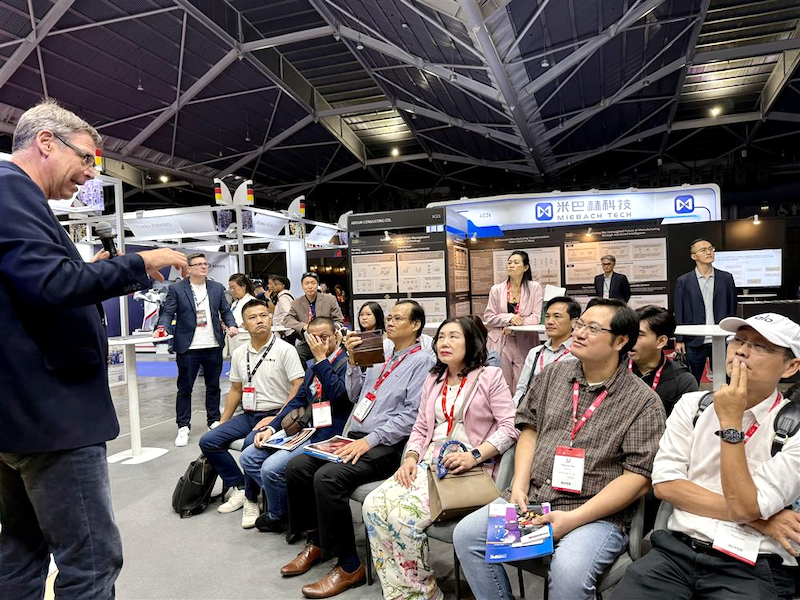
The Vietnam Electronic Industries Association's delegation joins a technology solutions exchange session with SAP. Photo: The VEIA
The program attracted strong participation from companies on both sides, creating conditions for trade and technology exchange and deepening understanding to promote future investment in high-tech and manufacturing sectors.
During the business-matching session, SSIA Executive Director Ang Wee Seng emphasized the importance of organizing regular networking sessions to help businesses build stronger partnerships and mutual trust.
He noted that Singapore’s Semiconductor Landscape Study had identified 13 new opportunities, especially in smart manufacturing and artificial intelligence.
Ang said that the combination of Singapore’s innovation ecosystem and Vietnam’s cost-efficient manufacturing capacity could form a sustainable and interconnected ASEAN semiconductor ecosystem.
Singapore now holds significant advantages in wafer fabrication, advanced packaging and semiconductor equipment, accounting for about one-fifth of the global market, he added.
The Singaporean executive said that Vietnam complements these strengths with its affordable production and rapidly developing electronics sector.
He praised VEIA’s efforts to help Singaporean enterprises better understand Vietnam’s industrial landscape and development goals, while highlighting that SSIA has been sharing information with Vietnamese companies about Singapore’s ecosystem to enhance bilateral cooperation.
Continuing the discussion, VEIA Executive Committee Member Do Thi Thuy Huong outlined both opportunities and challenges in Vietnam’s semiconductor industry.
She mentioned key issues such as a shortage of skilled workers, weak infrastructure and dependence on foreign investment.
Huong also reaffirmed Vietnam’s long-term vision of becoming a global supply chain hub by 2050 through major investments in STEM education, infrastructure development and domestic resource enhancement.
She said that deeper cooperation with Singapore in design, fabrication and technology transfer would play a vital role in achieving this goal.
Trade Counselor and Head of the Vietnam Trade Office in Singapore, Cao Xuan Thang, stressed that Singapore remains Vietnam’s top foreign investor and an important partner in the country’s industrial transformation.
Most of Singapore’s foreign direct investment in Vietnam is concentrated in manufacturing and processing, particularly in the electronics and electrical equipment sectors, which have recorded steady growth in recent years, he added.
The Vietnamese government has introduced comprehensive policies to boost the electronics, semiconductor and supporting industries, building a solid base for future cooperation and sustainable growth, Thang said.
The Industrial Transformation Asia-Pacific (ITAP) 2025, a HANNOVER MESSE event, continues to serve as the region’s premier platform for advancing manufacturing through technology, innovation and collaboration.
Held from October 15–17 at the Singapore EXPO and organized by Constellar in partnership with Deutsche Messe, ITAP 2025 connects regional and international industry players to drive smarter, greener and more resilient manufacturing under the theme “Powering the Future with Technology.”