Vietnam to launch smart agriculture innovation center in Lang Son
The center is expected to bridge gaps in technology testing, connect farmers with researchers and markets and accelerate sustainable, high-tech agricultural development nationwide.
THE HANOI TIMES — Vietnam plans to inaugurate a smart agriculture innovation center in the northern mountain province of Lang Son next year to address bottlenecks in the agriculture sector, according to Nguyen Thi Thu, founder of the Mevi Sustainable Agriculture Ecosystem.
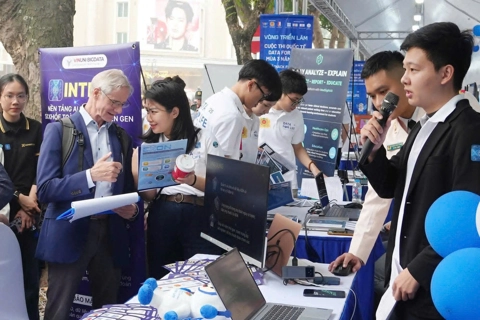
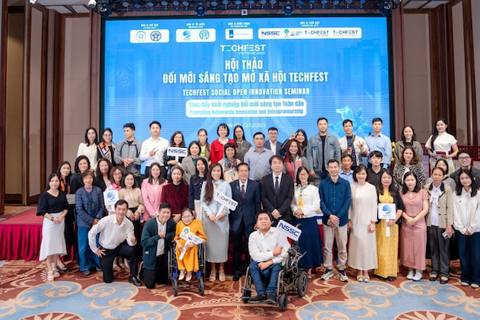
The smart agriculture innovation center is scheduled to bigin operations by Q2/2026, including experimental laboratories and technology demonstration zones covering the full agricultural value chain, said Thu at the seminar High-Tech Agriculture for Green Growth, held last week as part of TECHFEST Vietnam 2025.
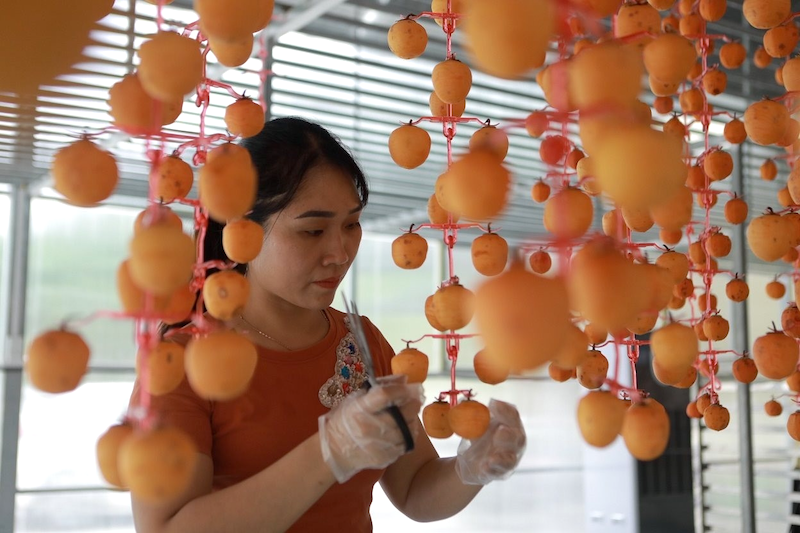
Vuong Thi Thuong, Director of Toan Thuong Agricultural Cooperative, with her wind-dried persimmon product. Photo: Lao Dong Newspaper
Thu, who has led the agriculture “tech village” at previous TECHFEST events, said the facility will serve as a space where farmers, businesses, researchers and technology providers can learn, test and apply solutions under real production conditions.
Pham Duy, head of the Investment Matching Department at TECHFEST Vietnam, welcomed the initiative and said Vietnam currently has very few innovation centers dedicated to specific sectors, especially key areas such as agriculture, healthcare and education.
“A focused agriculture center can play a meaningful role in speeding up technology adoption where it matters most,” he said.
Mevi expects the center to support about 10,000 people in measuring production efficiency, standardize 1,500 production models, connect 300 processing factories to address equipment depreciation challenges and link roughly 1,200 products through integrated value chains.
To ensure sustainability, Duy stressed the need for close coordination with local Departments of Science and Technology so the center can qualify as an official innovation center and access tax incentives and policy support.
Decree 268 outlines the criteria for innovation centers and took effect two months ago. Under the regulation, a center with at least 30 core staff, cooperation with experts and mentors and support for at least 50 enterprises in technology application and transfer may qualify as a national-level innovation center.
CARE Vietnam and BambuUp support Mevi. The idea for the center emerged from persistent challenges in Vietnamese agriculture, even though the sector recorded export revenues of US$62.5 billion last year.
Thu identified the biggest bottleneck as the lack of environments for hands-on learning, experience and experimentation. Farmers and businesses often receive training or new equipment, yet they frequently skip the critical testing phase.
This gap has caused costly mismatches between technology and actual needs. Thu cited a company that invested hundreds of thousands of dollars in tea-roasting equipment capable of producing a year’s output in one month. For the remaining 11 months, idle machinery created a financial burden instead of boosting productivity.
Another major challenge lies in the weak connection between farmers, scientists and the market. Farmers need practical, step-by-step guidance, while academic research often uses technical language that feels distant from daily production.
Thu emphasized the need for a “bridge” institution that can translate between these groups and guide technology toward the right users.
To address these issues, the innovation center will focus on technology demonstration, experimental laboratories and knowledge connectivity.
In production, testing zones will allow farmers and experts to trial new technologies and grassroots innovations, including preservation methods that can extend the shelf life of fermented products or wind-dried persimmons from six months to one year.
In processing and post-harvest stages, farmers will connect with institutes, universities or enterprises already applying relevant technologies. After training, they will test and assess feasibility before making investments.
Thu said experimentation remains the most critical step in technology adoption, yet stakeholders often overlook it.
In its initial phase, the center will prioritize five product groups with 14 core technologies, including starch processing, distillation, drying, cosmetic production and tea processing.
The value of an ecosystem-based approach appears clearly in the case of Toan Thuong Agricultural Cooperative in Lang Son Province.
Its director, Vuong Thi Thuong, raised VND5 billion (US$190,000) on Shark Tank Vietnam last year with her wind-dried persimmon product. Just three years earlier, she lacked basic skills such as presentation design and struggled with fruit preservation.
With support from the Mevi ecosystem and the Institute of Agricultural Mechanics and Post-Harvest Technology, the value of her persimmons increased twentyfold. The cooperative now links 27 households and sells nearly 1,000 tons of produce each year.
|
TECHFEST Vietnam 2025, co-organized by the Ministry of Science and Technology and the Hanoi People’s Committee, took place from December 12 to December 14 under the theme “Nationwide Entrepreneurship – A New Growth Driver” at the Hoan Kiem Pedestrian Street. In its ninth edition, the event attracted about 60,000 participants online and offline, along with 1,200 investment funds and incubators and 1,700 domestic and international startups. |