Vietnam to negotiate free trade deal with Mercosur
Benefits from FTAs have not brought along breakthrough changes for Vietnam, as most partners have similar economic structure, or even directly compete with Vietnam.
In the coming time, Vietnam will negotiate a free trade agreement (FTA) with the Mercosur, an economic and political bloc comprising Argentina, Brazil, Paraguay, Uruguay, and Venezuela, which is considered complementary to Vietnam’s market, according to Nguyen Manh Tien, vice chairman of the Vietnamese National Assembly’s External Relations Committee.
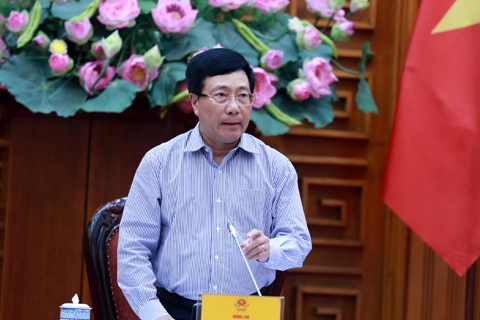
| Overview of the meeting. Photo: Cong Thuong newspaper. |

Complementary FTAs are those in which products exported from one side would not face direct competition in the other's market. In this sense, the FTAs that Vietnam signed with Japan, New Zealand and Chile, among others, have had positive impacts, Tien said at a meeting in July, 22 on efficiency in the implementation of FTAs.
Since Vietnam’s entry into the World Trade Organization (WTO) in 2007, the country has negotiated and signed 16 FTAs, of which three are under negotiation, namely the Regional Comprehensive Economic Partnership (RCEP), the FTA between Vietnam and the European Free Trade Association (EFTA), and the FTA between Vietnam and Israel.
Vice Minister of Industry and Trade Tran Quoc Khanh said these trade deals have opened up markets for Vietnam’s exports and also the opportunity for Vietnam to further integrate into global value and production chains.
The Comprehensive and Progressive Agreement for Trans – Pacific Partnership (CPTPP), after one year of implementation, has helped boost Vietnam’s trade revenue with six signatories that have ratified it by 8.2% year-on-yearto US$35.4 billion in 2019. Under the CPTPP, except for Australia and Singapore with which trade revenue with Vietnam declined or remained unchanged, the country recorded the highest export growth with Canada at 29.8% year-on-year, followed by Mexico at 26.3%.
In 2019, total exports of Vietnam to countries which are co-signatories of traditional FTAs hit US$123.11 billion, a significant improvement from just US$7 billion in 2004 when Vietnam only had two FTAs with the ASEAN and China. Meanwhile, Vietnam’s imports from FTAs partners stood at US$186 billion.
Among FTA partners, Vietnam recorded the largest annual export growth with India at 35.7%, followed by South Korea at 29.2%, Chile at 28.9% and China at 20.9%.
Vice Minister Khanh said Vietnam is still having trade deficits with FTAs partners, as the two major buyers of Vietnam namely the US and the EU do not have effective trade deals with Vietnam. The EU – Vietnam Free Trade Agreement (EVFTA) would come into effect on August 1.
Meanwhile, the majority of countries signing FTAs with Vietnam have similar economic structure, or even are in direct competition such as India, ASEAN or China, Khanh stated, adding benefits from those FTAs have not brought along breakthrough changes.
Nguyen Si Cuong, deputy head of NA’s Foreign Relations Committee, expected a timely issuance of legal framework for the implementation of FTAs, otherwise, the country may face risks of legal complaints for failure to realize its international commitments.
Minister of Planning and Investment Nguyen Chi Dung said FTAs put pressure on Vietnam to reform its policies and regulations to ensure a consistent, transparent and non-discriminated legal environment for both domestic and foreign businesses.
Dung urged local enterprises to actively restructure for greater productively and efficiency so that they can take advantage of FTAs and compete with foreign peers.