Vietnam to offer STEM scholarships to ease talent shortage
Expanding STEM education matters for Vietnam in building a skilled workforce for an innovation-driven, digital economy.
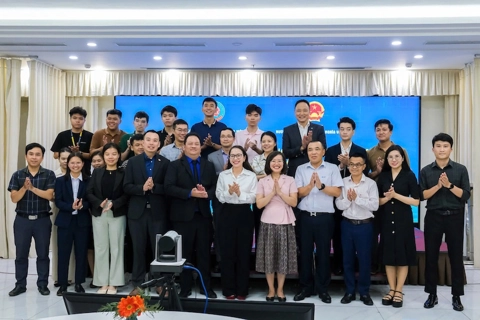
THE HANOI TIMES — The Ministry of Education and Training (MOET) is finalizing a policy to provide scholarships and preferential credit to students pursuing degrees in STEM (science, technology, engineering, and mathematics) to develop high-quality human resources.
During a press conference in Hanoi this week, MOET's Deputy Minister Pham Ngoc Thuong said that the draft decree, developed in collaboration with the Ministry of Finance, will be submitted to the prime minister later this month.
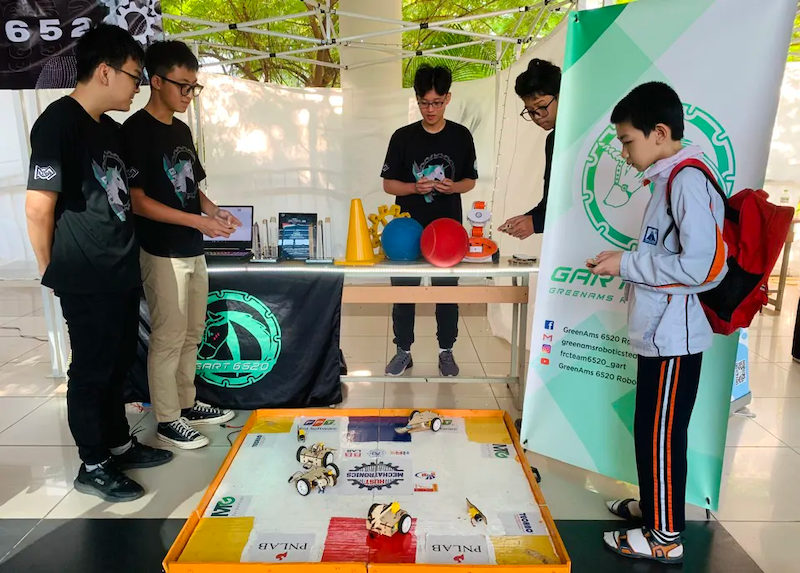
Students from Hanoi-Amsterdam High School for the Gifted experience STEM products at the IT and STEM Festival in 2023. Photo: The Hanoi Times
It aims to reverse Vietnam’s low STEM enrollment rate of 27%-31%, which lags behind that of countries such as Singapore (46%), Malaysia (50%), South Korea (33%), and Germany (39%).
"Expanding STEM education is an urgent need," said Thuong, citing the country's drive to strengthen its innovation and digital economy foundations.
Under the government’s high-tech human resources training program for 2025–2045, Vietnam targets a 35% STEM enrollment rate at all education levels by 2030. Of that total, at least 2.5% will focus on basic sciences, and 18% will focus on digital technology fields, such as AI and biotechnology.
Each year, Vietnam aims to graduate 80,000 information and communications technology (ICT) students, 10% of whom will hold engineering, master's, or doctoral degrees. The goal in artificial intelligence (AI) is to produce 8,000 graduates annually, 20% of whom will hold advanced degrees. All STEM programs will be required to integrate data analytics and AI into their curricula.
STEM education is gaining traction in Vietnam’s higher education.
In 2024, formal STEM enrollment jumped 10.6%, reaching 218,000 students and accounting for 36% of the national total, while master’s students rose 34% and Ph.D. candidates up 33% year over year.
To strengthen its semiconductor capabilities, Vietnam is implementing the prime minister's Program 1017 approved in 2024 to train at least 50,000 semiconductor engineers by 2030 and develop a globally competitive workforce by 2050.
During the 2024-2025 academic year, 19,000 students were enrolled in semiconductor-related majors, making up 10% of all STEM students. At present, 166 institutions offer training in the field of semiconductor technology, including 97 that are directly specialized in this area.