Vietnam’s Human Development Index improves 50% over past three decades
Vietnam's performance on the Gender Inequality Index, which measures inequality in three areas namely reproductive health, empowerment, and the labor market, has improved significantly.
Vietnam's Human Development Index (HDI) showed an improvement of 50% in the 1990-2022 period, as shown in the United Nations Development Program (UNDP)’s 2023/24 Human Development Report (HDR).
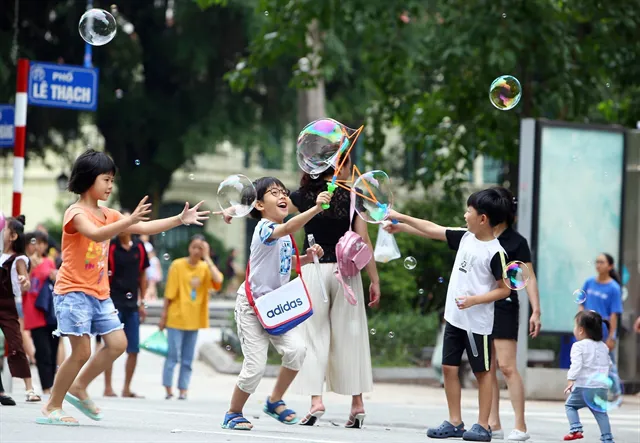
| Children enjoy community activities in Hoan Kiem Pedestrian Zone, Hanoi. Photo: Danh Lam/VNS |
The HDI value changed from 0.492 in 1990 to 0.726 in 2022, positioning it at 107 out of 193 countries and territories. In the 1990s, when UNDP introduced the HDI, Vietnam moved up from where it was at the relatively bottom of the ranking to the middle after making steady progress over the previous 30 years.
“Vietnam has remained a high human development country through the difficult years of the Covid-19 pandemic. Human development continues to be a focus of Vietnam’s development strategy, and we have seen very sizable gains over the past decades,” said UNDP Resident Representative Ramla Khalidi. She stated that Vietnam has done well in some respects, such as in terms of access to education and labor force participation.
Vietnam ranks 91 out of 166 countries in the Gender Inequality Index, which considers inequality across three dimensions: reproductive health, empowerment, and the labor market.
The 2023/24 Human Development Report (HDR), titled “Breaking the Gridlock: Reimagining Cooperation in a Polarized World”, indicates a concerning trend: the rebound in the global Human Development Index (HDI) – a summary indicator reflecting a country’s Gross National Income (GNI) per capita, education, and life expectancy – has been partial, incomplete, and unequal.
The HDI is expected to rebound sharply from its 2020 and 2021 lows to record highs in 2023. However, this development is incredibly uneven. Rich nations are seeing unprecedented levels of human development, but half of the world's poorest nations have not made as much progress as they did before the crisis.
Significant economic concentration exacerbates inequality on a global scale. According to the report, three or fewer countries account for nearly 40% of the world's trade in goods. In 2021, the combined market capitalization of the three biggest tech companies worldwide exceeded the gross domestic product (GDP) of over 90% of all nations.
“The widening human development gap revealed by the report shows that the two-decade trend of steadily reducing inequalities between wealthy and poor nations is now in reverse. Despite our deeply interconnected global societies, we are falling short. We must leverage our interdependence and capacities to address our shared and existential challenges and ensure people’s aspirations are met,” said Achim Steiner, Head of the UNDP.
He said this gridlock carries a significant human toll. The failure of collective action to advance action on climate change, digitalization, or poverty and inequality not only hinders human development but also worsens polarization and further erodes trust in people and institutions worldwide.
The paper emphasizes the fact that economic interdependence is still very high and that deglobalization is neither practical nor realistic in the modern world. It emphasizes how no region is even close to being self-sufficient because they are all dependent on imports of at least one major category of goods and services, amounting to at least 25% of total imports.
The report emphasizes how global interdependence is being reconfigured and calls for a new generation of global public goods. It proposes four areas for immediate action: (1) planetary public goods, for climate stability; (2) digital global public goods, for greater equity in harnessing new technologies for equitable human development; (3) new and expanded financial mechanisms, including a novel track in international cooperation that complements humanitarian assistance and traditional development aid to low-income countries; (4) and dialing down political polarization through new governance approaches focused on enhancing people's voices in deliberation and tackling misinformation.
According to the report, multilateralism is essential in this situation because bilateral agreements are unable to handle the inherently global character of providing global public goods.