Waste needs to be treated as a resource: Minister
It is necessary to encourage people to sort garbage out and that the government increases support the collection and treatment.
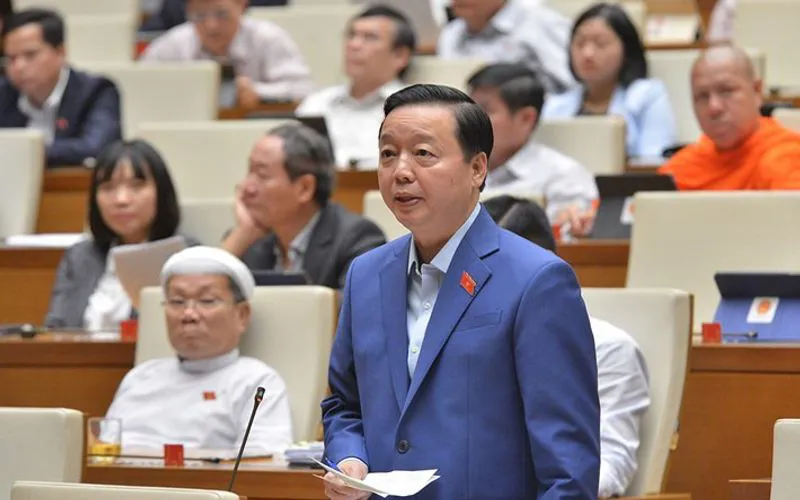
Minister of Natural Resources and Environment Tran Hong Ha told a National Assembly session on November 6 that if waste is seen as a resource, with a proper incentive, people will sort waste out and increase recycling and the reuse of garbage.
Recently, Prime Minister Nguyen Xuan Phuc has requested agencies to build a mechanism for businesses to join the coalition of recycling garbage, especially plastic waste, the minister said.
He added that regulations on garbage have been set up to hold people responsible for causing pollution and fine them.
It is necessary to encourage people to sort garbage out and that the government increases support for the collection and treatment, Mr. Ha added.
Minister of Natural Resources and Environment Tran Hong Ha speaks at a National Assembly sitting on November 6. Photo: Kinhtedothi.vn |
He stressed that the next solution is to determine the technical standards for the technology and consider waste treatment a public service, which will be tendered.
For treating solid waste, Vietnam has 381 incinerators, 37 composting furnaces, the rest are mainly nearly 1,000 landfills.
Mr. Ha said that on average, Vietnam generates 35,000 tons of solid waste every day in urban areas and about 28,400 tons in the countryside.
Currently, the garbage collection rate is 92% in cities and 66% in the countryside, 6 and 15 percentage points higher, respectively. However, waste treatment by burial is highly polluting, wasting resources because garbage is not considered a resource and has not yet been recycled.
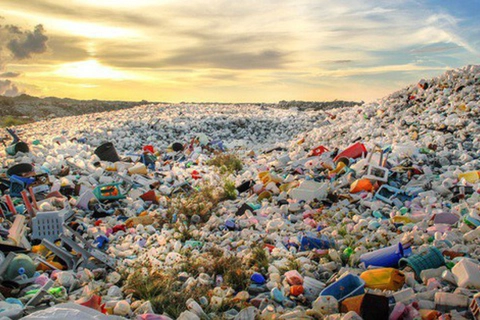
Vietnam in danger of becoming a dump
According to a report in June 2018 by Reuters, in Vietnam, fears of the country turning into “an international dumping ground” are growing.
Despite a halt in issuing scrap import permits since 2017, Vietnamese seaports have been clogged with thousands of containers of foreign scrap.
According to the Vietnam Maritime Administration, the goods range from electric cords, outdated household appliances, second-hand fabric and used cars to plastic and paper scrap, which makes up the majority of of foreign scrap in Vietnam.
At that time, Minister Tran Hong Ha responded to concerns that the country can become a landfill of industrial and radioactive waste.
Vietnam has to start saying no to scrap import because the country is not able to deal properly with solid waste, Mr. Ha stressed.
"Waste in Vietnam is different from that generated in other countries, so even advanced waste treatment technologies used in developed countries have proven unsuitable for Vietnam," said the minister.
Many domestic waste treatment plants failing to operate effectively and unable to meet technical and environment criteria must be shut down, Mr. Ha added.