What is role of Vietnam’s prime minister and deputy PMs?
Deputy prime ministers assist the Prime Minister in performing their assigned work and take direct responsibility before the PM and the law for the missions they are tasked with.
The Government of Vietnam has had four deputy prime ministers instead of five since the beginning of the term in July 2021.
Accordingly, the missions of the Prime Minister and four Deputy Prime Ministers will be adjusted with some changes following a decision signed on September 6 by Prime Minister Pham Minh Chinh.
The new work assignment will reveal how important they are in the 27-member cabinet for the 2021-2016 term.
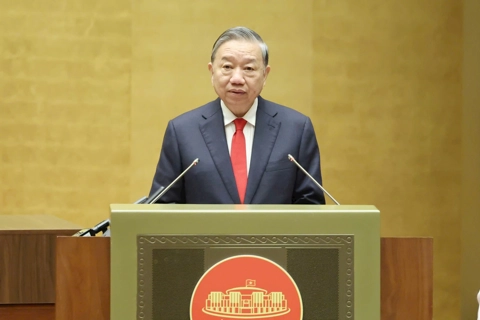
| Vietnam's Prime Minister Pham Minh Chinh. Photos: VGP |
.jpg)
Prime Minister Pham Minh Chinh leads the exercise of the functions, tasks, and powers of the Government.
Notably, the Prime Minister does not handle the tasks assigned to deputy prime ministers.
The PM directs and oversees the following fields: national socio-economic development strategies and plans; national financial, credit, and monetary strategies and policies; national defense, security, and foreign affairs strategies.
He also directs personnel work; organizing apparatus; administrative reforms; administrative boundaries; general issues on emulation and commendation; coordination between the Government and agencies of the Party, National Assembly, State President, the Vietnam Fatherland Front, and socio-political organizations.
The Government’s leader supervises the Ministry of National Defence, Public Security, and Home Affairs; takes responsibility for East Sea (the South China Sea) – Islands issues, e-government, cybersecurity, among others.
| Permanent Deputy Prime Minister Pham Binh Minh. |
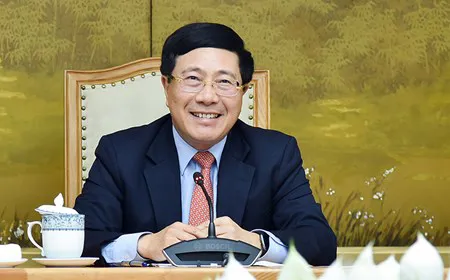
Permanent Deputy Prime Minister Pham Binh Minh on behalf of the Prime Minister, directs the implementation of the Government’s work in the Prime Minister’s absence and when is authorized by the PM.
Minh is in charge of diplomacy and foreign relations; official development assistance (ODA) and concessional loan; foreign non-governmental aid, foreign non-governmental organizations; international integration; negotiation and implementation of bilateral and multilateral commitments; ASEAN Single Window, National Single Window and Trade Facilitation; foreign direct investment (FDI), Vietnam’s investment abroad; Vietnam’s relations with international and regional organizations; border, East Sea – Island issues; overseas Vietnamese and foreigners in Vietnam; human rights issues.
He is also responsible for institutional building, ethnic and religious work; crime prevention; anti-smuggling and commercial fraud; traffic safety; and amnesty.
Minh oversees Ministry of Foreign Affairs, Ministry of Justice, Committee for Ethnic Minority Affairs, Government Office, and Bank for Social Policies.
| Deputy Prime Minister Le Minh Khai. |
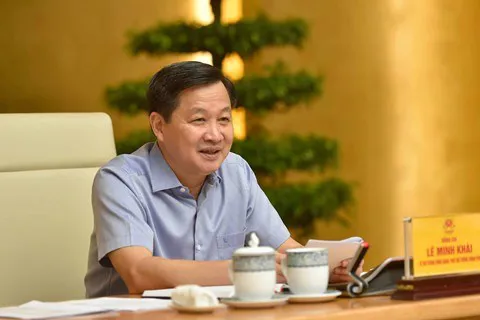
Deputy Prime Minister Le Minh Khai is in charge of the economy, including planning; finance; currency; capital market, stock market; financial investment sources; state budget; macroeconomics; salary policy and social insurance; types of enterprises; collective economy, cooperative; restructuring state-owned enterprises.
Khai is also responsible for state budget expenditure, use of state budget reserve, financial reserves, forex reserves and other state funds; bonds and government bonds issue.
He supervises Ministry of Planning and Investment, Ministry of Finance; State Bank of Vietnam; Government Inspection; Commission for Management of State Capital at Enterprises (CMSC); Vietnam Social Security; National Financial Supervisory Commission; Vietnam Development Bank; Deposit Insurance.
| Deputy PM Vu Duc Dam. |
.jpg)
Deputy PM Vu Duc Dam assumes responsibility for education, training and vocational training; science and technology; labor, employment and social issues; information and communication; culture, tourism, physical training and sports; health, population, family and children.
Dam supervises ministries of Education and Training; Labor, Invalids and Social Affairs; Information and Communication; Science and Technology; Health; Culture, Sports and Tourism; Vietnam Academy of Science and Technology; Vietnam Academy of Social Sciences; Hanoi National University; and HCM City National University.
| Deputy PM Le Van Thanh. |
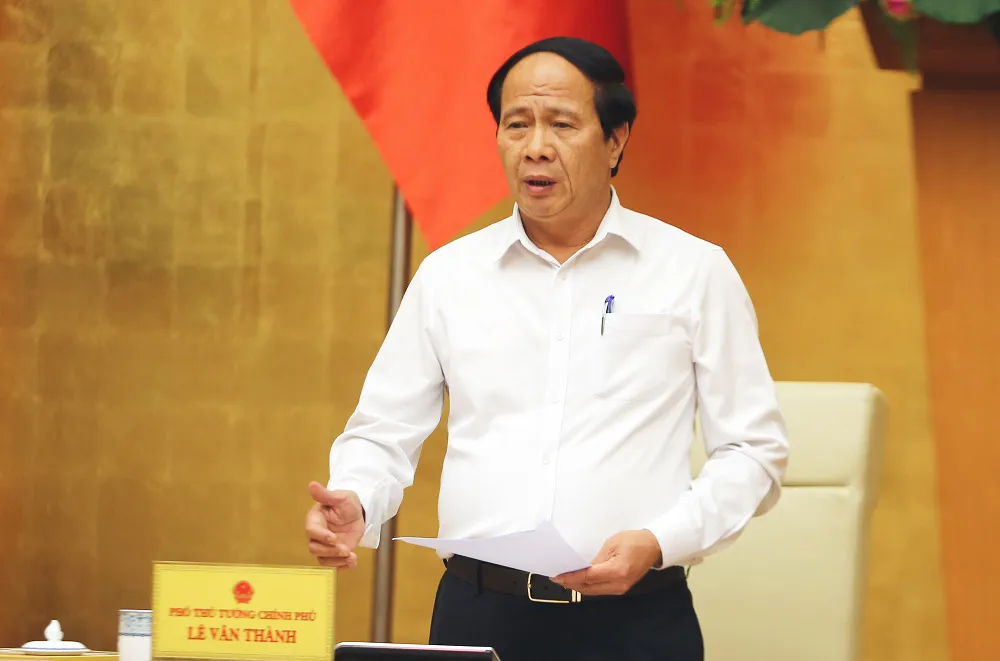
Deputy PM Le Van Thanh covers responsibility in industry, agriculture and rural development; trade – import and export; construction; transportation; natural resources and environment; national master planning, regional planning, provincial planning; energy security, energy efficiency; national key projects; economic zones, industrial parks, export processing zones; climate adaptation; flood and storm prevention, search and rescue.
He supervises Ministries of Agriculture and Rural Development; Industry and Trade; Construction; Transportation; Resources and Environment.
The cabinet has 27 member, including 22 ministers and ministerial positions, including two women. The State Bank of Vietnam and the Ministry of Home Affairs are led by women.