Vietnamese professor conferred Honorary Doctorate by Moscow Power Engineering Institute
The conferral of the Honorary Doctorate reflects the enduring friendship between Vietnam and Russia over decades, acknowledges the traditional ties between the two nations’ scientific communities.
THE HANOI TIMES — Professor Dr. Tran Hong Thai, Standing Vice President of the Vietnam Academy of Science and Technology (VAST) has been conferred the prestigious title of Honorary Doctorate for his outstanding contributions to scientific development, education and international collaboration in the energy sector.
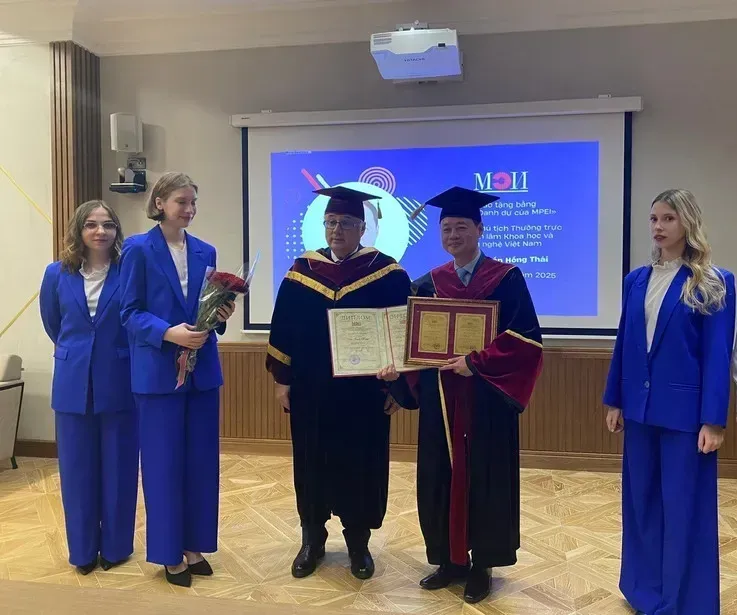
Professor Dr. Tran Hong Thai (second from right) receives the Honorary Doctorate title and certificate from Professor Nikolay Rogalev of MPEI. Photo: VNA
The recognition ceremony was witnessed by the academic community, scientists and delegates from Vietnam and Russia last weekend at the grand hall of Moscow Power Engineering Institute (MPEI).
N. Rogalev, MPEI Rector, presented the academic robe and the Honorary Doctorate diploma, highlighting the Russian academic community’s respect for Thai, who is an alumnus of the institute. His portrait was added to MPEI’s “Honorary Doctors” gallery, affirming his place among the distinguished scholars recognized by the university.
In his remarks, Thai congratulated the MPEI on its recent academic achievements, including the strong growth of research centers in energy, nuclear power, power systems and automation.
He noted that Vietnam is strongly shifting toward green energy and preparing for a nuclear power program-areas in which VAST plays a central role in research, policy advisory, and human resource training.
As a VAST leader and a former MPEI student, Thai pledged to act as a bridge to promote postgraduate training, interdisciplinary research and technology transfer between Vietnam and Russia.
The conferral of the Honorary Doctorate on Professor Dr. Tran Hong Thai marks new prospects for cooperation between VAST and MPEI in nuclear power, high technology and high-quality human resources, enhancing Vietnam’s sci-tech foundation for long-term development strategies.