AI in education: teachers must be key
Artificial intelligence is making its way into classrooms, changing the way teachers teach and students learn.
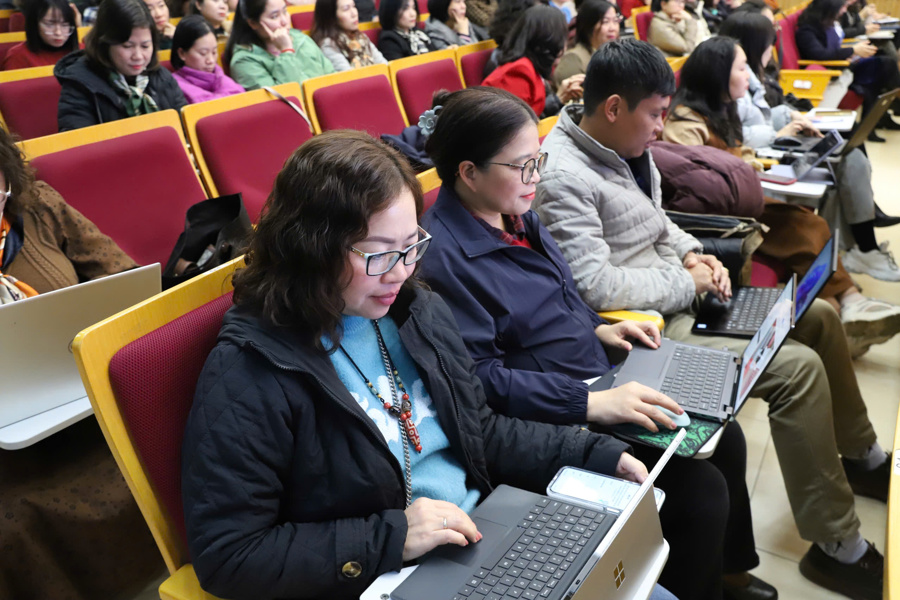
More than 200 key teachers and staff from schools in Ba Dinh District recently attended a training course on the application of artificial intelligence (AI) in management and teaching.
The training is part of Ba Dinh District's efforts to improve digital skills among educators, in line with a national master plan to develop a digital economy and society by 2030.
| Teachers and education managers in Ba Dinh District attend an AI training course. Photo: kinhtedothi.vn |
AI in education has sparked great interest among teachers and administrators.
A recent survey by the Ba Dinh District Education and Training Department and technology company Tomotech found that 78.3% of more than 2,100 teachers, administrators and staff in the district use technology daily, 9.5% use it two to three times a week, 9.2% use it once a week and less than 3% rarely use it.
However, only 62.3% of teachers and staff have used AI tools in their work. The remaining 37.7% have never used AI due to a lack of devices, skills or knowledge of how to use it.
The most common uses of AI include searching for information (66.4%), planning lessons (63%) and creating learning materials (46.5%). AI is also used for classroom activities (41.2%), designing tests (23.9%) and preparing content for parent meetings (21.7%).
Other uses include translation (16.5%), report writing and student assessment (14.9%), classroom management (10.3%), student counselling (8.8%), grading (7.4%), and other (less than 2.5%).
Of those not using AI, 34.5% say they have no need for it, 27.3% do not have access to devices, and 17.6% do not find AI useful for their work. Some 1.9% do not know how to use AI, 0.6% are not proficient and 0.4% have not updated their skills.
Most teachers want to improve their skills in data security, integrating AI into teaching, designing AI-based learning materials, and basic AI tools.
The application of AI in education will help teachers work more efficiently and create a modern, creative learning environment for students, said Le Duc Thuan, Director of the Ba Dinh District Education and Training Office.
The district expects around 3,000 teachers, staff and administrators from schools in the district to take part in AI training courses by April 2025, he added.
The training courses will discuss AI applications in school management, education data analysis, automated reporting, internal data security, AI-based educational games, learning material creation, and student data management, according to the local official. Previously, some schools in Hanoi had piloted AI in the classroom.
During a recent online meeting with Deputy Minister of Education and Training Hoang Minh Son, global tech giant Google suggested strengthening digital transformation in education, especially through AI applications.
Marc Woo, Managing Director of Google Asia-Pacific, said that Google has worked on several education technology projects, including AI-based teaching and training for more than 8,000 Vietnamese teachers.
Google proposed a comprehensive three-step solution to help teachers and students develop digital content. This includes integrating AI tools into Vietnamese textbooks, curricula and resources to support learning and teaching.
Can AI be taught to schoolchildren?
If teachers are trained to interact with AI, what about students?
In early February 2025, Truong Gia Binh, Chairman of technology group FPT, suggested that Vietnam should introduce AI education at all levels of schooling. If this were to be rolled out, even first-graders would be trained to use AI for tasks assigned by teachers.
However, this statement may be more about motivation than practicality. The world is experiencing rapid changes due to technology, especially AI.
A recent example is DeepSeek, a Chinese AI platform that has emerged as a competitor to OpenAI's ChatGPT in the global AI industry.
Binh's statement does not appear to be based on any specific research into the impact of AI on young students. Any major change in the learning environment has a significant impact on children's mental and psychological development.
If students are exposed to AI too early, most may become dependent on the technology rather than developing their creativity. Young children do not understand how AI works, making them passive recipients of information without critical thinking. AI is complex and requires users to think critically.
Excessive exposure to technology at a young age can impair children's social interaction skills. At this stage, they should be encouraged to develop communication, teamwork and real-world experiences rather than spending too much time on screens.
In addition, AI tools can become biased and produce malicious code. They may be vulnerable to manipulation. Users can easily generate content supporting chemical and biological weapons and cybersecurity threats, as well as hateful, threatening and even criminal content.
AI users should carefully check information from several reliable sources before trusting it, Trinh Quang Thuong, Business Director of Pama Communications & IT Company, told Dan Tri online newspaper.
"We need to understand the context and ask precise questions to avoid mistakes and misinformation, especially regarding politics, history and national sovereignty," he said.
Basic skills such as reasoning and problem solving should be taught before AI education is introduced. Training should be accompanied by a "technology ethics" curriculum.
Children need to learn how to use AI with responsibility, avoid cheating, and prevent the misuse of AI. AI should be seen as a supportive tool, not something that children passively rely on. Teaching AI to young students requires a scientific and responsible approach.