Amended Capital Law boosts Hanoi’s urban planning drive
This is expected to create a breakthrough in mobilizing comprehensive strength and effectively harnessing potential and advantages for the development of the capital city.
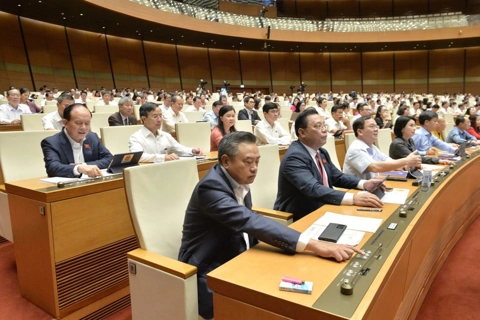
The revised Capital Law, approved by the National Assembly, aims to grant Hanoi greater decentralization and delegation of powers, allowing the city to develop exceptional and advanced mechanisms across various fields, including the planning and implementation of urban development plans.
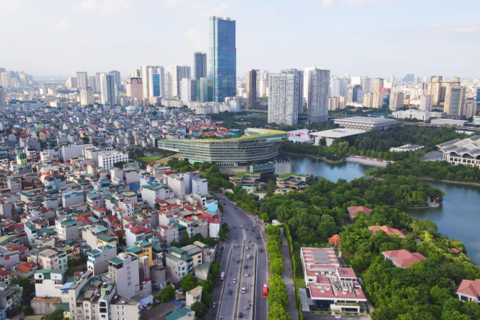
| Hanoi is set for breakthrough development following the National Assembly's ratification of the amended Capital Law. Photo: Thanh Hai/The Hanoi Times |

Urban planning, economic and social space development, and the construction of technical and social infrastructure have always been top priorities for Hanoi in building the capital city. Planning is considered an essential tool, serving as a foundation for promoting local economic and social development.
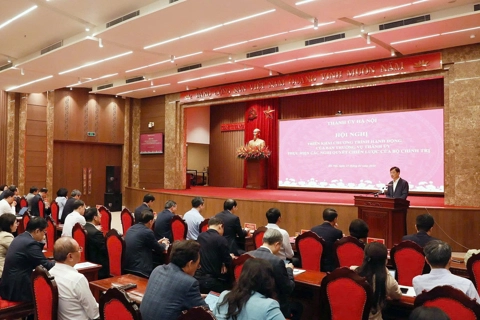
Currently, Hanoi is in the final stages of completing and submitting two key planning documents for approval: the master plan for the capital's development until 2045 with a vision to 2065, and the Hanoi as the Capital City Plan for the 2021-2030 period with a vision to 2050. These plans are closely aligned with the amended Capital Law to ensure consistency and to realize the development goals for the city in the coming years.
According to Associate Professor Bui Tat Thang, former Director of the Institute for Development Strategy (Ministry of Planning and Investment), Hanoi has been simultaneously working on three critical tasks: the comprehensive overhaul of the Capital Law, the drafting of the Hanoi as a Capital Plan for 2021-2030 with a vision to 2050, and the adjustment of the master plan for the capital until 2045 with a vision to 2065. One of these tasks has been completed with the National Assembly's approval of the amended Capital Law, and the two major planning documents are expected to be approved soon.
“This represents a significant opportunity for Hanoi to showcase its ambition to develop the capital into a "Civilized, Modern, and Cultured" city,” Thang said.
| Ho Guom Opera House in Hanoi. Photo: Pham Hung/The Hanoi Times |

However, he noted that the immediate challenge for Hanoi is to quickly implement the specific mechanisms and policies set out in the law to ensure practical application.
Expressing high expectations for the amended Capital Law, Architect Dao Ngoc Nghiem, Vice Chairman of the Vietnam Urban Planning and Development Association, pointed out that fewer than 10 countries worldwide have a specialized law for their capital cities.
“The enactment of such a law for Hanoi demonstrates significant attention from the Party, Government, National Assembly, and the people nationwide towards the capital's development,” Nghiem said.
"The approval of the amended Capital Law will create a legal framework to improve planning quality, motivate the implementation of these plans, and serve as a guiding principle for the capital's future development," said Nghiem.
He also noted that the amended law includes a specific chapter on the construction, development, management, and protection of the capital, clearly outlining the basis for urban development, renovation, and reconstruction.
| A tour of Red River. Photo: Lam Thanh/The Hanoi Times |

Effective implementation of the law a key issue
It emphasizes that development must follow the capital’s master plans and identifies the management of spatial, architectural, and landscape elements, especially the roles and significance of the Red River and the Duong River, he continued.
The amended law also specifically addresses the relocation of unsuitable facilities out of the metropolitan area, allowing the Hanoi People's Committee to decide on the list, measures, and timing of these relocations. Previously, the use of land after relocation was not clearly defined, but the amended law now stipulates that this land will be used to create public spaces and increase green areas.
| Tourists riding bicycles on the Red River's alluvial islet. Photo: Pham Hung/The Hanoi Times |

Moreover, the amended law includes a provision for underground space, which many experts believe will greatly facilitate the exploitation of new potential areas for the city's development. The law also clearly defines the roles and responsibilities of various levels and sectors in urban renovation and reconstruction.
One noteworthy provision is that the Hanoi People's Committee will establish and regulate the operation of the Historic Inner City Conservation Fund. This is seen as a crucial element in realizing the policy of renovating, embellishing, and reconstructing the urban area while preserving and promoting the cultural values of the historic downtown, which has been challenging due to a lack of resources.
Although the amended Capital Law introduces more than 50 specific policies for Hanoi, these are just framework policies.
“Hanoi must quickly develop regulations to detail these special mechanisms and policies into practice,” Nghiem said.
After the passage of the 2012 Capital Law, the Hanoi People’s Council issued nearly 20 resolutions within a year to flesh out the law. With the amended law now consisting of 7 chapters and 54 articles (an increase of 3 chapters and 27 articles compared to the 2012 law), the task is extensive.
Many experts pointed out that it would involve considerable effort on the part of the municipal People’s Council and close guidance from the Party Committee to ensure the law's effective implementation in daily life.