Capital Law revision helps Hanoi promote role as nation’s socio-economic hub
Amending the Capital Law is vital to align it with a comprehensive vision that matches the capital's development momentum, harmonizing economic, cultural, and social progress.
Amending the Capital Law will provide a unified legal framework for the capital's unique administrative regime and boost Hanoi's development as the nation's leading economic, political, and social hub.
| Editor-in-Chief of the Economic & Urban Newspaper Nguyen Thanh Loi (r) and Chairman of the University Council of Hanoi Law University Chu Manh Hung. Photos: Huy Pham/The Hanoi Times |
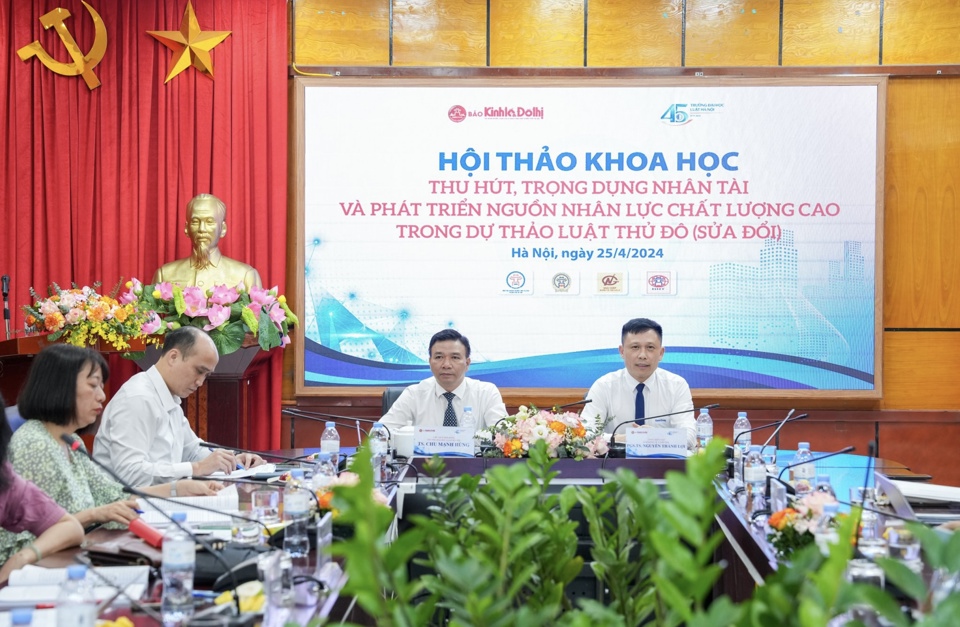
Editor-in-Chief of the Economic & Urban Newspaper Nguyen Thanh Loi shared the view during a scientific conference held today [April 25] to discuss talent attraction policies under the revised draft Capital Law.
According to Loi, the Capital Law was passed by the 13th National Assembly on November 21, 2012, and came into effect on July 1, 2013.
“This is an important legal document that regulates the position, role, responsibilities, and policies for the construction, development, and protection of the capital,” he noted at the conference, jointly organized by the newspaper and Hanoi Law University.
In recent years, ministries, sectors, and localities, especially Hanoi, have paid special attention and taken the initiative to make the law work by focusing on key issues and aiming to mainstream it into daily life. After more than 10 years of implementation, the 2012 Capital Law is considered a unique piece of legislation that facilitates the development of the capital, he continued.
However, in the current context of international integration, particularly in effectively implementing Resolution No. 15-NQ/TW dated May 5, 2022, of the Politburo on the direction and tasks for the development of Hanoi as the Capital city until 2030, with a vision to 2045, Loi said that amending the Capital Law is essential to tap the strong development momentum of the capital, harmoniously combining economic, cultural, and social development, along with ensuring national defense, security, and foreign affairs.
The draft of the revised Capital Law represents a significant step forward in perfecting the institutional framework for the construction and development of the Capital in a new context. Specifically, policies on developing a high-quality workforce have been clearly articulated, reflecting their importance in our country's human resources strategy, he continued.
| Overview of the conference. |

"Article 16 of the amended Draft Capital Law emphasizes attracting and employing talented individuals and developing a high-quality workforce, which is a significant step forward compared to the previous provisions. The 2012 Capital Law only set out general regulations for planning educational infrastructure based on the principle of centrally training a high-quality workforce for the capital and the whole country," Loi pointed out.
Furthermore, amending the Capital Law will help create a unified legal framework to institutionalize the Party's viewpoints, orientations, and policies of the State on the capital's special administrative regime, helping Hanoi accelerate its development, unleash its potential, and strengthen its position as the economic, political, and social "vanguard" of the nation, Loi noted.
To develop the Draft Capital Law (amended), in recent times, the Ministry of Justice and the Hanoi People's Committee have recently coordinated the organization of meetings with representatives from ministries, central agencies, departments, and sectors of Hanoi and relevant units under the Ministry of Justice to directly provide opinions on specific contents/clauses of the draft Law; holding consultation seminars with investors and businesses on regulations and measures to attract investment in the fields of culture, sports, education, healthcare, protection and development the culture of the Capital, mechanism for effective use of public assets; seminars on decentralization in the drafting of the amended Capital Law, among others.
| Delegates at the conference. |
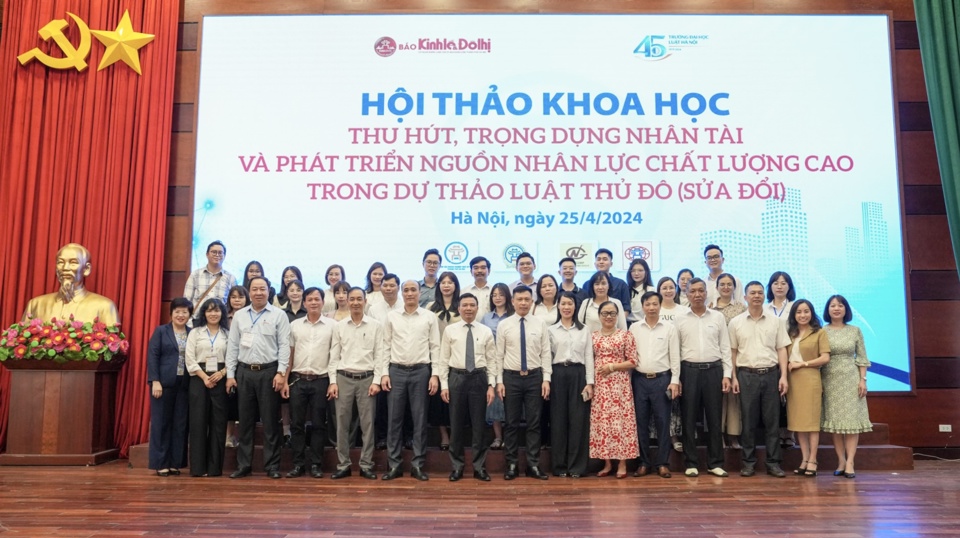
According to Loi, in recent times, the Economic & Urban Newspaper has been very active in disseminating information about the amended Draft Capital Law through various forms to gather opinions and improve the draft law, thus contributing to building social consensus.
At the seminar, participants exchanged views and clarified the general perception of developing and attracting high-quality human resources as well as employing talent. These are core factors for rapid and sustainable economic and social development, especially in the context of Vietnam's industrialization and modernization efforts.
Putting in place coordinated measures
Dr. Lai Thi Phuong Thao from the Hanoi Law University stated that to address the challenges in high-quality training and development of human resources in Vietnam, a comprehensive set of solutions needs to be implemented. This includes strengthening investment and resources for education and training: the government should enhance investment and provide sufficient resources for the education and training system, she said.
Additionally, Thao called for greater efforts to foster strong linkages between education and businesses and improve management and policies.
“The government needs to enhance management and promote policy enforcement within the education and training system. This involves building flexible policies and updating them to reflect changes in labor market demands and society,” she said.
Furthermore, raising awareness and organizing programs and campaigns to enhance awareness among teachers, students, and the community about the importance of education and training quality is crucial. This can be achieved through training and guidance, as well as through communication and educational activities, Thao continued.
Meanwhile, Dr. Ta Quang Ngoc expected Hanoi to develop and implement a scientific recruitment process to attract high-quality human resources.
This process should aim to build a high-quality workforce, valuing talent for the long term, ensuring continuity and succession, and providing opportunities for recruited individuals to demonstrate their abilities and dedication.
Policies for attracting high-quality human resources and valuing talent should be flexible, proactive, timely, democratic, and transparent, without discrimination based on educational background, personal history, ethnicity, religion, or gender, he added.
Expert Nguyen Thi Hong Thuy stressed the necessity to strengthen policies to attract high-quality human resources, such as Vietnamese overseas to serve the country in various forms: living and working full-time or for a certain period within the country; residing abroad but participating in advisory, consulting, or dual roles... This aims to address the brain drain issue while leveraging the knowledge of these individuals.
“Additionally, there is a need to attract high-quality foreign talent to contribute to the city and the country through appropriate policies,” Thuy said, referring to Singapore as the country with the most fundamental policies for attracting high-quality foreign human resources globally.
During the conference, Professor Chu Manh Hung, Chairman of the University Council of Hanoi Law University, emphasized that attracting and leveraging talented individuals and developing high-quality human resources is one of the nine policies addressed in the amended Capital Law. Providing input on this content in the draft law from scientists, managers, and business representatives demonstrates a high level of responsibility towards Hanoi specifically and the country as a whole.
"The presentations, which were grounded in reality, and the quality of contributions from scientists, managers, and direct discussions at the workshop, will be forwarded to relevant authorities to contribute to the refinement of the amended Capital Law, which is expected to be passed in the upcoming session of the National Assembly," Hung said.