Banks foregone over $1 billion in profit to support businesses during Covid-19 outbreaks
A group of 16 commercial banks, accounting for 75% of total outstanding loans, has committed to foregoing around VND20.6 trillion ($906.3 million) in waiving and lowering interest rates for customers in the remainder of the year.
From January 23 to August 31, banks have foregone a total of VND26 trillion ($1.14 billion) in profit to support customers, while 16 banks have reduced their profit by VND8.86 trillion ($390 million) from July 15 to August 31, or 43% of their committed amount.
Since the first Covid-19 outbreak last year, commercial banks and credit institutions under the instruction of the State Bank of Vietnam (SBV) have been actively providing support for businesses struggling with the Covid-19 impacts and stabilizing the macroeconomy for a speedy recovery.
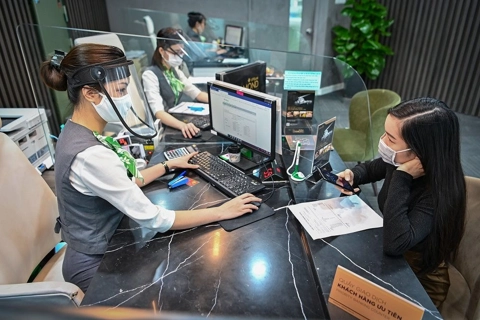
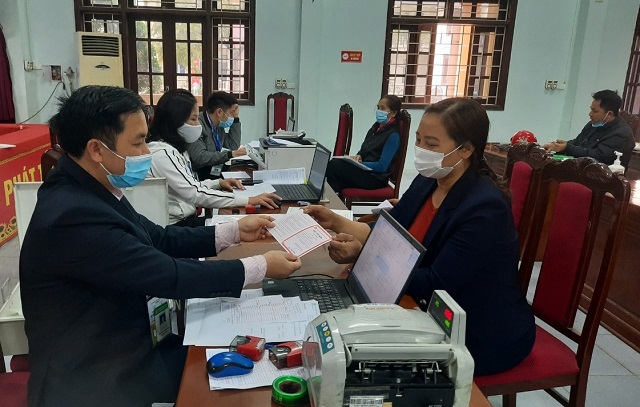
| Vietnam Bank for Social Policies at Ba Vi District, Hanoi, provides preferential loans for customers. Photo: Hong Dat |
In 2020, the SBV cut the policy rates three times with a total of 1.5-2 percentage points per annum, which created room for banks to lower lending rates for customers. At present, interest rates for short-term loans in priority fields (agriculture, exports, supporting industries, hi-tech) are capped at 4.5% per annum.
“The average lending rate declined by one percentage point per annum in 2020 and remained so in the first half of 2021 and then saw a further decrease of 0.55 percentage points,” stated the SBV, noting the total rate cut is 1.55 percentage points against the pre-Covid-19 period.
So far, 16 commercial banks, accounting for 75% of total outstanding loans, have agreed to cut an addition of one percentage point per annum for the last five months of 2021 in a move to support customers, equivalent to around VND20.6 trillion ($906.3 million) being foregone.
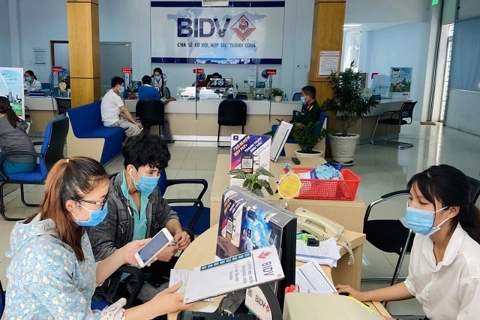
The SBV noted four state-owned commercial banks including Agribank, Vietinbank, BIDV, and Vietcombank, have committed to providing support packages worth VND4 trillion ($176 million) in form of lowering lending rates and other banking fees for customers under the stay-at-home order.
As of August 31, the banking sector has lowered and waived lending rates for 1.13 million customers with a combined amount of VND1,580 trillion ($69.5 billion); provided new loans with preferential rates of VND4,460 trillion ($196.2 billion) for 628,662 customers since January 23.
Since early September, the SBV has agreed for banks to extend the debt schedule for another six months until June 30, 2022, which is applicable to all debts incurred before August 1, 2021, instead of the previous timeline of June 10, 2020.
The SBV said it remains focused on supporting businesses and people from now on until early 2022 by putting in place a series of measures.
“Pace of credit growth should be managed in line with credit quality and control of the capital inflows into risky fields,” it said.
The central bank urged commercial banks to continue providing support for businesses and people affected by the pandemic while ensuring sufficient funds to meet capital needs in production and business activities amid the difficult economic situation.
The SBV would continue to work with related agencies to draft new regulations on easing procedures to access loans for the purpose of paying workers’ salaries affected by the pandemic.