Business: Key pillar in Vietnam-China economic cooperation
Prime Minister Pham Minh Chinh said cooperation is expanding rapidly, especially in green, digital, circular, and knowledge-based economies.
THE HANOI TIMES — The Vietnam–China business community should continue to serve as a vital bridge and key pillar in connecting the two economies, said Prime Minister Pham Minh Chinh at the Vietnam–China Business Connection Forum on June 24.
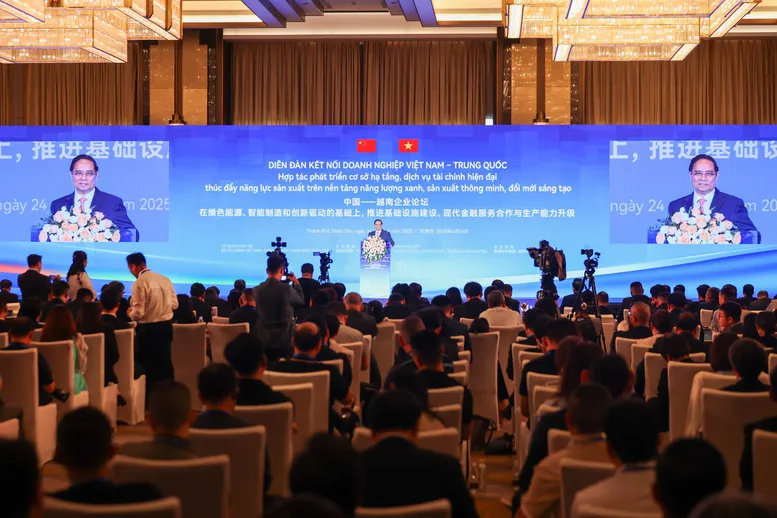
Vietnam’s Prime Minister Pham Minh Chinh at the conference. Photos: VGP
“Vietnam highly values the contributions of Chinese businesses to the country’s economic development and the bilateral relationship in recent years,” Chinh said.
The prime minister expressed his hope that enterprises from both countries would strengthen connections and help advance the Comprehensive Strategic Cooperative Partnership and the shared future community between Vietnam and China, for the sake of peace, cooperation, and development in the region and the world.
He called on the business communities in both nations to maintain their role as a bridge between the two economies and engage more deeply in global value chains.
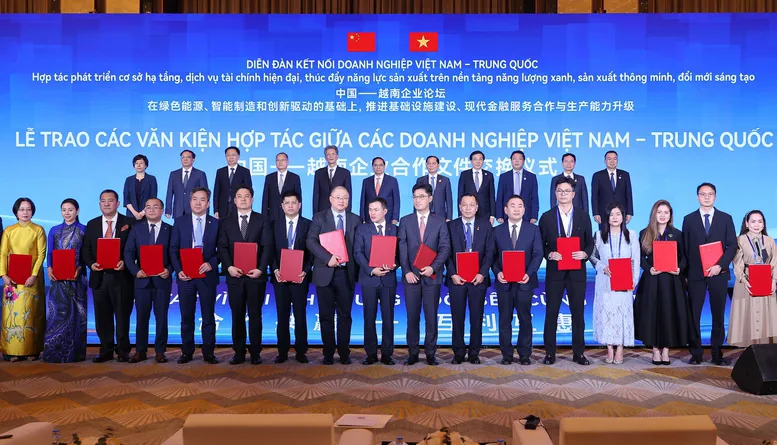
The prime minister and delegates witness the signing of nine memoranda of understanding between businesses from both countries.
In 2024, Vietnam remains China's largest trading partner in ASEAN and its 4th largest globally. Bilateral trade reached over US$205 billion, up 19.3%. In the first five months of this year, bilateral trade stood at $92.9 billion, a year-on-year increase of 18.7%.
China is Vietnam's 6th largest foreign investor as of the end of last year, with 5,111 active projects and a total registered capital of over $30.8 billion.
At the forum, Jonathan Choi, a Standing Committee Member of the Chinese People's Political Consultative Conference, described Vietnam as one of the fastest-growing economies in Southeast Asia and globally, with an increasingly important strategic position.
He said Vietnam’s forward-looking policies on infrastructure, green economy, and fintech have attracted strong interest and investment from Chinese enterprises.
Choi highlighted the growing potential for China and Vietnam to collaborate in sectors such as industry, technological innovation, capital linkage, and regional cooperation, in addition to deeper cooperation in key areas, including infrastructure, high technology, green energy, and overall energy development. Moreover, he suggested that China could support Vietnam in developing an international financial center.
Chinese bank invited to join Vietnam int’l finance center
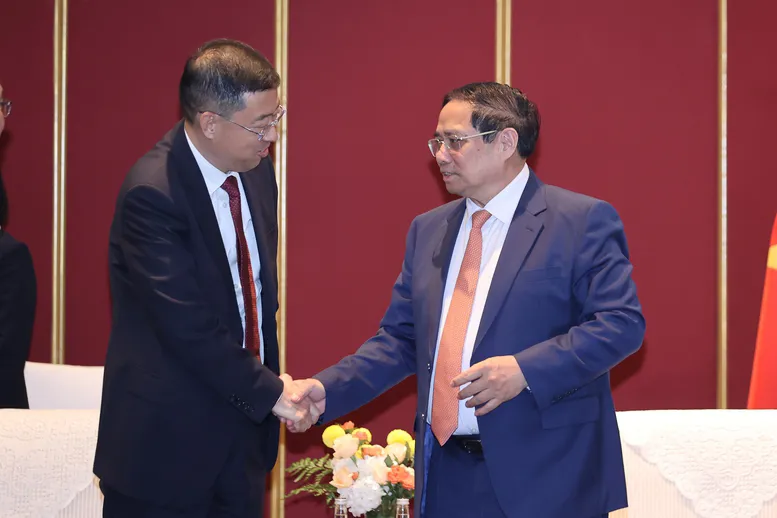
On the same day, during a meeting with Chairman of the Bank of China (BOC), GE Haijiao, Prime Minister Chinh expressed hope that the bank would expand its presence and consider participating in the restructuring of weak Vietnamese banks.
The prime minister noted that Vietnam is finalizing a breakthrough legal framework for an international financial center that ensures transparency and security.
Chinh called on the BOC to share its experience and help find partners, investors, and financial experts to build, operate, and develop the international financial center jointly.
The draft resolution on the center is expected to be passed by the National Assembly on June 27.
Vietnam plans to establish an international financial center in two cities: Ho Chi Minh City and Danang.
The center in Ho Chi Minh City will offer a full range of services and products, including banking and capital markets, asset and fund management, and fintech regulatory sandboxes. The Danang center will focus on green finance, the controlled piloting of digital assets and currencies, payments, and attracting investment and remittance funds, as well as small- and medium-sized fund management companies.
BOC Chairman GE Haijiao stated that the bank plans to increase its presence and investment resources in Vietnam. BOC is prepared to provide comprehensive financial services for large-scale infrastructure projects, promote financial and monetary cooperation, facilitate cross-border payments.
BOC operates in mainland China and 64 other countries and territories worldwide. As of the end of 2023, the bank had 12,000 branches and over 300,000 employees. Its Ho Chi Minh City branch, established in 1995, was the first licensed Chinese bank branch in Vietnam. It provides services including credit, international payments, trade finance, and foreign exchange.
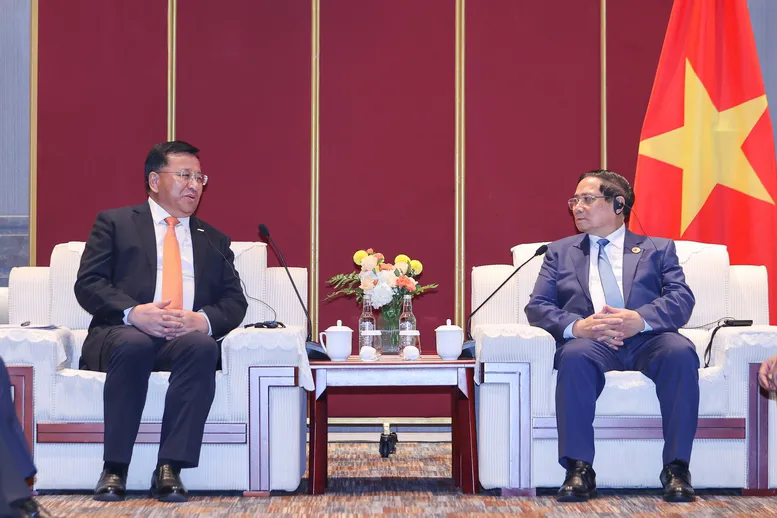
The prime minister and CRCC Chairman Dai He Gen.
Prime Minister Chinh also met separately with leaders of three major Chinese corporations in railways and transport infrastructure: China Railway Group (CREC), China Railway Construction Corporation (CRCC), and China Communications Construction Company (CCCC). All of them expressed interest in participating in infrastructure and railway projects in Vietnam, especially the three key routes that link Vietnam and China. Construction on the Lao Cai–Hanoi–Haiphong line is expected to begin in December.
Besides railways, CCCC leaders expressed interest in seaport projects (Lach Huyen and Can Gio), expressways (Ho Chi Minh City–Trung Luong–My Thuan and Ho Chi Minh City–Moc Bai), ring roads, and metro lines in Hanoi and Ho Chi Minh City.
The prime minister welcomed the corporations' plans for investing in Vietnam, especially in railway development.
He urged both sides to innovate their approaches to ensure the upcoming projects are carried out faster and more effectively. He said that Vietnam would expedite site clearance to facilitate project progress. “The Vietnamese government is committed supporting Chinese enterprises,” the prime minister affirmed.
Prime Minister Chinh is visiting China from June 24 to 27 to attend the 16th Annual Meeting of the New Champions of the World Economic Forum (WEF Tianjin 16), at the invitation of Chinese Premier Li Qiang and WEF President and CEO Børge Brende.
Themed “Next Frontiers for Growth,” the conference gathers over 1,700 delegates from governments, businesses, international organizations, and academic institutions worldwide.