DNA bank debuts to identify remains of martyrs
The launch of the gene bank will help determine the identities of unknown martyrs in cemeteries.
On the eve of the 77th National Day of War Veterans and Martyrs [July 27, 1947-2024], a ceremony was held in Hanoi to honor revolutionaries and inaugurate a special gene bank to help identify hundreds of thousands of unaccounted-for fallen.
Speaking at the event, Prime Minister Pham Minh Chinh said that taking DNA samples from unaccounted for and direct relatives of the martyrs for examination and storage in the gene bank will be the best preparation for the long journey of searching and identifying the soldiers.
Prime Minister Pham Minh Chinh addresses the conference. Photos: VGP |
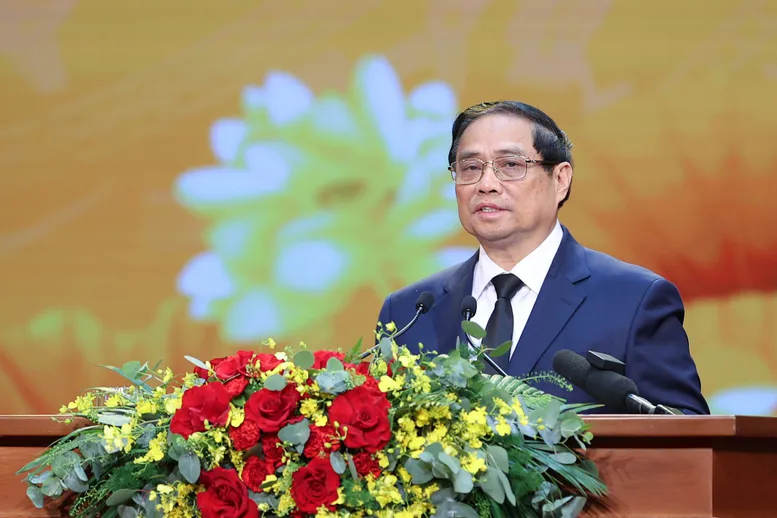
"Nearly 1.2 million Vietnamese voluntarily headed to the battlefields, leaving behind their dreams and ambitions, to defend the motherland against foreign aggression, and many of them laid down their lives there. The war is over, but nearly 200,000 martyrs' remains have not been found, and 300,000 martyrs' remains are in cemeteries whose identities are unknown," Chinh stressed.
The launch of the gene bank will help determine the identities of unknown martyrs in cemeteries, said the Prime Minister, who set a target for the gene bank to identify at least 60% of unknown martyrs and called for speeding up the process of searching, collecting and verifying martyrs' remains using empirical methods for martyrs' graves that lack information in cemeteries.
Chinh also urged the relevant ministries, agencies, and localities to carry out the Party's directives, state policies, and laws on the care of war invalids, sick soldiers, martyrs' families, and people who have rendered meritorious service to the revolution.
Minister of Labor, Invalids and Social Affairs Dao Ngoc Dung, citing ministry statistics, said nearly 10,000 samples of martyrs’ remains and more than 3,000 biological samples of martyrs' relatives have been taken for DNA testing, and more than 1,000 martyrs have been identified.
He said taking samples from unidentified martyrs and their relatives for examination and storage in the gene bank is a step forward in finding and verifying the identity of their remains. "This is a very sacred task of great importance in the journey of the search for and the return of the names of the fallen heroes."
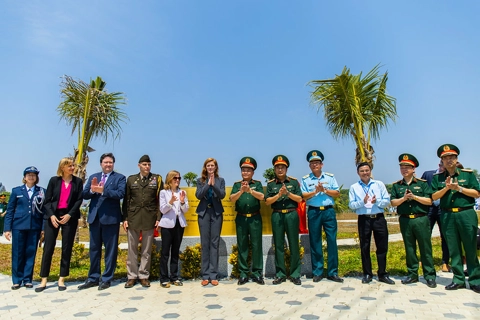
Prime Minister Pham Minh Chinh and other leaders activate the DNA database for unidentified soldiers and their relatives. |
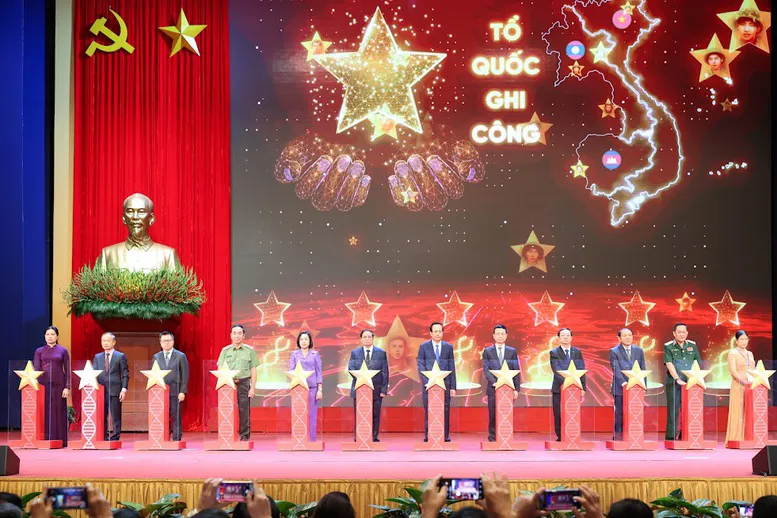
Co-hosted by the Ministry of Labor, Invalids and Social Affairs (MoLISA), the Ministry of National Defense, the Ministry of Public Security, and the Hanoi People's Committee, the inauguration ceremony brought together 400 veterans and families of fallen heroes.
Prior to the event, Prime Minister Pham Minh Chinh and delegates observed a moment of silence to commemorate the sacrifices and great contributions of heroic martyrs who fell in the cause of national construction and defense.
On the occasion, Prime Minister Chinh and other Party and State leaders presented gifts to veterans and handed over DNA certificates to representatives of 10 martyr families, including four families who were finally able to reunite with their lost loved ones after decades of waiting.
In July 2019, a DNA identification center for revolutionary martyrs under the Institute of Biotechnology was opened in Hanoi to facilitate the verification of the remains of war martyrs.
The Institute of Biotechnology under the Vietnam Academy of Science and Technology is the first institution in Vietnam to develop DNA analysis technology to identify the remains of revolutionary martyrs.
Chau Van Minh, director of the academy, said the center was expected to facilitate the identification of martyrs' remains, meeting the expectations of the people and the government. "The center has been working at full capacity to analyze 4,000 sets of martyrs' remains annually," Minh said.
In 2015, the Vietnamese government set a target to build three DNA identification centers. Almost half a century after the reunification of the country, there are still 300,000 sets of remains of war martyrs without information.
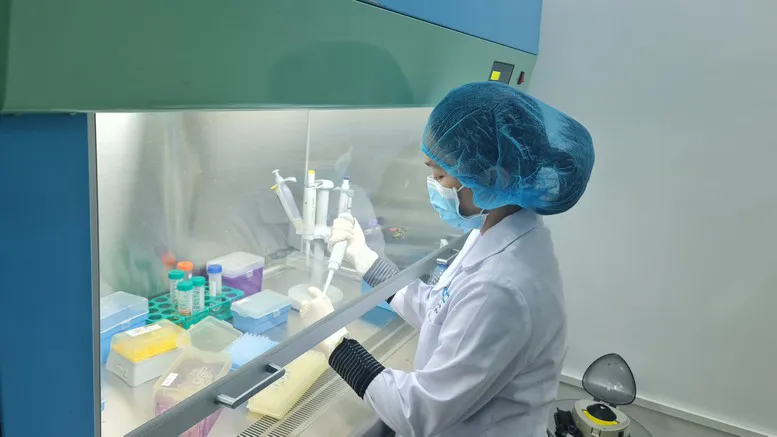
An examiner from the DNA Identification Center for Revolutionary Martyrs analyzes a sample from the remains of a martyr. |