Dynamic policies to revitalize Hanoi’s old apartment buildings
Having stagnated for decades, renovating Hanoi's old apartment buildings requires new, critical methods to move forward.
THE HANOI TIMES — New policies for renovating old apartment buildings should embody innovative thinking and create mutual benefits for the state, investors, and residents, said Tran Huy Anh, Standing Member of the Hanoi Association of Architects, in an interview with The Hanoi Times.

Tran Huy Anh, Standing Member of the Hanoi Association of Architects.
Why has the renovation of old apartment buildings in Hanoi been so slow for so long?
In 2000, Hanoi began rebuilding Block A3 in Giang Vo. Originally, it was a dormitory for the staff of the Ministry of Planning and Investment. The building was so deteriorated at the time of renovation that it posed a safety hazard and needed to be torn down. The ministry funded a new building on the same site to replace it, expanding its size and height.
All residents were resettled on-site into larger, upgraded apartments at low cost thanks to state funding and free public land expansion, making the project a city-declared success, though it reduced public land bank and strained the budget.
Next, Hanoi proceeded to rebuild Block A6 Giang Vo, a five-story, prefabricated apartment building with four residential floors and a ground floor occupied by a government agency. The new building had more floors and a larger footprint, allowing for more units. These units sold out quickly at low prices, making the renovation appear profitable. Building on this momentum, Hanoi moved forward with Block B7 Giang Vo. Though permits were granted quickly, conflicts with residents delayed the project for more than a decade.
Renovating old apartment buildings is a major real estate venture where ground-floor owners hold key influence, but despite procedural tweaks, progress remains stalled in the absence of a new dialogue framework, as regulators focus on easily manipulated technical criteria rather than homeowner agreements.
How will the 2024 Land Law, the 2024 Capital Law, and the two-tier local government model support Hanoi in redeveloping old apartment blocks?
The Land Law is crucial, but it lacks an important component: land valuation. This is necessary for calculating the economic value of surface land, underground space, and airspace. These factors directly impact the current and future values of old and renovated apartments. Without proper pricing, sellers (homeowners) and buyers (investors) have no basis for negotiation.
The 2024 Capital Law includes provisions for urban development based on the TOD (Transit-Oriented Development) model, including apartment renovation. Hanoi is actively preparing 1:500 scale detailed plans for old apartment areas to lay the groundwork for reconstruction. Functional agencies must carefully calculate to properly carry out these plans and solve both urban pressure and urban renewal issues.
In recent years, Hanoi has introduced several new policies for renovating old apartments, but challenges persist. In my view, success will require moving away from outdated thinking and toward dynamic, effective solutions that benefit the state, developers, and residents. Hanoi could empower creative organizations and independent experts to propose new models.

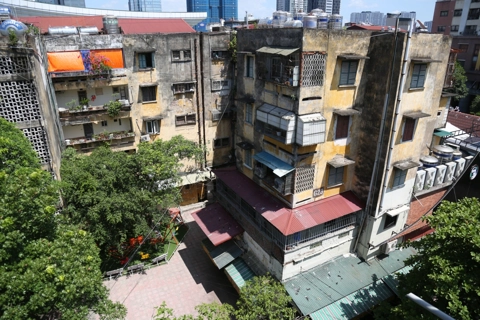
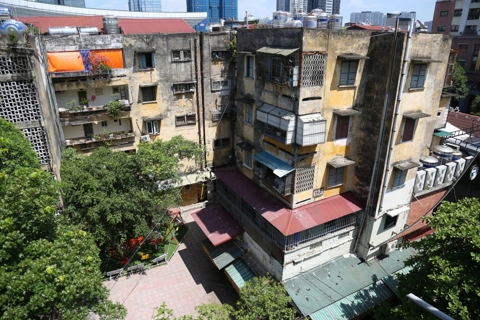
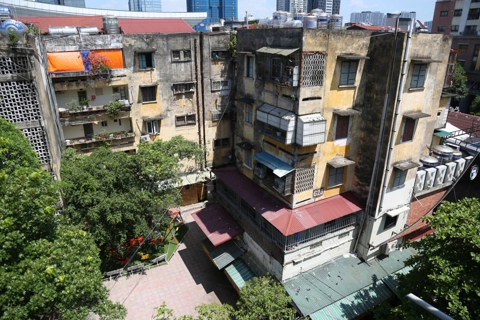
An old apartment building in Giang Vo Ward, Hanoi. Photo: Pham Hung/The Hanoi Times
When designing new apartment buildings, what should be considered to align with the capital’s historical, cultural, and architectural identity?
Hanoi is not alone in reconstructing old apartment blocks; other cities in China, Hong Kong, and ASEAN countries have done the same. Renovation is part of the inevitable process of urban renewal and modernization. This is an opportunity for Hanoi to transform into a modern, human-centered, culturally rich city.
Successful urban renewal requires recognizing the importance of community participation. Cities that pursued TOD (Transit-Oriented Development) without taking community needs into account suffered failures. On the other hand, cities that evolved toward the TOC (Traffic-Oriented Community) model have found greater success.
Between 2024 and 2025, Hanoi hosted many international conferences on TOD. However, reports showed that current efforts are insufficient to make TOD projects viable. International experts have advised Hanoi to establish a clear legal framework, build a digital land database, and develop sustainable financing strategies through green and infrastructure bonds.
At the same time, developers must build cohesive residential communities, support commuting, and generate obvious socioeconomic benefits.
A modern, green, smart, and globally connected Hanoi will only become a reality if urban transport planning moves beyond "paper-based plans" and aligns with real-world travel needs and financial capacities.
To overcome current shortcomings and avoid the risk of an unfeasible urban rail system, experts recommend that Hanoi adopt a more open mindset toward TOD. This approach puts residential and economic communities at the center of investment decisions. Public transportation then becomes a catalyst for creating livable urban spaces and nurturing prosperous, sustainable communities.
A community-focused approach to public transportation offers safe, affordable, and convenient mobility while boosting livelihoods, attracting investment, and engaging experts and businesses alike.
Sustainable urban development requires more than plans; it demands a deep, courageous, and responsible vision that asks: Is public transportation built to meet quotas or to truly serve people's needs?
If Hanoi can answer this question, the city will enter a new era of sustainable development and confidently take its place on the global stage.
Thank you for your time!