Eco-labeling gives Vietnam green passport to global markets: experts
The eco label is seen as a “green passport” that helps Vietnam’s businesses expand markets, reach responsible consumers, and provide safe and quality choices for buyers.
THE HANOI TIMES — Promoting sustainable production and consumption through eco labeling requires a shared, responsible effort among businesses, consumers and government agencies.
Experts, specialists and business representatives shared their thoughts about the topic at a seminar about green and eco-friendly product labeling held this week in Hanoi.
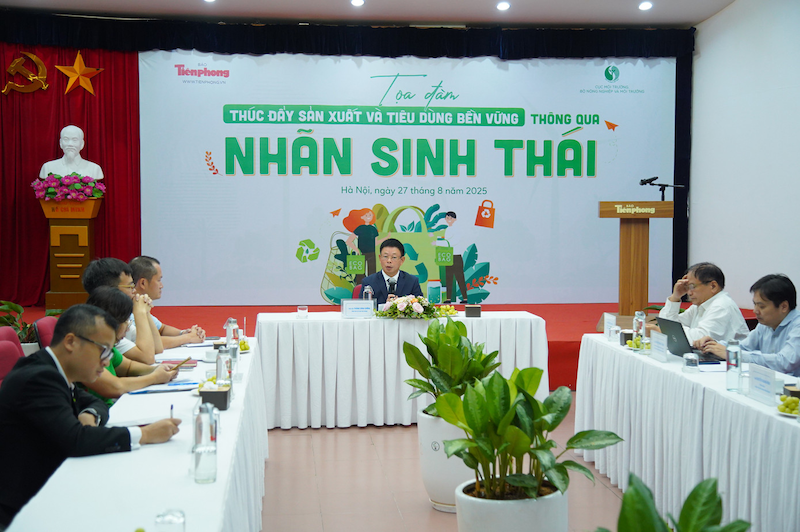
An overview of the seminar “Promoting Sustainable Production and Consumption through Eco Labels” held on August 27 in Hanoi. Photos: Tien phong Online Newspaper
Le Hoai Nam, Deputy Director of the Department of Environment, Ministry of Agriculture and Environment: Vietnam has built an eco-labeling system, but stronger incentives and markets are needed.
Green labeling and eco-labeling are important environmental regulatory tools used in developed countries such as South Korea, Japan, China, Thailand, and across Europe. They help businesses shift from polluting products to greener ones, and guide consumers to make healthier, sustainable choices.

Le Hoai Nam, Deputy Director of the Department of Environment.
In Vietnam, the legal framework for eco-labeling has evolved through the Law on Environmental Protection versions 2005, 2014, and 2020. A pilot program, titled "The National Ecolabeling Program in Vietnam" was initiated in 2009 to focus on certified “Vietnam Green Label” products and eco-friendly plastic bags. However, adoption remains limited due to weak domestic capacity, lack of incentives, and insufficient guidance.
The 2020 law created a unified Vietnamese eco-labeling system and introduced preferential policies for green products. Public investors must now prioritize eco-friendly goods, an important step to boost sustainable production.
To overcome barriers, three main policy groups are being advanced.
First, administrative measures: banning and phasing out polluting products, with single-use plastics prohibited nationwide after 2030.
Second, economic tools: taxes on polluting goods and financial incentives for green producers.
Third, market development: expanding eco label product markets, which in Vietnam remain very small compared to countries like Japan, where eco-labeled goods were valued at more than US$44 billion in 2016.
Nguyen Trung Thang, Deputy Director of the Institute of Strategy and Policy on Agriculture and Environment: Vietnam should ease rules and boost eco-labeled product market growth.
Consumer awareness is changing fast: 86% of Vietnamese consumers are willing to pay more for eco-friendly products, while 62% say their purchases are influenced by companies’ green commitments.

Nguyen Trung Thang, Deputy Director of the Institute of Strategy and Policy on Agriculture and Environment.
International pressure is also mounting. Stricter environmental standards from the EU, the US, Japan, and China, and the rise of digital transformation and AI, create both challenges and opportunities for Vietnam’s green transition.
After more than 20 years, Vietnam has only 17 eco-labeling criteria, with just 125 certified products to date. Most consumers still care more about food safety, while technology gaps, high costs, and red tape hinder wider adoption.
To move forward, I propose comprehensive solutions. We must boost both demand and supply. The State needs to improve regulations, create an attractive market, and set sector-specific criteria that align with green transition goals.
At the same time, procedure streamlining, introduction of preferential loans, and digital transformation will help cut compliance costs. Transferring certification to independent organizations could also make eco-labeling more transparent and effective.
Trinh Quang Hung, Head of the Division of Property Tax, Resource Tax, and Environmental Protection Tax - Department of Tax Policy, Fee and Charge Management and Supervision, the Ministry of Finance: Vietnam should boost tax incentives for green projects, carbon credits, and eco-friendly products.
Vietnam’s tax system has long placed environmental protection at its core. Eco-tax policies are clearly reflected in laws and decrees.

Trinh Quang Hung, Head of the Division of Property Tax, Resource Tax, and Environmental Protection Tax.
For example, under the Law on Environmental Protection Tax 2010, plastic bags were taxed from VND10,000 (US$0.4) to VN50,000 ($1.9) per kilogram, while eco-friendly bags were exempt.
Corporate income tax policies grant significant incentives for environmental projects such as renewable energy, clean energy, waste treatment, and energy-saving products, as well as projects in disadvantaged areas. Businesses can also enjoy tax exemptions when transferring emission reduction certificates or operating in green-certified sectors.
Vietnam has also embedded green priorities in other taxes, including special consumption, import-export duties, and registration fees, which favor cleaner fuels, vehicles, and products.
Looking ahead, the Ministry of Finance is drafting a revised Law on Personal Income Tax, and submitting the proposal to the National Assembly for review in October. This will expand incentives for green growth and sustainable development, including tax exemptions on carbon credits, green bonds, and their transfers.
Vietnam’s tax policies consistently prioritize environmental protection, aligning with global net-zero and carbon neutrality goals.
Trinh Thi Hong Loan, Representative of the Vietnam Association of Retailers: Vietnamese retailers call for legal support, incentives to expand eco-labeled products.
We need to improve the legal framework and support policies so that more businesses can participate in producing eco-labeled products. That means clearer communication on how certification works, what benefits companies receive, and how tax incentives are applied.

Trinh Thi Hong Loan, Representative of the Vietnam Association of Retailers.
Vietnam lags behind international practices. In some countries, the government covers up to 50% of the cost for eco-labeling. In Vietnam, only 13 companies have joined the scheme in the past two years, a very small number.
We need to tell businesses, consumers, and especially young people that green products reduce harmful chemicals and protect the environment. In our retail system, some members now give priority to eco-labeled goods. They even offer discounts to boost sales in those items.
We advise our members to monitor supply chains, give priority to eco-labeled suppliers, and work with authorities to expand sources of green goods. We also cooperate with market regulators to ensure transparency and protect the credibility of certified products.
More importantly, we need to strengthen green consumption and encourage people to cut back on single-use plastics.
Nguyen The Chinh, senior researcher at the Institute of Meteorology, Hydrology and Climate Change: Vietnam urged to boost green product market with stronger policies, consumer trust, state leadership.
We need special, timely policies to drive the growth of green products. Tax incentives and targeted support for businesses producing eco-friendly goods are essential. Right now, creating a real market for green products remains difficult, we don’t yet have a strong foundation.

Nguyen The Chinh, senior researcher at the Institute of Meteorology, Hydrology and Climate Change
That’s why breakthrough solutions are needed to attract consumers, especially through better communication and product promotion.
At the same time, we need to ease regulations for both producing and consuming green products. Environmental regulations and clear standards for green certification are critical in this process.
The State should set an example in using and purchasing green products to motivate the wider market to follow. Businesses, consumers, and regulators must further cooperate to promote green production and consumption.
Finally, building consumer trust is essential. To do so, authorities must step up market supervision and strictly punish violations such as making and selling counterfeits. Only then can we protect and grow a truly sustainable green product market.
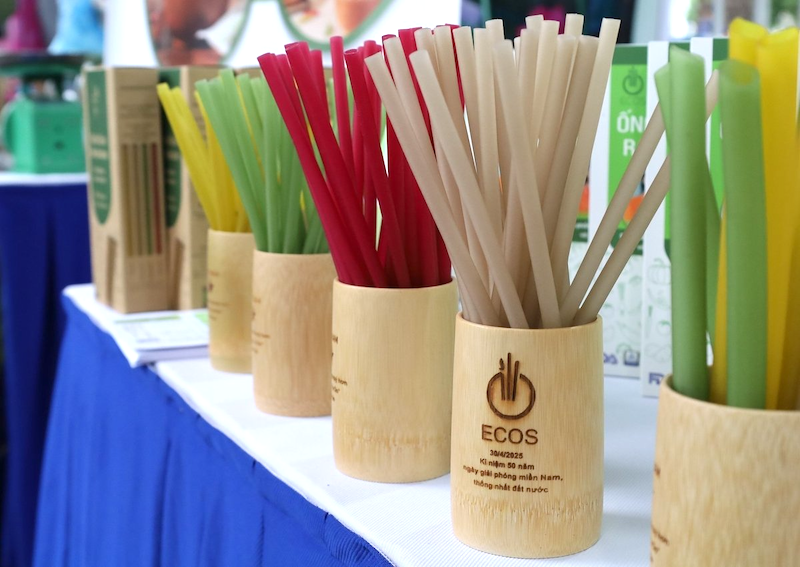
Rice straws, one of the green products showcased at the program “Promoting Sustainable Production and Consumption 2025,” held in June in Hanoi. Photo: Nong nghiep & Moi truong Newspaper |