French painter and strong attachment to Hanoi
French painter Jean-Charles Sarrazin was first drawn to Vietnamese culture and people while studying fine arts in Hanoi nearly four decades ago.
In 1987-1988, French cartoonist Jean-Charles Sarrazin roamed the streets of Hanoi and the countryside. He took about 300 photos, mainly about the life of Hanoi people, street corners, houses and rustic rural images. He also sketched many scenes in Hanoi, Vietnam and has kept them until now. These works have been displayed in several small exhibitions in Paris.
He has returned to Hanoi to tell people about his inspiration and made it material for his artworks.
After nearly 40 years since the first time he came, Sarrazin's love for Vietnam remains intact, and he is always willing to go to Vietnam for creative inspiration and to exchange ideas with readers and colleagues.
A fine arts student in Hanoi
In 1986, as a student about to graduate from the Olivier de Serres University of Industrial Fine Arts, Sarrazin had the opportunity to meet the poet Cu Huy Can, then Minister of Culture, on a business trip to Paris.
Sarrazin told him of his desire to study abroad, and the minister responded with a question: "Why not come to Vietnam?"
So it was poet Huy Can who helped the young Frenchman get in touch with art schools in Vietnam.
| Sarrazin began studying fine arts in Hanoi, where he became an artist. |
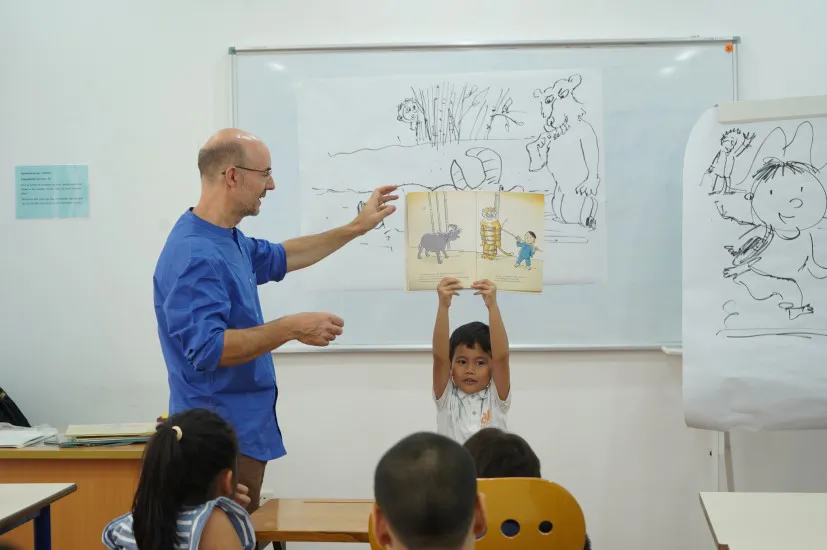
Sarrazin developed a project to share artistic knowledge and submitted it to the Hanoi University of Industrial Fine Arts. The French student also expressed interest in learning traditional Vietnamese skills such as lacquer, wood carving, silk painting, and so on and offered to teach at the School of Traditional European Arts.
"The project convinced the leaders of the University of Industrial Fine Arts and they accepted it." The French Ministry of Foreign Affairs decided at the time to create a scholarship for this initiative, which they gave to me. This is the first scholarship for a French student to study in Vietnam since the war," Sarrazin recalled.
Although his studies in Vietnam lasted only one year, Sarrazin had the opportunity to meet a number of famous artists such as Bui Xuan Phai, Buu Chi and art teachers such as Trinh Tuan (Hanoi University of Industrial Fine Arts) and Tran Trong Vu (Vietnam University of Fine Arts).
| Ordinary Life by O Quan Chuong Gate in Hanoi. |
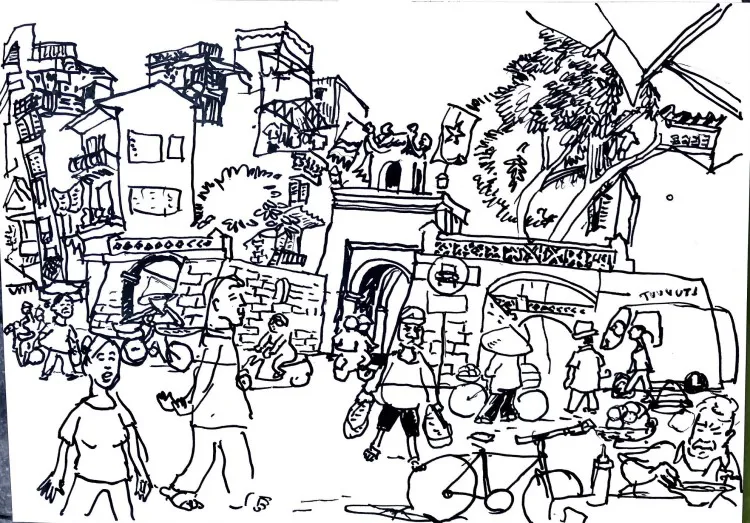
"We would ride our bikes around the countryside, visiting temples and traditional festivals, painting and taking pictures," the French artist said.
For him, Mai Chau (Hoa Binh) is the most impressive place to visit because of its peaceful landscape, authentic cuisine and the Muong ethnic people's stilt houses. The bicycle trip took the French artist to Tay Phuong Pagoda and Thay Pagoda (Hanoi), where he was deeply enchanted by the fine artistic motifs.
Since then, he has made several trips to Vietnam to present his works through lectures, workshops, exhibitions and discussions with readers.
Cultural affinities with Vietnam
So far, Jean-Charles Sarrazin has remained faithful to the traditional method of creating books, rejecting the technology available to graphic designers. He believes that "children with innocent souls will easily understand what is closer, purer, and dearer".
| Sarrazin will be in Vietnam for seminars and exchanges with readers this year. |
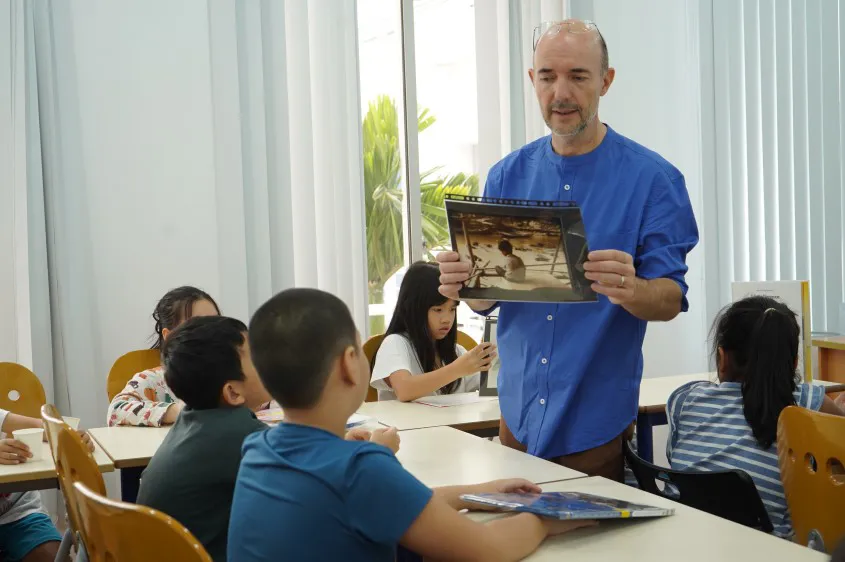
Artist Sarrazin admitted that the time studying and researching in Vietnam changed his life.
"During my time in Vietnam, I was exposed to a culture that was different from mine." "I see the interference between the East and the West when I study Eastern culture," the artist said, adding that he was inspired by Vietnamese art after meeting several prominent Vietnamese painters.
His creations are influenced by Vietnamese art and culture, such as wood carving, lacquer painting, silk painting, and things he learned while studying in the country.
In particular, he published a book inspired by the fairy tale Tri khon cua ta day (Here is My Wisdom).
Sarrazin's book tells the story between the buffalo and the tiger, but the man who owns the buffalo was replaced by a boy to make the story more child-friendly.
Through the dialogue in the story, the artist wants to convey the message that everyone is smart in their own way. They need to know how to use it properly. This is also the goal of his creations: to help children develop their personalities from an early age.
| Sarrazin's sketch of the Long Bien Bridge. |
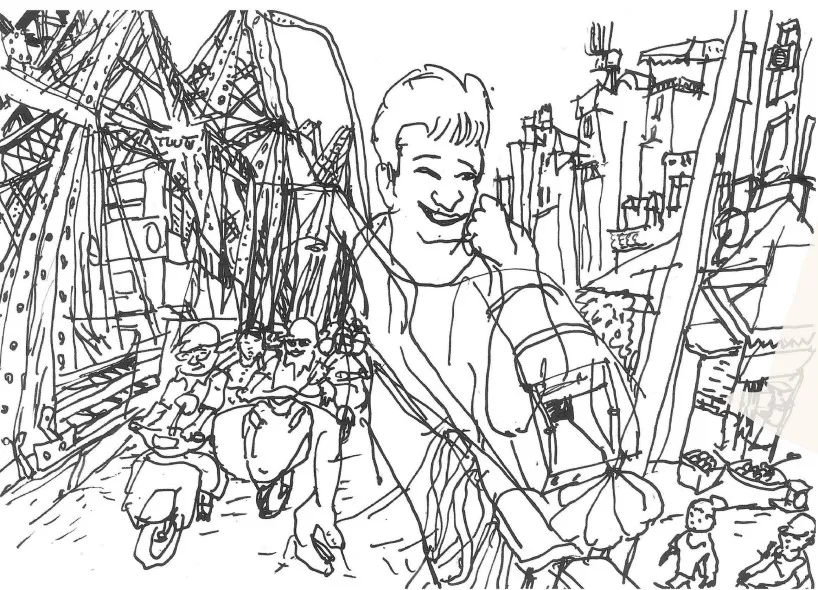
"I am very happy that this book is loved by Vietnamese children, especially when I saw how students adapted it into a play," he said.
This year, at the invitation of the French Institute in Vietnam, Sarrazin will hold exhibitions, exchanges, and workshops in Hanoi, Hue, Danang, and Ho Chi Minh City to share his work and creative process.
"For me, this country is dear and near to my heart. My journey with Vietnam continues. Thank you, Vietnam, for all the good things you have brought me," Sarrazin shared.