Hanoi accelerates innovation reforms to become favorite destinations for investors, technology talents
Hanoi is pushing forward a wide range of innovation-driven reforms and investment initiatives as it works to become one of the world’s most attractive destinations for high-tech and strategic investors.
THE HANOI TIMES — Hanoi is pressing forward with bold, transformative reforms to firmly position itself as one of the world’s most attractive destinations for high-tech and strategic investors, according to Tran Anh Tuan, Director of the Hanoi Department of Science and Technology.
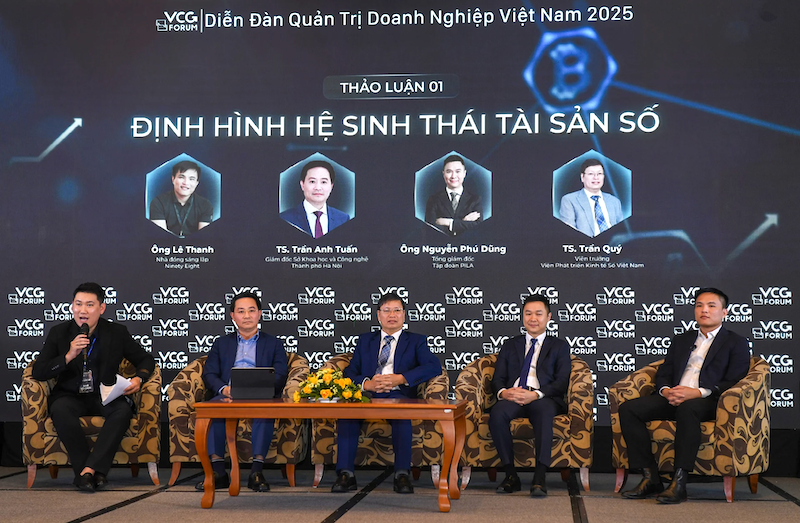
Tran Anh Tuan, Director of the Hanoi Department of Science and Technology (second from left) and other delegates at the VCG Forum. Photo courtesy of the organizing board
At the Vietnam Corporate Governance Forum 2025 (VCG Forum) on December 10, Tuan said Hanoi enjoys special regulatory flexibility under the Law on the Capital, which allows it to pioneer reforms unavailable to other localities.
In science, technology and innovation, Hanoi plans to apply both the Law on the Capital and national legislation to issue new resolutions, he said.
One example is the controlled sandbox mechanism, introduced for the first time in Vietnam, giving companies the chance to test innovative solutions under regulatory supervision, Tuan added.
“The city is now receiving applications from businesses seeking to join these testbeds,” the science and technology department’s director said.
“Hanoi will be the first city to use public funds to purchase research outcomes from scientists, commercialize them and apply them in daily life.”
He added that Hanoi expects to sign a contract with a research team that created a patented cancer-detection test kit in late December.
According to Tuan, other initiatives include launching a technology trading floor, signing memoranda of understanding with five organizations and funding five research teams to establish university spin-offs by the end of December.
Hanoi is also the first locality in Vietnam to create a venture capital fund under a resolution passed by local legislators in late September.
The city will contribute VND600 billion (US$22.8 million) in seed capital and attract around ten strategic investors. The fund will operate on market principles and follow governance by an independent board, allowing greater flexibility and higher risk tolerance.
With Hanoi targeting a digital economy share of at least 40% by 2030 and economic growth of 11% or more, Tuan said the city cannot rely on traditional growth models.
“Science and technology, innovation and new models such as the digital economy will drive this transformation,” he said.
Recognizing the value of data, semiconductors and digital assets, the city is actively searching for “chief architects” in these fields, the director said.
He encouraged global founders and innovators to return to Hanoi, noting that the city has strong human capital, yet many skilled workers and innovators have left for other cities or countries.
Reversing that loss has become a central mission. “Our goal is to bring back the talent, expertise and financial capital that Hanoi has lost over the years,” he said.
Blockchain – a key growth driver
Vietnam lists blockchain among 11 strategic technologies it aims to master, including digital assets, cryptocurrencies, blockchain networks and traceability systems.
At the forum, Tuan emphasized Hanoi’s expectations for blockchain applications, including traceability solutions and digital asset exchanges and highlighted the city’s search for a chief architect in this field.
Experts discussed blockchain’s potential in Vietnam’s evolving policy landscape. Nguyen Phu Dung, CEO of Pila Group, said the technology can help close the trust gap in Vietnam’s economy.
He noted that capital circulation lags behind regional peers due to investor skepticism.
“Investors rely on digital trust, meaning transparent and verifiable data,” he said. “Achieving this requires real-time data, independent verification and national-level infrastructure.”
Blockchain, he added, delivers data immutability, automation through smart contracts, transparency and decentralization.
“Blockchain will become the trust layer of the digital economy. When data becomes transparent, trust forms naturally and capital flows.”
Le Thanh, co-founder of blockchain firm Ninety Eight, said Vietnamese engineers play key roles in global blockchain organizations, from exchanges to core platforms such as Ethereum.
Clearer digital-asset regulations, he said, will unlock opportunities for domestic firms and motivate young talent to return and contribute.
“Vietnam may not stand at the very top, but we are not behind anyone. The gap is small and with the right policies, we can close it quickly,” he said.