Hanoi agriculture grows 3.6%, exports reach over US$2 billion in 2025
Hanoi’s agricultural sector showed solid resilience in 2025, posting GRDP growth of 3.6% and highlighting its stability despite ongoing global economic uncertainty.
THE HANOI TIMES — Hanoi’s agricultural sector maintained steady momentum in 2025, posting a growth rate of 3.55% and export turnover of more than US$2 billion, according to the Hanoi Department of Agriculture and Environment.
Key agricultural and food products accounted for about $1.4 billion of total exports, reflecting progress in quality upgrading, traceability and market expansion.
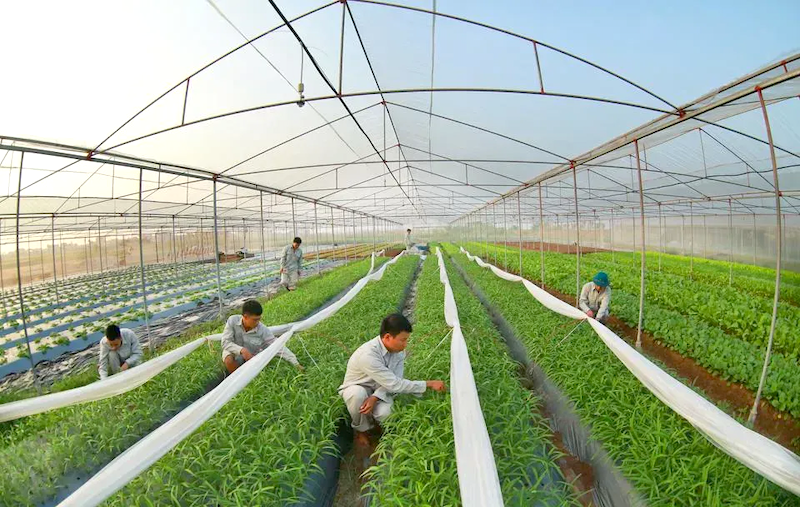
Hygienic production at the Japan-Vietnam Vegetable Fruit Company. Photo: Phuong Nga/The Hanoi Times
The sector’s production value reached VND70.4 trillion ($2.7 billion), with agriculture contributing 91%, reaffirming its central role in the capital’s rural economy.
Crop production remained the backbone of the sector. Food output reached 958,000 tons, ensuring food security for the city.
Livestock and fisheries recorded solid growth while keeping risks under control. Despite ongoing disease pressure, livestock output grew by an average of 4.4%.
Fisheries output reached nearly 140,000 tons, up 4% year on year. Aquaculture accounted for about 135,800 tons, rising 4.1%, while capture fisheries remained stable at 1,600 tons, in line with resource protection policies.
The One Commune One Product (OCOP) program and the expansion of agricultural value chains emerged as key highlights, underscoring Hanoi’s shift toward a more market-oriented agricultural model.
During 2025, the city developed more than 3,400 OCOP products, including nine five-star products, 19 potential five-star products, nearly 1,600 four-star products and about 1,800 three-star products.
Hanoi achieved its OCOP targets one year ahead of schedule and retained its leading national position in both scale and quality of certified products.
At the same time, the city built 172 effective agricultural value chains, up more than 53% from the previous period. These include 59 livestock chains and 113 crop chains, forming a stronger base for stable production and consumption.
Structural challenges remain
Behind the positive figures, structural constraints persist, according to Deputy Director Ta Van Tuong of the Hanoi Department of Agriculture and Environment.
Agricultural production remains fragmented and small-scale, while slow land consolidation and rapid urbanization continue to shrink farming space. These trends limit broader adoption of mechanization and high-tech farming.
Value added remains modest for many products due to limited deep processing and continued reliance on raw outputs. Weak branding and competitiveness still prevent products from fully reflecting their potential.
Linkages among production, processing and consumption remain fragile, leaving farmers vulnerable to price volatility and recurring cycles of oversupply.
The application of science, technology and digital transformation remains uneven, with many advanced models still confined to pilot stages.
Environmental pressure persists, particularly from livestock farming, craft villages, solid waste and untreated rural wastewater. Progress toward green agriculture and a circular economy has lagged expectations.
Climate change, extreme weather and disease risks continue to challenge the sector, while aging labor, skill gaps and limited youth participation weigh on long-term sustainability.
Toward deeper restructuring in 2026
Looking ahead to 2026, Hanoi’s agricultural strategy will focus on deeper restructuring as the capital enters a new phase of urban-driven growth, Tuong said.
The city aims to raise value added and efficiency on increasingly limited agricultural land by prioritizing urban agriculture, ecological farming and high-tech production.
Production will shift decisively from quantity to quality, with specialized zones for vegetables, flowers, fruit trees, biosecure livestock farming and circular, low-emission aquaculture.
Science, technology, digital transformation and traceability will serve as key drivers to improve governance, transparency and market access.
Tuong said Hanoi will strengthen rural economic development alongside advanced and model new rural development programs.
In 2026, agriculture will integrate more closely with processing, services, agricultural tourism and the preservation of traditional craft villages, moving beyond reliance on raw outputs.
The OCOP program will continue upgrading quality, branding and international competitiveness, helping build a distinctive ecosystem that links products with markets and local culture.
Environmental protection and climate adaptation will remain central priorities, as Hanoi tightens land and water management, controls pollution and expands circular economy models, organic farming and low-carbon agriculture.
To support these goals, the city will refine policies to attract investment, upgrade rural human resources and strengthen regional and value-chain linkages, laying a more resilient foundation for sustainable agricultural growth.