Hanoi artist capitalizes on traditional H'Mong paper
Artist Nguyen Manh Quynh tries to paint on traditional H'Mong paper to create his own art world and help develop the traditional craft of paper making.
“Contemporary painting on giang (a type of bamboo) paper is captivating, spreading power and joy. Giang paper's presence takes me back to a spiritual world with a beauty that is difficult to describe in words.”
This is how Hanoi-based artist Nguyen Manh Quynh explains his decision to choose the rough, magical surface of giang paper as the material for abstract works of expression with attractive, free contemporary brushstrokes.
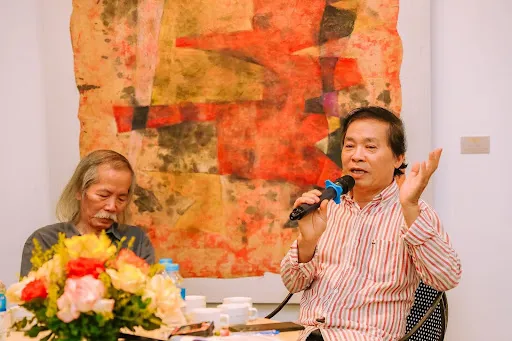
| Painter Nguyen Manh Quynh talks about the artworks painted on giang paper during a talk show in Hanoi. Photo courtesy of Vietnam Museum of Fine Arts |
Spiritual world’s material
The paper is made from giang tree, a type of bamboo, which is mainly used in rituals related to festivals and ancestor worship. It has a rough surface and is highly absorbent, which is perfect for watercolor painting.
Giang paper is associated with Pa Co Village of the H'Mong ethnic people in Mai Chau District, Hoa Binh province. This is an extremely important item in the spiritual life, associated with many cultural activities of this ethnic group.
Giang paper is taped to the wall opposite the front door, defining a place of worship for the homeowner. On the traditional New Year's Day, people draw charms on giang paper with chicken feathers to decorate the ancestral altar. Giang paper can be cut into small pieces to burn for the deceased.
The spiritual life of the H'Mong people cannot be complete without giang paper, the bond between the living and the dead and the bridge that connects the descendants with the ancestors.
Although in the beginning, the profession of making giang paper was only to serve the worship practices of a small community, in recent years, giang paper has quickly caught the eyes of visual artists and has become a particularly attractive creative material. The variable permeability and spillability create different random shapes and colors, helping giang paper to be compatible with a variety of materials, from natural to industrial. Giang's paper inspires and stimulates artists to experiment with unlimited creative possibilities.
Although the process of making a single piece of paper can take up to six months from the time the tree is cut down, it requires considerable effort, while the economic gain is not very significant. The H'Mong people did not trade in giang paper at first, but the demand from the artists motivated them to produce more, with more refined quality, which is also an effective way to help preserve the traditional craft.
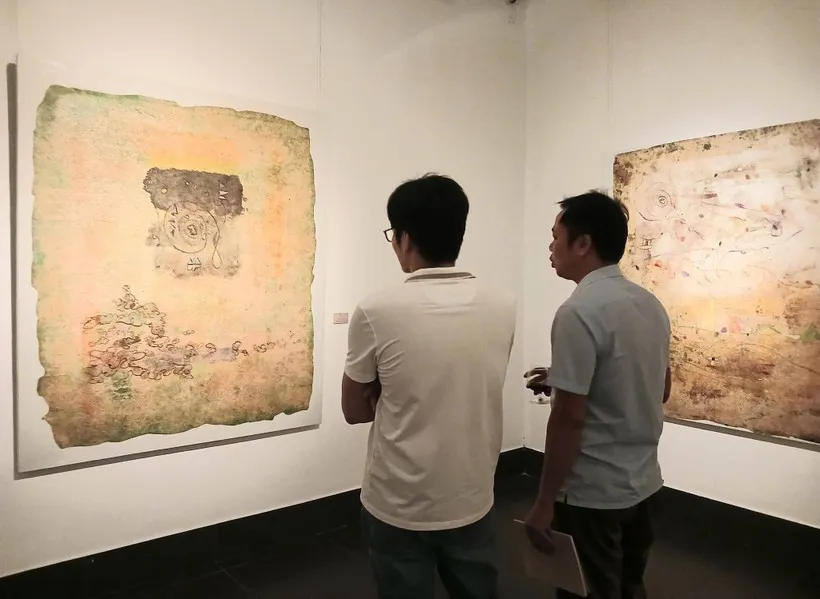
| Visitors contemplate Nguyen Manh Quynh's artworks on giang paper. Photo: giaoducthoidai.vn |
Modern features on traditional paper
Artist Nguyen Manh Quynh has been familiar with this type of paper since 2020. He was fascinated when he arrived in Pa Co and observed the locals gathering bamboo, processing it by hand, and using unusual methods to make paper.
"The surface of the paper changes with the light, resembling enigmatic layers of nature," Quynh said.
Artists are always passionate about finding new things, and in essence, giang paper is the new thing that contains constant creativity right in itself.
"When I stand in front of giang papier-mâché, I feel that the paper is in harmony with me, and I only need to follow the spontaneous emotions it evokes to be able to let my creativity fly endlessly and creatively," he said.
Vietnamese often draw on do (poonah) paper before attempting to embrace the global art form of painting on canvas. Currently, Nguyen Manh Quynh focuses on drawing on giang paper. The artist covers giang paper with canvas and then paints.
Artist Nguyen Manh Quynh said that each meticulous line on the artwork is the result of four years of effort to better understand the paper. The artist's inspiration for the content of the paper works comes from the life of the H'Mong ethnic people, such as the relationship between man and nature, gods, the universe, houses, and others.
| Some artworks by Nguyen Manh Quynh. |
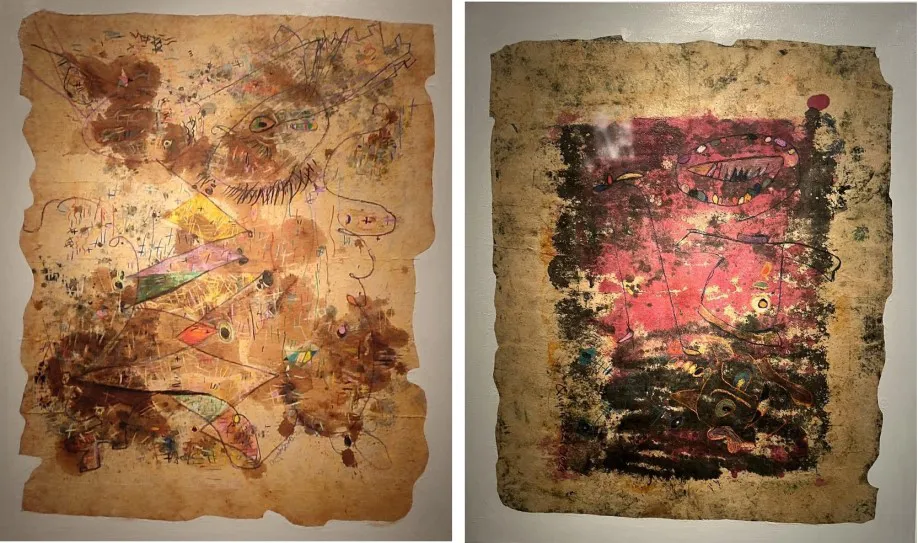
Commenting on Quynh's artwork, painter Dinh Quang Tinh said: "Mixing traditional and contemporary materials is a very challenging task. Adding modern art to ethnic materials requires a deep love for the subject. Nguyen Manh Quynh, an artist, can be seen as a link between art and the development of traditional handicrafts through his work on paper."
Poet and painter Nguyen Quang Thieu said that when he saw the first paintings by artist Nguyen Manh Quynh, he recognized signals from a world he did not know. That was the first reason his paintings captivated Thieu and drew him into their mysteries.
"The more time I spend with Nguyen Manh Quynh's paintings, the more expansive and boundless the world seems to me. I tried to find the end, but I failed. This is an extremely important characteristic of a work of art. The artist determines the nature of the materials to push them beyond their own limits because the materials themselves cannot establish anything," Thieu said.
According to Thieu, giang paper and colors have opened up ancient beauties of land, caves, houses, temples, and legends, but the images created by Quynh bring modern beauty to the artworks.
“Giang paper and Quynh’s drawings created the world named after Nguyen Manh Quynh, the world that defined him. That's why Quynh's paintings took me on a journey through different eras: ancient - present - future and vice versa," said Thieu.