Hanoi begins construction of Tran Hung Dao Bridge over the Red River
Hanoi has begun construction of the Tran Hung Dao Bridge over the Red River, a major project aimed at easing downtown congestion and improving regional connectivity by 2027.
THE HANOI TIMES — Hanoi has begun construction of the Tran Hung Dao Bridge, a 4.2-kilometer-long and 40-meter-wide project with a total investment of nearly VND16 trillion (US$607 million).
The bridge is expected to be completed by 2027, easing traffic congestion in the city center and enhancing connectivity with eastern Hanoi.

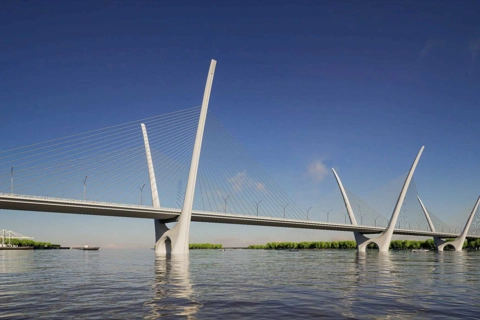
Architectural rendering of the Tran Hung Dao Bridge. Photo: Project investor
Tran Hung Dao Bridge construction is one of eight key infrastructure projects launched in celebration of the 71st anniversary of Hanoi’s Liberation Day (October 10).
The bridge will start from the Tran Hung Dao-Tran Thanh Tong intersection in Hoan Kiem Ward and end at Nguyen Son Street in Long Bien Ward.
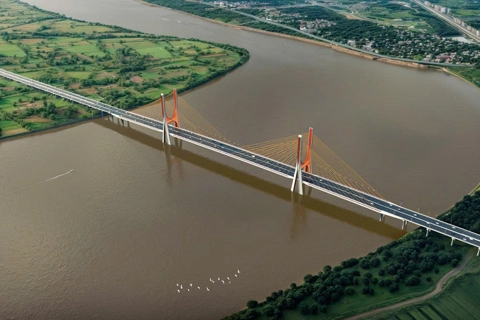
The main bridge crossing the Red River will span 870 meters, featuring six spans and a width of 43 meters, accommodating six lanes for motor vehicles, two bicycle lanes and two pedestrian lanes.
Approach roads on both sides of the bridge will extend 1.4 kilometers with a width of 25.5 meters – 30 meters.
The project also includes the construction of three major intersections: the grade-separated Tran Khanh Du-Nguyen Khoai intersection, the intersection with the Long Bien-Xuan Quan Road and a level junction with Nguyen Son Street.
Of the total investment, the costs for construction and site clearance are roughly equal, each accounting for about VND8 trillion ($303 million). The project is scheduled for implementation from 2025 to 2027.
According to Vice Chairman of the Hanoi People’s Committee Duong Duc Tuan, the Tran Hung Dao Bridge is among 18 planned crossings over the Red River.
Its completion will promote urbanization, redistribute population and reduce pressure on central Hanoi, he said at the groundbreaking ceremony on October 9.
“This project aligns with Hanoi’s long-term development orientation, connecting major transport corridors along both sides of the Red River and easing congestion on the Chuong Duong and Vinh Tuy bridges,” he said.
The bridge is expected to help complete Hanoi’s core transport network, form modern urban spaces on both riverbanks and strengthen inter-regional connectivity between the capital and the provinces to its east and northeast.
Currently, nine bridges span the Red River, including Thang Long, Chuong Duong, Vinh Tuy, Thanh Tri, Nhat Tan, Vinh Thinh, Long Bien and Viet Tri-Ba Vi.
Hanoi plans to build nine more bridges from now until 2050, including Tu Lien, Tran Hung Dao, Van Phuc, Hong Ha, Me So (Ring Road 4), the new Thang Long (Ring Road 3), Thuong Cat, Ngoc Hoi (Ring Road 3.5) and Phu Xuyen.
This year, the city has broken ground on three bridges: Tu Lien, Thuong Cat, and Tran Hung Dao.