Hanoi drafts multi-tier talent strategy to build digital elite workforce
Hanoi is shaping a long-term talent development strategy to build a two-tier workforce, from digital professionals to elite talent, while addressing youth concerns over education, startups and sustainable growth.
THE HANOI TIMES — Hanoi is drafting a comprehensive talent development scheme to build a two-tier workforce, from high-quality digital professionals to an elite pool of exceptional talent, according to the Hanoi Department of Science and Technology.
The scheme will meet the city’s long-term development needs and the demands of global enterprises, said Director Tran Anh Tuan of the department, at the 2025 dialogue between local authorities and Hanoi’s youth on December 17.
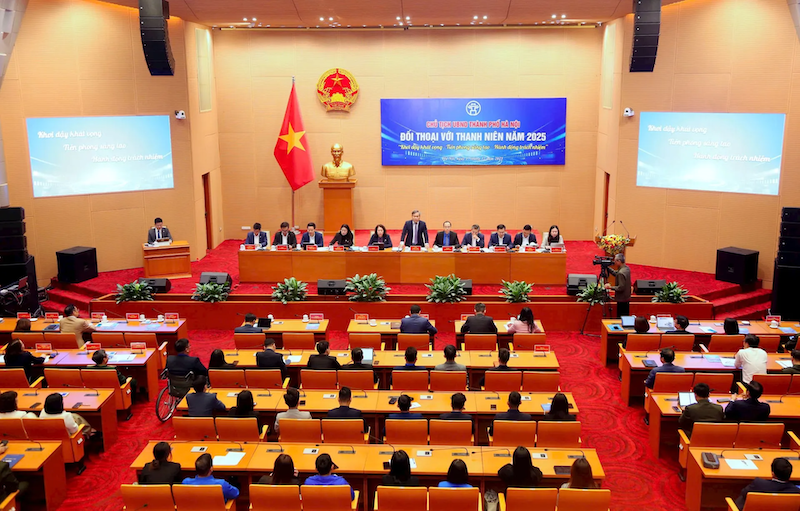
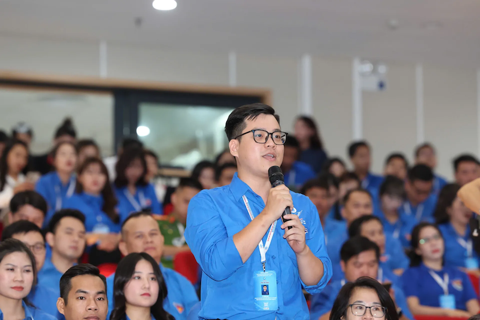
An overview of the 2025 dialogue with Hanoi’s youth on December 17. Photos: VGP
According to Tuan, the draft outlines several training pathways at different levels.
Under the first track, Hanoi plans to train about 50,000 high-quality digital professionals through a “training-by-order” model in cooperation with universities and academies.
The city will select outstanding second- and third-year students based on strict criteria and fund their targeted training in strategic technologies and priority sectors. After graduation, participants will commit to working for the city for a fixed period.
The second track, known as the “Next 1,000” excellence program, will focus on identifying top bachelor’s and engineering graduates in strategic technology fields from 2026 onward.
Hanoi will fully fund their advanced training at leading universities and institutions worldwide. In return, participants must work in Hanoi for at least five years after completing the program.
The third track will focus on elite talent development, including advanced programs for exceptional secondary school students, supported by artificial intelligence, digital tools and domestic and international experts.
Over the coming years, Hanoi plans to build a strong high-quality workforce to serve the city’s development first and meet the talent needs of global companies investing in the capital.
University relocation roadmap
The conference also addressed questions about Hanoi’s plan to relocate universities and colleges to suburban areas.
The conference also addressed questions on Hanoi’s plan to relocate universities and colleges to suburban areas. Nguyen Thi Viet Linh, a lecturer and Deputy Secretary of the Youth Union at Vietnam National University, Hanoi, asked about the roadmap and measures to ensure stable learning and living conditions for students.
Responding to the question, Nguyen Phi Thuong, Director of the Hanoi Department of Construction, said the city is developing a multi-center urban model. In this framework, Hoa Lac has been designated as a hub for science and technology, education and training and will host relocated universities, forming a new growth pole centered around the Hoa Lac Hi-Tech Park.
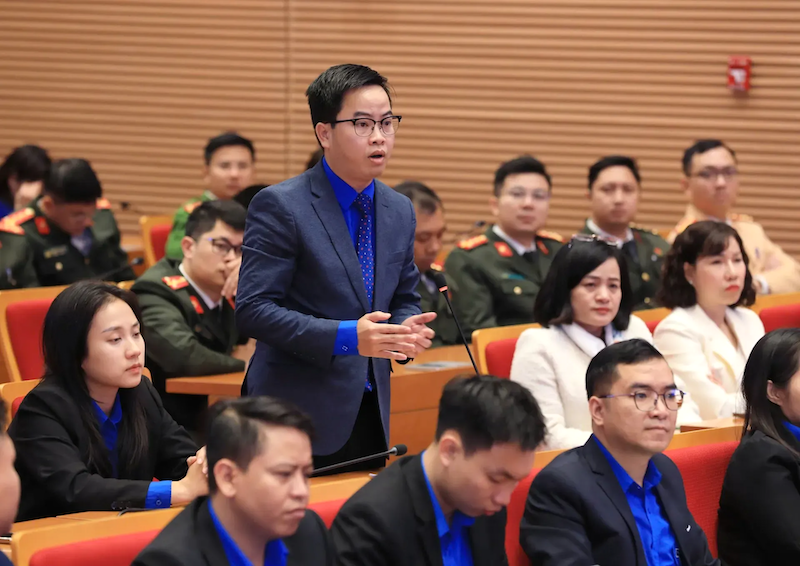
Hanoi’s young delegate voices his view at the dialogue. Photo: VGP
He added that Vietnam National University, Hanoi, has already moved part of its operations to Hoa Lac, while other institutions are preparing their relocation plans.
Thuong said the municipal People’s Council has approved a resolution requiring a phased relocation of higher education institutions, prioritizing large public universities. By 2030, Hanoi aims to develop university cities in Hoa Lac and other satellite areas, supported by synchronized infrastructure.
During 2025-2030, the city targets relocating major public training institutions, with around 200,000 students studying in new university urban areas linked to research, training and innovation centers, according to the director.
To support this vision, Hanoi is set to break ground on the Van Cao-Hoa Lac Metro Line No. 5 on December 19, with a total investment of VND74 trillion ($2.8 billion).
"The line is expected to be operational before 2030, serving as a key transport artery for Hoa Lac and surrounding areas," said Thuong.
Problems faced by young entrepreneurs
At the conference, many young delegates spoke candidly about the challenges they face in starting and growing businesses.
Tran Van Luc, CEO of Awake Drive JSC, said many young enterprises struggle from the very first stage, particularly with legal procedures such as business registration, intellectual property protection, tax compliance and contract signing.
He noted limited legal knowledge and resources have slowed the growth of promising startups and exposed them to unnecessary risks.
Drawing from this experience, he proposed that the city consider establishing a legal support center for young businesses and startups, or launching a “legal mentors for startups” program to provide guidance, legal templates and ongoing compliance support.
In the area of green and sustainable economic development, Bui The Quyen, Chairman of Truong Long Phat International JSC, said Hanoi’s push for ecological urban agriculture and modern rural development has created new opportunities for young entrepreneurs in high-tech agriculture.
However, access to land, infrastructure investment and market linkages remain major obstacles, he added.
He called for tailored policies on land use, infrastructure and value-chain connectivity to encourage long-term investment.
Responding to these concerns, Ta Van Tuong, Deputy Director of the Hanoi Department of Agriculture and Environment, said the 2024 Capital Law has eased land-use constraints in concentrated farming areas and allows construction of facilities serving production, product showcasing and experiential education.
"With some 1,350 craft villages, Hanoi offers potential for youth-led models to combine agriculture, eco-tourism and creative industries," he said.
On international integration, Nguyen Luong Tu, Vice Secretary-General of the Hanoi Young Business Association, noted that new-generation free trade agreements are opening doors for young firms to join global supply chains. "To seize these opportunities, stronger support is needed in trade promotion, international connections and brand building."
Vo Nguyen Phong, Director of the Hanoi Department of Industry and Trade, affirmed the city’s commitment to supporting young businesses in trade promotion, leveraging free trade agreements and expanding exports to promising markets, such as the Middle East, Africa and South America.
Wrapping up the conference, Vu Dai Thang, Chairman of the Hanoi People’s Committee, said 2025 will mark the first year of full implementation of the city’s 18th Party Congress Resolution.
He stressed that Hanoi’s youth are both the main beneficiaries of these policies and the driving force in adopting new technologies, building data platforms and shaping an innovation ecosystem that turns policy into practice.