Hanoi household businesses support e-invoice shift
Despite some difficulties in the early stages, most home businesses and freelance sellers in Hanoi comply with the new rule on using e-invoices.
THE HANOI TIMES — Home businesses and self-employed sellers in Hanoi support the government’s Decree No. 70, which requires the use of e-invoices generated from cash registers, according to the Sub-Department of Taxation – Area I.
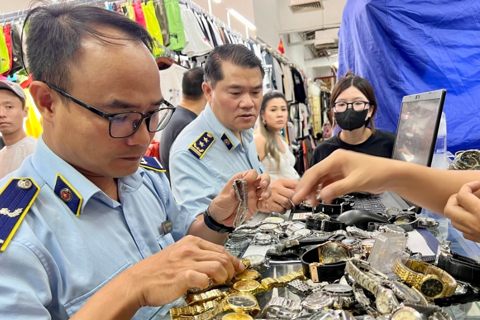
Tax officers perform their duties. Photo: Kinh te & Do thi Newspaper
The new policy, effective June 1, 2025, aims to promote greater transparency, efficiency, and modernization in business operations.
On June 17, the sub-department’s Deputy Director Nguyen Minh Tien told local media that nearly 4,400 household businesses and sellers required by the decree have registered to use e-invoices from cash registers.
Moreover, over 4,500 additional businesses and sellers, who are not yet legally obligated to do so, have voluntarily begun using e-invoices. In total, almost 9,000 home businesses and sellers have committed to making the switch, surpassing the set goal by 180%.
Currently, the sub-department oversees more than 311,000 businesses, households, and self-employed traders in Hanoi.
Of those, nearly 5,000 households with annual revenues exceeding VND1 billion (US$38,300) are required to use e-invoices generated from cash registers. This group accounts for just 1.6% of the total number of businesses under management.
Nguyen Thi Hanh, a vendor in Dong Xuan Market, said she and other sellers received guidance from tax officers on how to use e-invoices and cash registers.
Most sellers follow the rules and have equipped their stores with the necessary devices, she said.
Hanh acknowledged that e-invoices are convenient and save time. However, she is concerned about invoices for purchasing supplies and products.
"I’ve bought items from other individual sellers without any receipts. Without input bills, my business becomes illegal,” she said.
Nguyen Minh Tien from the Subdepartment of Taxation – Area I said that the policy does not change any existing tax obligations or disrupt business operations, despite some fears to the contrary.
"The tax sector has helped household businesses and sellers understand and implement the policy correctly, moving towards a more transparent, fair, and modern business environment," he said.
Before the policy came into force, Hanoi tax authorities conducted extensive outreach, including workshops, training sessions, and door-to-door support for local businesses. Communication materials, such as articles and instructional videos, were also published across media channels.
Tien acknowledged that many businesses were unfamiliar with the policy and new technologies at first. "In this initial period, our focus is on education and support, not penalties. However, in cases of deliberate noncompliance, we will enforce penalties as required by law.”
He added that confusion remains among vendors and traders because media outlets have reported cases of shops closing or scaling back operations in markets such as those in Ninh Hiep, Dong Xuan, Long Bien, and La Phu, as well as on commercial streets like Hang Ngang and Hang Dao.
In May and June, over 2,900 household businesses in Hanoi temporarily suspended operations. Of those, only 263 were required to issue e-invoices, accounting for 8.8% of businesses that suspended operations and 5% of those subject to the decree.
He attributed many business suspensions to concerns about inspections for counterfeit goods rather than to the tax policy itself.
Others worry that they might be taxed retroactively if their actual sales turn out to be higher than the amount they declared to the tax authorities when using e-invoices.
According to the tax authorities, lump sum taxes are determined based on data from the tax authority combined with business declarations, as outlined in the Law on Tax Administration and Circular 40/2021/TT-BTC.
If a business's revenue for the year differs by more than 50% from the revenue they declared, they may request a tax adjustment, which will only apply from the time of the revenue change onward.
The Sub-Department of Taxation – Area I encouraged businesses to clearly understand tax policies to fulfill their responsibilities to the state budget. Officials will manage business revenues by industry to determine appropriate tax levels.
Business owners are also advised to request invoices when purchasing goods and services for commercial use to support the government's efforts against counterfeit and low-quality products and to enable origin traceability.