Net Zero – who really owes whom?
As Vietnam pushes toward net zero, bearing the brunt of climate change with limited resources, a deeper question arises: In the global climate equation, who really owes whom?
THE HANOI TIMES — Standing on a muddy stretch of coastal dike in Soc Trang last weekend, I watched university students from Cantho, rangers, and local volunteers wading waist-deep in sludge to plant young mangrove trees, vital for wave prevention and climate regulation.
It was a stark image, and it awakened something in me: a deeper consciousness of climate change.
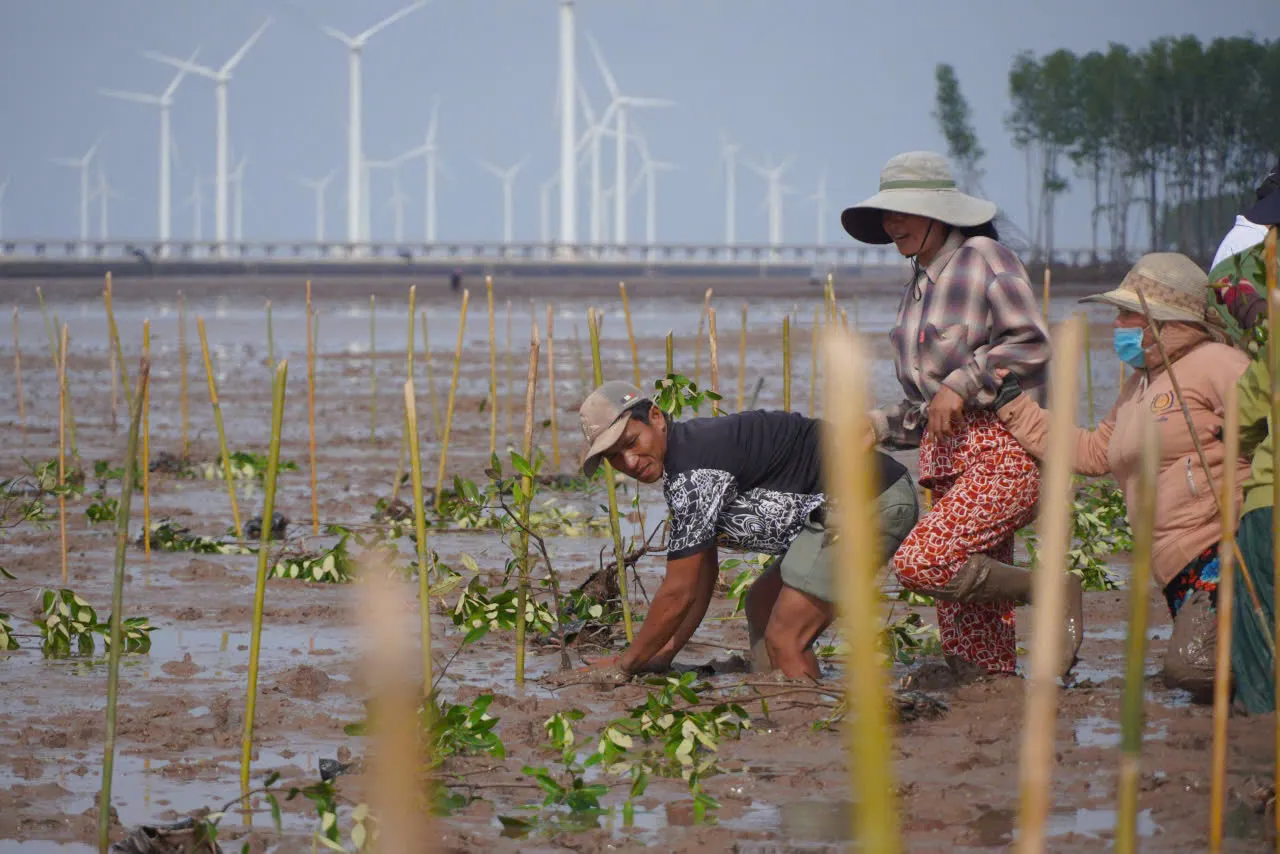
Local residents plant young mangrove trees to buffer waves and regulate the climate along a coastal dike in Soc Trang. Photo: Tu Giang
These trees, including mam, duoc, ban, are the frontline defense in Vietnam’s battle against rising seas and storms. Behind the dike, a few tin-roofed houses, weathered and humble, dotted the landscape. They are homes to locals who, like generations before them, rely on the sea for survival.
Offshore, the horizon was lined with giant wind turbines, some spinning, others motionless. Each one costs between US$2 million and US$4 million to build. And there, in the contrast between modest mud-covered efforts on land and towering wind power installations offshore, lies a portrait of Vietnam’s fight against climate change: a country striving toward Net Zero… amid poverty.
The poor bear the heaviest costs
Vietnam ranks among the ten countries most vulnerable to climate change. The Cuu Long Mekong Delta, in particular, faces a dangerous mix of rising sea levels, its low-lying geography, and heavy dependence on upstream water from outside its borders.
International environmental organizations have warned that if sea levels rise by one meter under a high-emission scenario, 15,000 to 20,000 square kilometers, about 40% of the entire Delta, could be submerged.
At the 2021 COP26 Climate Summit, Vietnam pledged to reach net-zero emissions by 2050. Since then, wealthy nations have raised their climate finance commitments from US$100 billion to US$300 billion annually, aimed at helping developing countries cope with the climate crisis.
Vietnam is among the recipients. Through the Just Energy Transition Partnership (JETP), the country is promised US$15.5 billion in loans over the next three to five years to support urgent energy transition needs.
However, according to research, these loans carry interest rates similar to standard ODA loans for developing countries and fall far short of the massive capital Vietnam needs for energy development.
According to the updated Power Development Plan VIII, approved by the Vietnamese Government in April, the country will require US$266.3 billion over the next decade to develop its power generation and transmission infrastructure. That’s nearly US$27 billion per year, many times the JETP commitment, just to meet green energy goals.
Meanwhile, Vietnam’s primary energy consumption per capita, which refers to the total amount of raw or unprocessed energy used before conversion into electricity, heat, or other usable forms, remains low: just 58% of the global average, 26% of the Organisation for Economic Co-operation and Development (OECD), 32% of the EU, 60% of Thailand, 18% of South Korea, 7% of Singapore, 34% of Malaysia, and 40% of China.
And Vietnam contributes just 0.8% to global CO₂ emissions.
In short, we’re a low-emission, energy-thrifty developing country, and yet one of the most severely impacted by climate change.
So, who really woes whom?
I’ve raised this question “Is this fair?” “Who really owes whom?” with officials from donor countries at press briefings in Hanoi. No one ever gave a satisfying answer. Unsurprisingly, no one would be reckless enough to directly answer such a divisive question.
Thankfully, that question was addressed at a recent roundtable organized by the Kinh te & Do thi newspaper, ActionAid Vietnam, Cantho University, and the Vietnam Fund for Social Protection Programs (AFV).
Associate Professor Dr. Van Pham Dang Tri, Director of the Institute for Climate Change at Cantho University, said:
“Of course, developed countries have historically emitted far more CO₂ than we have. As a developing country, Vietnam contributes far less. If we look at it that way, developed countries actually owe us more because they’ve polluted more. So, their investments in us are just a way of paying back that debt.”
His point aligns with ActionAid’s newly released report, Who Owes Who?
According to the report, by 2025, 54 countries are expected to be in debt distress, forced to cut spending on health, education, and climate adaptation to repay foreign debt.
Low- and lower-middle-income countries collectively owe US$1.45 trillion in external debt. In 2023 alone, they repaid US$138 billion, a sum exceeding the entire health budgets of 75% of these nations.
Meanwhile, the richest countries, the biggest emitters that have long exceeded their fair share of atmospheric space, have yet to repay their “climate debt.” That bill is estimated at US$107 trillion, 70 times more than the debt burden carried by poorer nations.
To gradually repay this climate debt by 2050, rich countries would need to transfer over US$4 trillion annually, nearly 30 times the current rate of climate finance.
The global imbalance of power allows poor countries to be forced to repay their debts, while the climate debt of wealthy nations remains entirely unenforced.
Even the 2015 Paris Agreement’s pledge of US$100 billion per year, and the updated US$300 billion announced at COP29 in 2024, mainly refer to loans, not grants and still come with vague terms.
As rich countries delay action, the debt system itself is fueling the climate crisis. To earn the dollars needed to repay loans, poorer nations must extract more natural resources, expand chemical industries, push agricultural exports, and often deforest and degrade their environments. Worse, they’re charged higher interest rates because of their “credit risk” status.
So, the once-rhetorical question “Who really owes whom? Who profits from the current system? Who keeps it alive?” now has a painfully clear answer.
However, turning that answer into concrete action by developed nations, especially in relation to developing countries like Vietnam, is a long road, one that likely has no easy or foreseeable end.
Still, watching those volunteers in Soc Trang, students, rangers, and locals, planting mangrove saplings with muddy hands, I saw Vietnam’s approach in motion.
We may not have the luxury to wait. We must adapt. We must act.
Because no one’s coming to save us.