Hanoi industrial production growth slows to 4.44% in Q1
Such a growth pace is the slowest in many years, due to growing impacts of the Covid-19 pandemic.
Hanoi`s Index of Industrial Production (IIP) in March expanded 0.9% month-on-month and 4.7% year-on-year, leading to an increase of 4.44% year-on-year for the first quarter, according to the Hanoi Statistics Office.
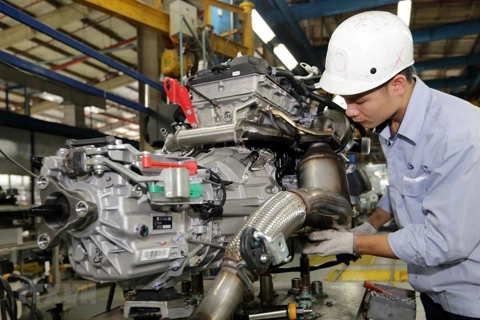
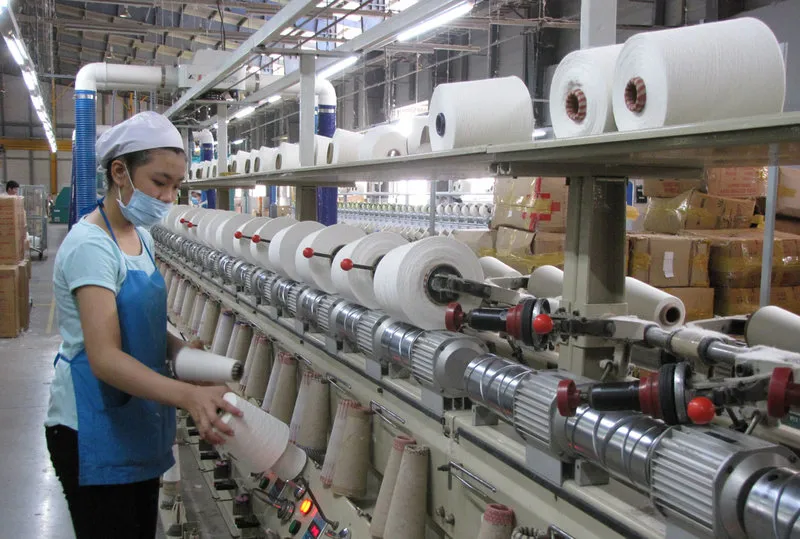
| Illustrative photo. |
The first-quarter growth pace is the slowest in many years, due to growing impacts of the Covid-19 pandemic, compared to an expansion of 6.71% recorded in the January – March period last year, said the municipal Statistics Office in its monthly report.
The report suggested a disruption of global supply chains due to stalled production in China has led to a shortage of input materials for local industrial sectors. As a result, companies are forced to scale down or even halt operations.
Upon breaking down, the mining industry’s output saw a decrease by 15.3% year-on-year in the first quarter, while the manufacturing and processing industry expanded 4.3%, respectively.
Production and distribution of electricity rose 5.9% year-on-year; water supply, sewage treatment and water collection was up 7.1%.
Major industrial subsectors that saw their output down in the January – March period were beverage (-22% year-on-year), textile (-3.7%), electricity equipment (-5.8%), machinery (-11%).
Meanwhile, other subsectors have increased sharply due to growing demand during the pandemic, including food processing up 6.8% year-on-year, medicine and drugs up 32.4%; and electronic products up 23.5%.
In March, Hanoi’s consumer price index (CPI) declined 0.89% month-on-month but was up 0.1% against last December and 4.36% year-on-year.
As a result, the average CPI of the first quarter grew 5.23% year-on-year.
Statistics revealed eight out of 11 commodity groups, which are components of the basket for CPI calculation, witnessed monthly decreases in prices, with transportation posting the highest decline of 4.19%, followed by culture, tourism and entertainment with 2.97%; food and catering services with 0.77%.
As of March 23, Hanoi attracted US$646.4 million in foreign direct investment (FDI). Of the total, the city government approved 170 new projects and other 36 received additional capital worth a combined of US$389 million, while foreign investors contributed US$257.4 million in capital to other projects.
Total retail sales of consumer goods and services in Hanoi in the first quarter are estimated at VND135.7 trillion (US$5.78 billion), up 2.3% year-on-year, much lower than the growth rate of 10.1% in the same period last year.
As tourism is among the hardest hit sectors by the Covid-19 pandemic, the number of foreign tourists coming to Hanoi declined 36.9% year-on-year to 756,000 during the period, while that of domestic tourists stood at 1.9 million, down 33.6%.
In the January – March period, Hanoi’s exports reached US$2.74 billion, down 18.1% year-on-year, while imports were down 21.3% to US$5.83 billion, resulting in a trade deficit of US$3.09 billion.
The city's state budget revenue reached VND67.5 trillion (US$2.87 billion), up 9.4% year-on-year, of which revenue from crude oil reached VND518 billion (US$21.91 million), down 39%, and domestic revenue reaching VND67 trillion (US$2.85 billion).
Hanoi’s gross regional domestic product (GRDP) growth is estimated at 3.72% in the January-March quarter, lower than an expansion of 6.99% recorded in the same period last year.
This makes the growth target of 7.5% onwards in 2020 an increasingly difficult task.