Hanoi intensifies efforts to achieve its digital goals by 2025
In Hanoi, digital transformation is always a top priority to support management and resolution procedures for people and businesses.
Hanoi has issued a resolution to achieve 15 digital transformation goals by the end of 2025 to become a smart city based on three main pillars: digital government, digital economy, and digital society.
By 2025, Hanoi is expected to lead ASEAN in data science and artificial intelligence, with all government processes fully accessible online in the fourth stage of the four-stage system, including through mobile devices.
The capital expects full connectivity and data sharing between specialized and national databases on population, land, business registration, finance and insurance.
It aims to achieve a digital economy share of around 30% of GDP by 2025. The target for labor productivity growth is set between 7% and 7.5%. In addition, Hanoi aims to build a robust innovation start-up ecosystem in the country.
Helping citizens to use online public services in Hai Ba Trung District. Photo: VGP |

Nguyen Viet Hung, Director of the city's Department of Information and Communications, said Hanoi's digital transformation is moving very fast.
"Departments, sectors and districts have many initiatives that contribute to the city's digital transformation in all three pillars: building a digital government, promoting the digital economy, and developing and fostering a digital society and digital citizens. As of September, 8 of the 15 goals have been completed, accounting for over 50%," Hung said.
In order to support the operation of all the city's public services and applications according to the pillars of the digital economy and digital society, he said Hanoi plans to develop digital infrastructure and build the municipal CLOUD network, an exclusive cloud infrastructure dedicated to the city.
"Hanoi's leaders also emphasized the need to create an enabling environment that encourages businesses to operate digitally and facilitates the creation of successful digital products," Hung said.
This includes encouraging the involvement of major technology companies and other investors in deploying smart technology solutions, such as artificial intelligence and data analytics, to address the city's fundamental challenges.
Many positive results
As the administrative center of the country, Hanoi has always identified digital transformation as a top priority to support management and resolve procedures for people and businesses. The city government has been actively exploring ways to implement its digitalization plan and has made remarkable progress, Hung said.
Hanoi is the first subnational entity to issue a resolution waiving fees for online public services until 2025.
For the first time, the city's leaders have fully authorized digital signatures on the shared document management software system. All city offices prioritize conducting transactions in the online environment.
Some 10,000 digital signatures have been registered free of charge for Hanoi citizens to use online public services. Photo: Cong Hung/The Hanoi Times |

Seven municipal information databases and 14 national information databases have been connected to Hanoi's local government service platform.
In June 2024, the capital launched a series of information systems and applications for citizens and businesses, most notably the Digital Capital Citizen Application (iHaNoi), which puts people and businesses at the center of services and improves communication between the city government and citizens.
In the transportation sector, Hanoi has installed GPS devices on buses to monitor the operation of the city's bus system. Radio Frequency Identification technology has been used to manage, administer and inform passengers of traffic conditions in selected areas via loudspeakers and LED panels. Passengers also benefit from a bus locator application and an online ticketing system.
The Hanoi Traffic Ticket application, which uses dynamic QR codes, is being tested for public passenger use throughout the transportation system.
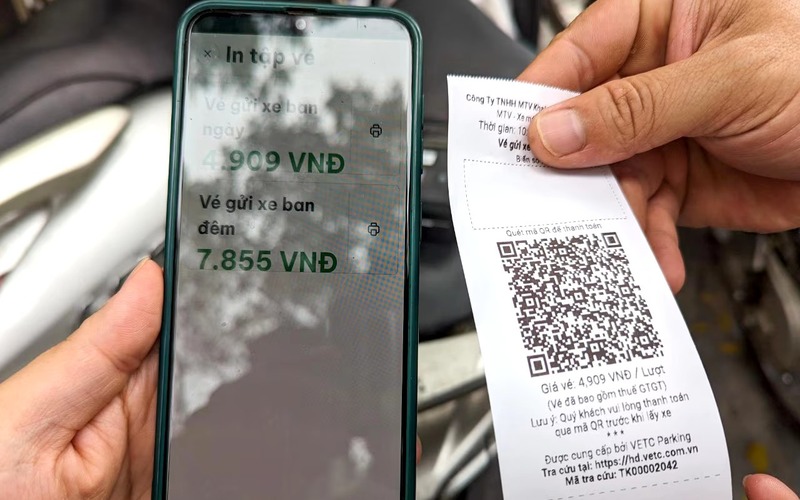
The city is also piloting cashless vehicle parking, aiming to create transparency in fee collection and reduce congestion in the city center.
The Hanoi Agro-Forestry-Fisheries and Food Traceability System (check.hanoi.gov.vn) has been set up in the agricultural sector, and mobile devices can now use QR codes to trace the origin of One Commune One Product (OCOP) products. These measures enhance the safety and reliability of Hanoi's agriculture, forestry, fishery, and food products. In addition, efforts are underway to establish a common database for the agro-industry.
In the financial sector, Hanoi has developed comprehensive software to monitor the execution of investment projects funded by the state budget.
The city has deployed electronic health records that manage medical examinations and treatment, linking 661 medical facilities and Vietnam's social security system.
Digital transformation in sectors such as tourism, culture, sports, natural resources, environment, planning, architecture and construction has also made significant progress.
Barriers and obstacles
Experts emphasize that digital transformation is a new and complex field, and despite the positive results, it poses significant challenges for Hanoi. The city's vast territory and large population make it difficult to build a smart city.
According to Ha Minh Hai, Vice Chairman of the Hanoi People's Committee, despite great efforts, there are still some obstacles in the way of digital transformation, such as insufficient human resources in information technology (IT).
QR code to pay the parking fee to the parking operator's account. Photo: Anh Kiet/The Hanoi Times |
"Communes have no regulations on specialized personnel for the field, while the workload is increasing and the requirements are getting higher. Hanoi is strengthening its resolve to accelerate digital transformation with many solutions," Hai said.
The Hanoi government also asked the sectors to urgently promote the training and improvement of knowledge and skills of IT staff specializing in IT and digital transformation in the units.
"Moreover, the Municipal People's Committee is building a mechanism to attract talent to the city's government departments, especially in the fields of information technology and digital transformation," the vice chairman said.
Nguyen Nhat Quang, Vice President of the Vietnam Association for Software and IT Services (VINASA), listed a number of problems that need to be solved, including the absence of precise ideas, policies, and legal frameworks for digital government, digital economy, and digital society.
"Overcoming these challenges and ensuring a change in mindset will enable Hanoi to make rapid progress. The lack of an effective and safe investment mechanism is also a major obstacle to the implementation of specific digital projects. Without addressing these issues, it will be difficult to achieve the city's digitalization goals set for 2025," Quang told The Hanoi Times.