Hanoi Old Quarter master plan to address challenges in preservation
The Hanoi Old Quarter contains great values of culture, history and architecture for the capital and the whole country.
With the rapid development of the urban area, the preservation of the Hanoi Old Quarter has faced a spate of challenges, thus the zoning plan of this area for approval needs to solve them, according to local media.
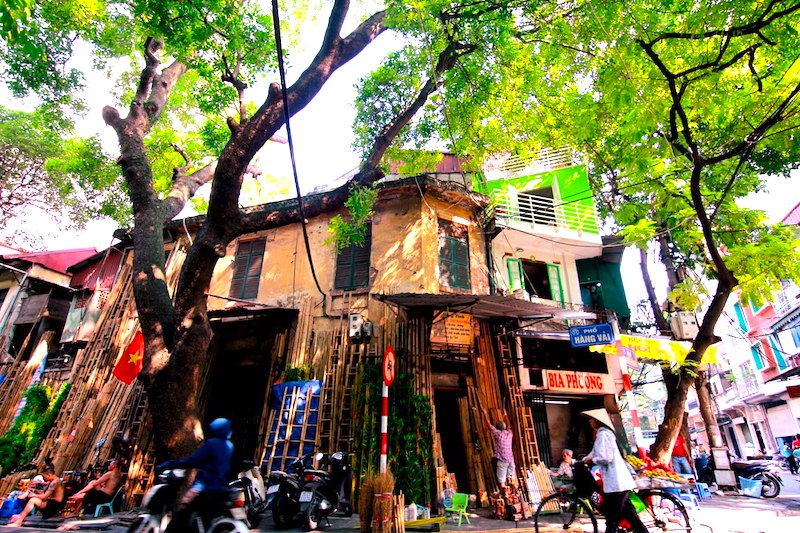
Hang Vai street near Hanoi Old Quarter. Photo: Ho Ha/Kinh te & Do thi |
Difficulty in preserving space and architecture
The Hanoi Old Quarter covers an area of 82 hectares, 10 wards, and 78 streets in Hoan Kiem district. With a population of more than 66,000 people, the population density stands at 823 people per hectare, well above the 2020 target of 500 people per hectare, according to a master plan. This is also one of the main causes of the overload and serious degradation of the urban living environment at the Old Quarter.
Mr. Tran Ngoc Chinh, chairman of the Vietnam Urban Planning and Development Association, said that the old town is the center of Hanoi, not just of Hoan Kiem district. The need to have special regulations, policies and legal basis to manage such a large heritage is an urgent issue for Hanoi.
Ms. Tran Thi Thuy Lan, deputy director of the Hanoi Old Quarter Management Board, said that the Old Quarter has a special place in the historical center of the city, associated with the Thang Long - Hanoi development process. With these values, the old town was classified as a national monument in 2004, a condition that has facilitated the concentration of resources, the implementation of many initiatives and solutions to preserve, beautify and promote heritage values as well as enhance trade - tourism.
In addition to the achievements, the Hanoi Old Quarter space faces many challenges, especially the conservation and development dilemma. Located in the center of the capital, the population density of the Old Quarter is extremely high, which poses difficulties to the preservation of spatial morphology and landscape architecture, while measures to improve living conditions within deteriorated and old houses have not been synchronized. However, at the same time, it is prone to bustling economic activities and diverse culture.
Head of the Socio-Cultural Committee under the Hanoi People's Council Nguyen Thanh Binh stressed the importance of raising the level of conservation and promote the value of Hanoi's old town, so that this place is recognized as a special national relic, world heritage and a “living museum.”
The planning of the old town needs to include technical and social infrastructure works such as public spaces, schools, car parks, underground spaces, environment protection and the creation of comfort and convenience for residents, according to Ms. Binh.
Jointly protect the cultural and architectural values
Bao Khanh street near Hoan Kiem lake. Photo: Vietnamnet |
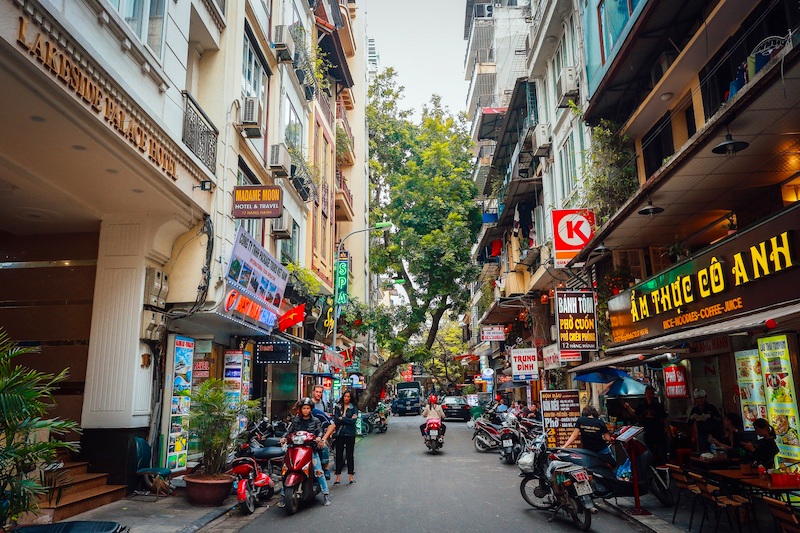
In order to protect the architecture of the old town in the best way, the role of its residents is key, Assoc. Dr. Nguyen Truc Anh, director of Hanoi Department of Planning and Architecture, said, adding that communication work to protect the cultural values of the old town, especially the architecture of the space, should be enhanced.
Once the local residents realize the importance of protecting traditional cultural values, there is nothing better than linking their own economic and social interests with protection work, according to Mr. Truc Anh. Therefore, there should be a mechanism to involve private resources for the protection and exploitation of ancient houses. In addition, it is necessary to map out programs to assess the impact of tourism activities and development on architectural values of the Old Quarter to have a reasonable allocation plan and minimize adverse impacts.
The master plan on building Hanoi toward 2030 and with a vision to 2050 with focus on the historic inner city area, especially the Old Quarter, stressed the need of renovation, preservation and promotion of the values of the historical quarter, improving the system of social and technical infrastructure in the area; avoid building high-rises, and preserving the characteristics and old urban structure.
So far, the municipal Department of Planning and Architecture and the Hanoi Construction Planning Institute are studying the formulation and appraisal of Urban Zone Planning H1-1A (Hanoi Old Quarter), and submitted to the city People's Committee for approval.
The master plan encourages the development commerce, services, hotels, traditional trade streets in the old town area to promote the image and attract domestic and international demand; relocating unsuitable production facilities and repurposing land use functions, preserving community spaces, applying green architectural solutions, and building more urban facilities.
Under the master plan, the pedestrian space would be expanded to the entire old town area, connecting with the walking space of Hoan Kiem lake and its vicinity, and pagodas and temples would be restored.
The master plan also contemplates the conservation of the street facades. Seven craft streets have been identified for preserving the traditional production and trade. The facade of the remaining streets will be restored to the original one. The construction of new houses is allowed but must respect the traditional features of the town and ensure harmony with traditional architectural styles.
Mr. Truc Anh added that the Hanoi Institute of Construction Planning has taken into consideration opinions from local authorities, organizations, individuals, communities, the Ministry of Construction as well as the instructions of the City People's Committee to improve the plan. Once it is approved, this will be the basis for the comprehensive management and development of this area.