Hanoi pioneers in using interoperable smart cards for public transport
The system of interoperable cards in Hanoi has been improved to increase the efficiency of public transportation.
Hanoi will use interoperable smart cards for public transport from January 1, 2025, becoming one of the first cities in the country to apply the system, according to Do Viet Hai, Deputy Director of the city's Department of Transport.
The Vietnam Government Portal quoted Hai as saying that the interoperable smart card system integrates modern features and provides many conveniences for people. "People can use their citizen ID cards to ride public transportation. Biometric technology is used to help passengers get on and off public transportation safely and quickly."
A girl uses a smart card for a bus ride in Hanoi. Photo: Hung Khai/The Hanoi Times |
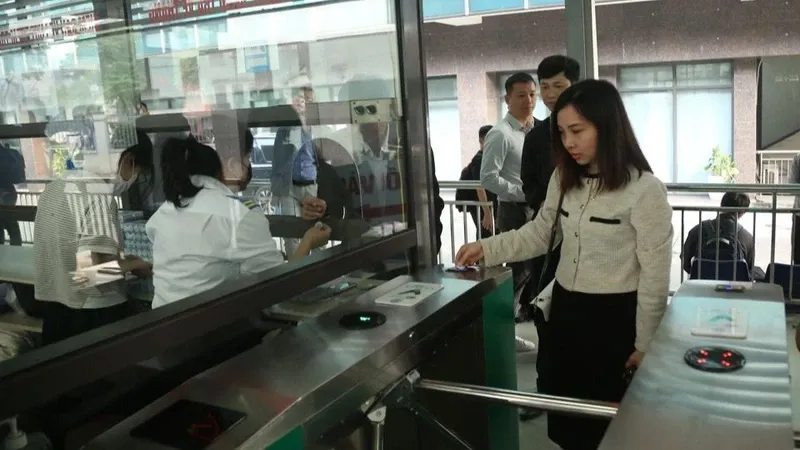
He said that many large domestic and international companies, such as Mastercard, Visa, Viettel, VNPT and FPT, have expressed interest in and cooperation with the project. They have committed to increasing their investments in this system. However, the system still needs to be expanded and improved to meet public expectations and increase the efficiency of public transportation.
The Intelligent Transportation System (ITS) will effectively support government management, ensure transparency, help reduce traffic congestion and environmental pollution, and save costs. One of the most important achievements is that traffic management and operations are performed on a digital platform through an intelligent traffic control center that fully connects the necessary components and functions.
"In addition, intelligent transportation allows for the collection of inputs for a large database, opening up the potential for the exploitation of information, an extremely valuable resource in the context of increasingly depleted natural resources. This system is a solution for the present and an important foundation for the sustainable development of Hanoi's transportation sector in the future," Hai stressed.
Hanoi's Transport Department in mid-2024 launched the ITS, which is expected to ensure traffic safety and order, cut travel costs and time, and protect the environment.
The deployment of ITS is part of the digital transformation plan adopted by the Hanoi Party Committee, which aims to make the capital a smart and modern city connected to a global network of smart metropolises by 2030.
On-duty traffic police officers handle traffic offenses through the surveillance camera system at the Hanoi Traffic Control Center. Photo: VNA |
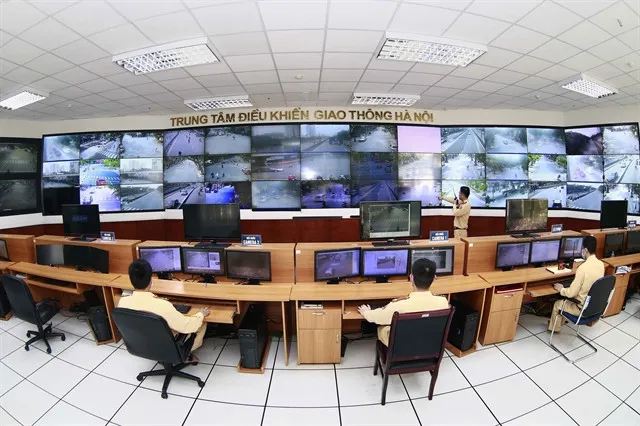
Meanwhile, Thai Ho Phuong, Director of the Hanoi Traffic Management and Operation Center, told Hanoimoi Newspaper that Hanoi's ITS integrates technologies in the management and operation of the traffic system with traffic surveillance cameras, speed cameras, and variable message signs (VMS).
"Hanoi's ITS roadmap will consist of three phases: Phase 1 (2024-2026) will see the installation and operation of the Traffic Operations Center; Phase 2 (2027-2029) will involve the expansion of the Traffic Operations Center; and Phase 3 (2030) will focus on sustainable development," Phuong said.
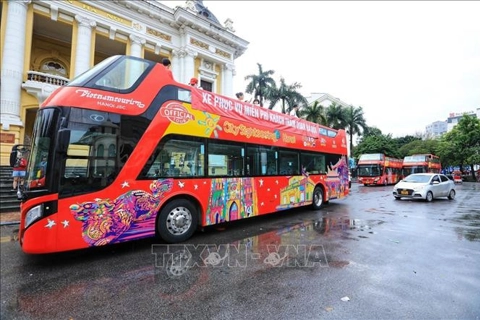
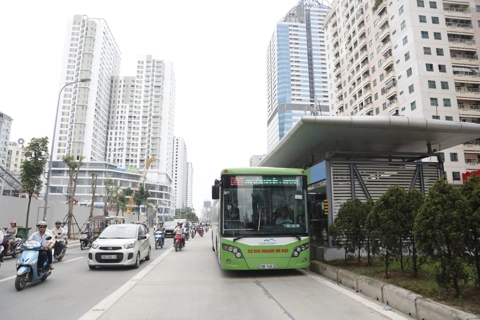
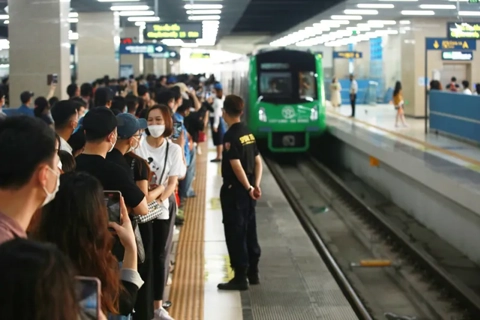
A common technical platform will be developed for all modes of public transportation in the capital, including Bus Rapid Transit (BRT) buses, regular buses, and metro lines.
In the future, the e-ticket can be used as e-money in many shopping malls in Hanoi. In this way, the project will lay the foundation for a smart city in the years to come.
"Given Hanoi's traffic congestion, increase in traffic accidents, and deteriorating air quality, the development of public transport such as urban railway lines, BRT, and expansion of the city's regular bus network will be pushed forward," the official said.
Phuong emphasized the need for an initiative to develop common rules defining the technical details of an interoperable automatic fare collection (AFC) system for settling payments between different transport operators.
The Kinh te & Do thi (Economic and Urban) Newspaper quoted Nguyen Phi Thuong, Director of the city’s Department of Transport, as saying that the introduction of electronic bus tickets is in line with Hanoi's digital transformation strategy to build an intelligent transport system.
"It is a leap forward in making services more convenient for passengers. The gradual introduction of the electronic bus ticketing system is the core component to lay the foundation for building a smart traffic system in the capital city," Thuong emphasized.
He noted that by facilitating sales and control, the electronic bus ticketing system encourages people to use public transportation services. “People can easily manage their travel expenses and track their travel history. It's all done through an application that is updated in a smart and convenient way.”
This is how digital transformation improves the quality of public transport services, and is a prerequisite for interoperability of tickets across all modes of public transport. "Interoperable smart cards will help to increase the number of public transport users in the future, contributing to the city's project to improve public transport and reduce the number of private vehicles in the city," Thuong said.
Regarding the roadmap, the director noted that the technical system of interoperable cards will be available for the bus network in 2025. After that, it will be used with Cat Linh-Ha Dong and Nhon-Hanoi Station metro lines in 2026.