Hanoi real estate market: Developing in right direction
The price increase for apartments in Hanoi in the first half of 2024 compared to the beginning of 2023 is 31%.
Experts suggest that Hanoi's real estate market is currently at a turning point, poised for significant growth and stabilization over the next one to two years.
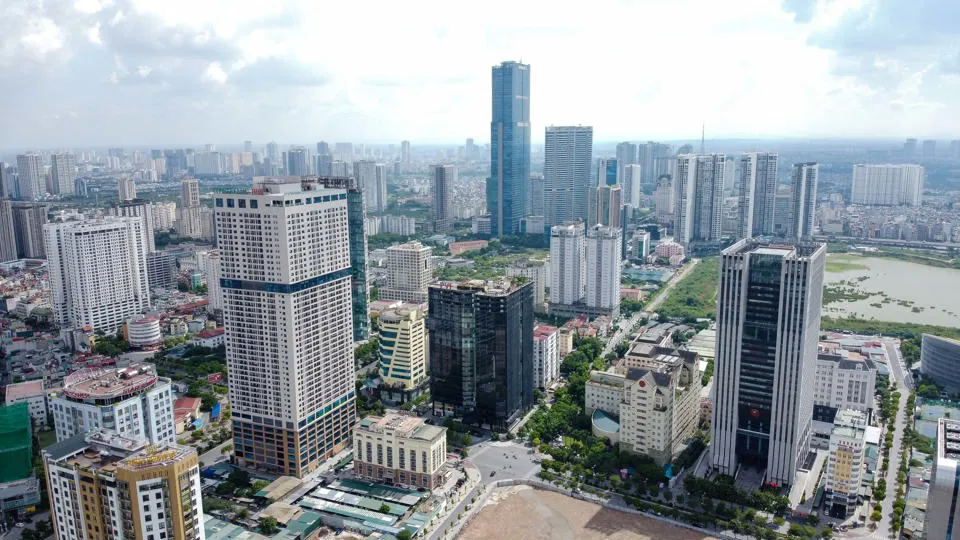
| Hanoi from above. Photo: Huu Thang |
Nguyen Quoc Anh, Deputy General Director of the real estate website Batdongsan.com.vn, stated that the concept of a "turning point" was introduced in December 2022, based on statistical data and market research of various development cycles.
“In the previous cycle, this point came in mid-2013 when inventory values fell 15% after seven consecutive years,” Anh said.
According to Anh, the first factor leading to a turning point is credit. In 2013, credit growth targets were revised upwards for the first time, reaching over 12%. The second factor is interest rates; in early 2012, banks cut interest rates significantly, and about 1.5 years later, the market started responding. The last factor is policy changes. “Three important laws—the Land Law, the Housing Law, and the amended Law on Real Estate Business—were passed by the National Assembly in 2013 and 2014,” he explained.
He noted that the three factors mentioned above are similar to those in the previous real estate market cycle.
First, Vietnam's credit growth target for 2024 remains high at 14-15%. Although credit growth was quite low at 2.4% in the first five months of 2024, there are now signs of improvement compared to the beginning of the year.
Second, policy interest rates have been continuously reduced since early 2023, with lending rates currently at 9-11%. In the short term, pressure from exchange rates and deposit levels has slightly increased deposit rates by about 0.2-0.9% per year. However, in the long run, interest rates are expected to remain low.
Third, revised laws related to real estate, such as the amended Land Law, the amended Housing Law, and the amended Law on Real Estate Business, have been passed by the National Assembly and will take effect on August 1st.
“We maintain our view from the end of 2022 that the real estate market will reach a turning point by mid-2024. Thereafter, the market will go through stages of exploration, consolidation, recovery, and stabilization. At each stage, buyer sentiment, the development trajectory of different types of real estate, and solutions for businesses to seize opportunities will vary," said Anh.
Sharing this view, Associate Professor Dr. Tran Kim Chung, former Deputy Director of the Central Institute for Economic Management, predicted that the real estate market will strengthen in the second half of 2024, going from good to very good.
“With three real estate-related laws taking effect five months ahead of schedule, the market will move out of a wait-and-see mode,” Chung noted.
Additionally, the stable economic development and accelerated public investment, with large amounts of capital being disbursed, will benefit the real estate market.
Meeting actual needs
Vice Chairman of the Vietnam Association of Realtors Nguyen Chi Thanh noted that the market is currently showing many positive signals, especially for housing projects with well-developed urban infrastructure and improved living standards. Even projects in remote areas with good transportation connections are attracting the attention of buyers with real housing needs.
Many other experts agree that this is a time when both buyers and investors are cautious due to recent challenges such as difficulties in obtaining real estate loans and the lack of liquidity in many investments. Therefore, they prioritize factors such as real housing needs, clear legal frameworks, good financial support policies, stable rental yields, and optimized costs.
Anh from Batdongsan.com.vn emphasized that during the "turning point" and exploration phases, apartments attract the most interest and have the highest liquidity among real estate types. Data from the previous cycle also shows that apartments developed strongly during this period. Specifically, according to the Ministry of Construction, apartment inventory values decreased by 30% from mid-2013 to early 2014. During that time, many projects with supportive policies were launched.
Currently, although interest in apartments has "cooled down," prices have not dropped. According to Batdongsan.com.vn's price history tool, apartment prices in Hanoi in May 2024 reached the same level as in Ho Chi Minh City, reaching VND50 million (US$1,982) per square meter. Compared to the beginning of 2023, the price increase for apartments in Hanoi is 31%, while in Ho Chi Minh City, it is only 6%.
Experts suggest that during the exploration and consolidation stages, to meet buyer needs, developers should focus on creating products that cater to real housing needs and offer practical and effective financial support policies while ensuring the legal clarity of their projects.
Real estate exchanges should optimize costs and focus on their strengths in specific types and regions. Additionally, with the implementation of the 2023 Law on Real Estate Business, real estate brokers must have practice certificates and operate within exchanges or real estate service companies.
“Exchanges and brokers must provide complete, honest project documentation and be accountable for the information they provide. Brokers must be trained and improve their professional knowledge annually. Therefore, real estate exchanges need to professionalize and enhance transparency in their operations, regularly upgrading the expertise and skills of their employees,” Anh continued.