Hanoi targets top five in FTA Index to boost trade competitiveness
Hanoi is accelerating efforts to improve its Free Trade Agreement Implementation Index (FTA Index) performance, targeting a top-five national ranking in 2025 through stronger business support, green transition measures and enhanced competitiveness in global trade.
THE HANOI TIMES — Hanoi eyes the top five on Vietnam’s Free Trade Agreement Implementation Index 2025 to enhance its trade performance and competitiveness, according to Nguyen The Hiep, Deputy Director of the Hanoi Department of Industry and Trade.
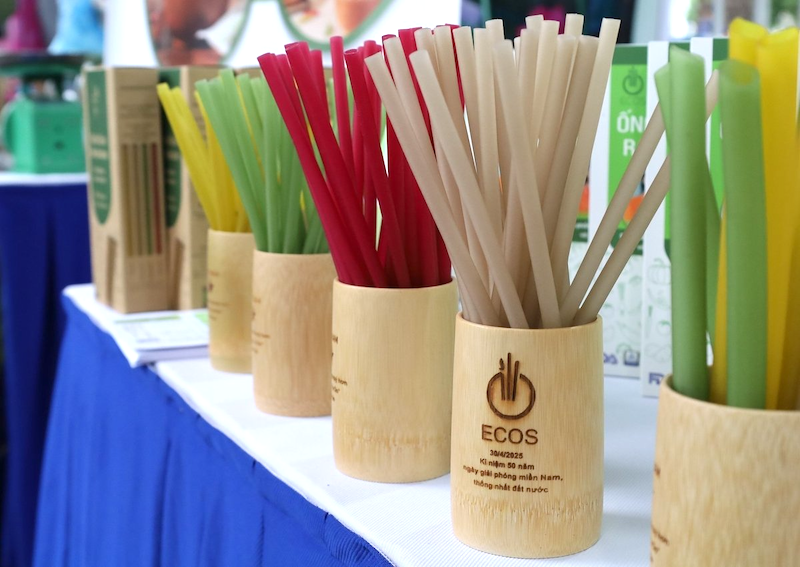
Rice straws, one of the green products showcased at the program “Promoting Sustainable Production and Consumption 2025,” held in June in Hanoi. Photo: Nong nghiep & Moi truong Newspaper
In the 2024 evaluation, the city ranked 30th out of 63 provinces and cities. Over the past year, the department and the Ministry of Industry and Trade’s Multilateral Trade Policy Department have organized workshops, training sessions and guidance programs to help local enterprises understand the FTA Index.
Hiep said the city has launched tailored support programs for major export sectors and initiatives to help businesses expand into new, high-potential markets.
Accordingly, Hanoi’s action plan focuses on improving FTA information dissemination, updating the local legal framework, supporting businesses, boosting competitiveness and promoting sustainable development.
The city prioritizes the removal of barriers in green transition, digital transformation and compliance with international standards.
Enterprises are encouraged to diversify export markets, maximize preferential tariffs under FTAs and reduce reliance on imported materials to meet rules-of-origin requirements. These steps aim to prevent trade fraud and avoid tariff circumvention risks.
“Our goal is to improve every component of the FTA Index by supporting exporters, enhancing competitiveness and helping Hanoi’s key industries access global supply chains,” said Hiep.
Mac Quoc Anh, Vice Chairman and Secretary General of the Hanoi Association of Small and Medium Enterprises (HANOISME), suggested that raising awareness of FTAs, improving administrative procedures, logistics efficiency.
Advancing the green transition could increase FTA utilization by 10% and boost export turnover by 10%–20%, he said.
To achieve this, he proposed establishing an FTA Center in Hanoi to serve as a coordination and advisory hub connecting the Ministry of Industry and Trade, customs and enterprises.
Anh said the FTA Index covers not only trade performance but also non-tariff standards such as green transition, circular economy, ESG, labor, environmental protection and carbon regulations.
“The FTA Index reflects the competitiveness, credibility and performance of exporters,” he emphasized.
He noted that only 32% of HANOISME members fully understand rules of origin and fewer than 25% use FTA incentives.
Even more concerning, just 18% have carbon reduction plans, although such requirements will apply to exports to the EU from 2026–2027. Without adaptation, businesses could lose 5%–8% of profits each year, according to Anh.
He said the proposed FTA Center would offer up-to-date guidance, aiming to raise the share of businesses benefiting from FTA preferences from 32% today to 55% by 2026.
Nguyen Van Than, Chairman of the Vietnam Association of Small and Medium Enterprises, said small and medium enterprises, which make up 97% of all businesses, still lack the capacity to take full advantage of FTAs.
Many focus on subcontracting instead of developing high-standard products for demanding markets such as the EU, the US and Canada, he said.
Than stressed that a change in mindset is essential. “Businesses must evolve into professional producers and traders to seize integration opportunities.”
He also called for more diverse communication channels to raise awareness of FTA benefits, helping enterprises recognize long-term value and invest in compliance and innovation.
|
The FTA Index measures and compares how effectively localities implement Vietnam’s trade agreements. It also serves as an incentive for provinces to innovate, reform administrative procedures and help businesses fully capitalize on FTA opportunities to diversify markets, supply chains and export products. |