Hanoi’s health sector issues monkeypox monitoring guidance at Noi Bai Int’l Airport
Besides screening measures at the airport, the health sector has also requested monitoring at different health facilities and greater vigilance at certain events in the community.
The Hanoi Health Department has just issued a dispatch instructing the monitoring and prevention of monkeypox at the city's Noi Bai International Airport amid the complicated evolution of the disease.
Accordingly, the department has requested the Hanoi Center for Disease Control (CDC Hanoi) to coordinate with other relevant units to monitor and test, so as to prevent the monkeypox epidemic from being imported to the capital city, especially at Noi Bai Airport.
Risk factors include making contact with people infected or suspected to be infected with monkeypox, or having had sexual intercourse with multiple partners, within 21 days before the first symptoms appear, according to a temporary guide for monitoring and preventing monkeypox by the Ministry of Health.
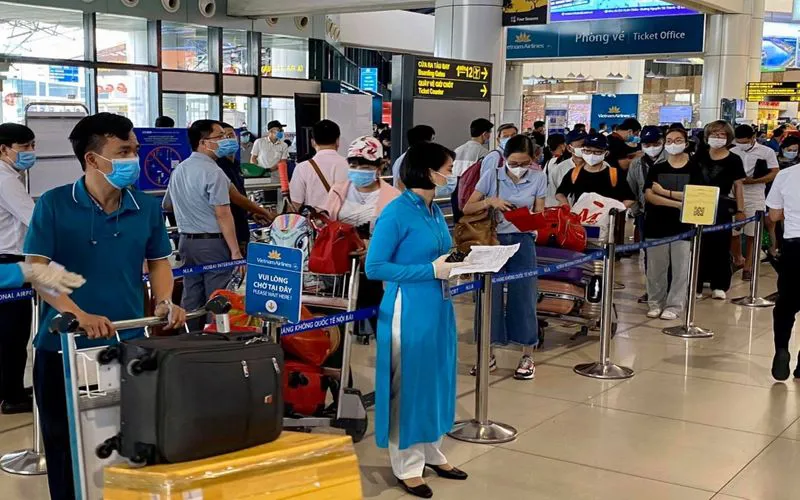
People wait in line to complete procedures at Noi Bai International Airport in Hanoi. Photo: Phan Cong |
Based on their risk factors, inbound passengers will be transferred to medical facilities for diagnosis, treatment and self-monitor for 21 days after entry. This policy will also be applied to passengers coming from countries/regions with monkeypox.
The measures at the airport also include supervising quarantine officers, the dispatch said, adding that the protection of health workers, high-risk and vulnerable people should be prioritized. Besides, the airport needs to set up a hotline to receive information and assist in handling the monkeypox.
People with suspected symptoms must be placed in temporary isolation for further testing and transferred to medical facilities for treatment or self-monitoring of their health for 21 days from the date of entry.
People who enter Hanoi from countries or regions with cases of the disease are also required to self-monitor for 21 days, and those displaying symptoms such as a rash, headache, fever, chills, sore throat, malaise, fatigue or swollen lymph nodes should go to a medical facility immediately.
CDC Hanoi is also required to closely monitor the situation of the monkeypox epidemic in the world, and continuously update the instructions for epidemic prevention and control.
Hanoi’s health sector also requested increased surveillance in the community and at health facilities to detect suspected cases.
To prevent monkeypox from spreading, it is recommended to avoid close contact with people who have or are suspected of having the disease; and frequently wash hands with soap and clean water or hand sanitizer, among other measures.
Besides screening measures at the airport, the health sector has also requested monitoring at different health facilities and increased vigilance at certain events in the community.
As of mid-August, the World Health Organization (WHO) had recorded over 35,000 monkeypox cases in 92 countries and territories, including those close to Vietnam such as Thailand, Singapore, South Korea, China, and Japan. Twelve people have died.
Typical symptoms of the disease include fever, headache, muscle pain, skin lesions, and rashes. It is transmitted through contact with bodily fluids or lesions.
As of August 23, Vietnam has not recorded any case of monkeypox. Health officials have admitted that the country currently lacks sufficient testing capabilities to detect the disease.