How strong is India’s resilience in global health crisis?
India is believed to rise stronger after the crisis unleashed by the coronavirus pandemic is over.
The pandemic has left a broad impact on India’s economy due to lockdown, restrictions, and the economic slowdown that followed, prompting the government to act to turn crisis into opportunities.
| Prime Minister Narendra Modi. Photo: PTI |
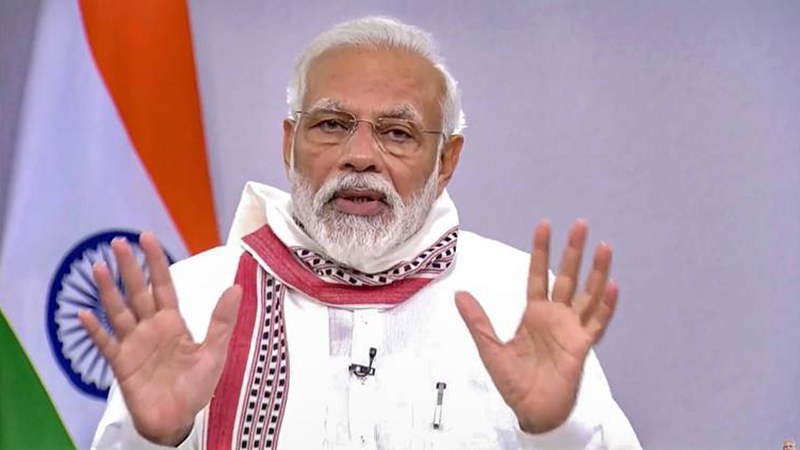
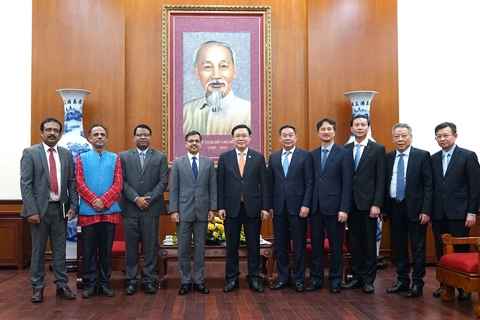
On May 11, Prime Minister Narendra Modi announced the Atmanirbhar Bharat (“Self-reliant India”) economic stimulus package worth US$300 billion, equivalent to 10% of India’s GDP, Ambassador of India to Vietnam Pranay Verma said at a talk in Hanoi late July.
The self-reliance package stands firm on five pillars namely Economy, Infrastructure, Technology-driven systems, Demand, and Demography.
With a long-term focus, the first tranche of measures focuses on reviving businesses through longer-term soft-lending and debt and tax relief.
The second tranche of measures focusing on migrants, small traders, and small farmers includes supplying free food grains to migrants for two months, concessional loans to small farmers, and affordable housing for migrants and the urban poor.
Boosting resilience
| Atmanirbhar Bharat (“Self-reliant India”). Photo: Tomorrowmakers |
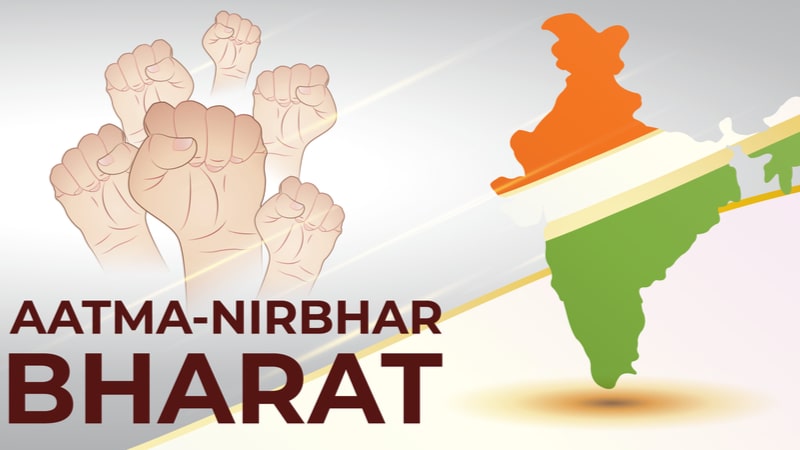
On June 8, after 10 weeks of lockdown, India started a phased reopening of its economy. With Unlock 1.0, the country is trying to balance attempts to revive the economy while dealing with increasing caseloads and new hot spots.
Addressing the 45th US-India Business Council (USIBC)’s “India Ideas Summit” on July 22, Prime Minister Narendra Modi said “Global economic resilience can be achieved by stronger domestic economic capacities. This means improved domestic capacity for manufacturing, restoring the health of the financial system and diversification of international trade.”
Prime Minister talked about the need to place the poor and the vulnerable at the core of growth agenda. He underlined that ‘Ease of Living’ is as important as ‘Ease of Business’.
He said that the pandemic has reminded us of the importance of resilience of the global economy against external shocks, which can be achieved by stronger domestic economic capacities. He emphasized that India is contributing towards a prosperous and resilient world through the clarion call of an ‘Aatmanirbhar Bharat’.
India offers a perfect combination of openness, opportunities and options, the PM said, adding that in the last six years, efforts have been undertaken to make India's economy more open and reform oriented, resulting in better competitiveness, enhanced transparency, expanded digitization, greater innovation, and more policy stability.
Meanwhile, Ambassador Pranay Verma said resilience not only enables India to move forward but also shares values to the world to help many others benefit from the stronger connectivity and cooperation.
Supporting livelihoods
| Wall paintings to spread awareness on wearing masks decorate the walls of Vijayawada. Photo: K.V.S. Giri |
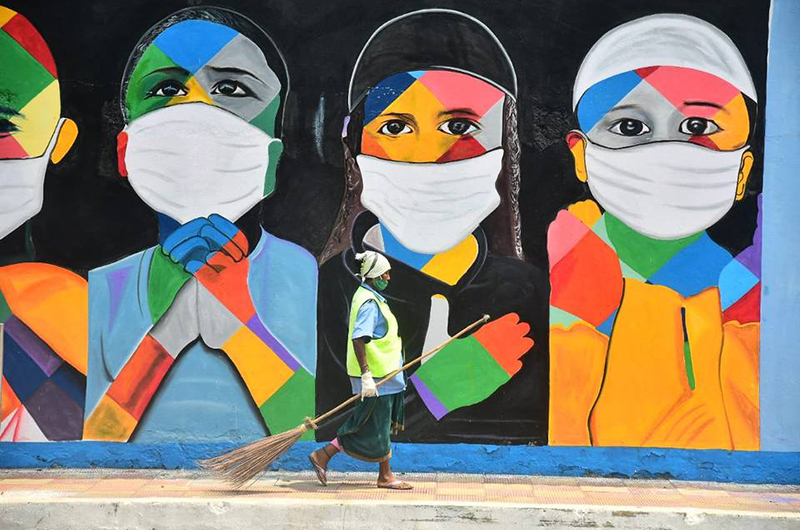
India’s pandemic preparedness and its policy response has been varied across the states. However, both the central and state governments are constitutionally empowered to legislate various activities in response to disease outbreaks.
On March 19, the Covid-19 Economic Response Task Force was set up under India’s finance minister to tackle the economic challenges resulting from the pandemic.
On March 23, the government introduced the Pradhan Mantri Garib Kalyan Yojana (PMGKY) or Prime Minister’s Poor Welfare Food Program, the world’s largest food security project. It’s a set of relief measures, including an amount of US$23 billion, to mitigate economic distress faced by vulnerable and poor people.
This program would benefit 800 million poor people in India.
This program provides free essential food items, cooking gas, direct cash transfers to the poor, and insurance coverage to Covid-19 health workers.
In addition, tax relief and debt relief has been provided to small and medium enterprises in statutory and regulatory compliance matters related to income tax, goods and service tax, customs, financial services, and corporate affairs.
Conclusion
International analysts said the crisis unleashed by the coronavirus pandemic will almost definitely create a new global order, and India could emerge stronger.
For the rest of the world, India’s promise is huge: its historical civilization, geo-strategic location, huge labor force of 500 million people, the fourth largest military in the world, and a formidable consumer market.
There are many arguing that India will bounce back once the government eases the drastic lockdown it imposed as a response to the coronavirus pandemic.