How tougher enforcement is changing Vietnam’s food safety landscape
Welcome to Words on the Street on The Hanoi Times. Today’s discussion looks at food safety as a lived reality, not a regulatory slogan. It is a slow, grinding problem that chips away at trust, confidence and peace of mind.
THE HANOI TIMES — Buying food has never felt easier. A few taps on a phone, a message in a group chat, or a tip from a friend or influencer and a meal appears.
People embrace these habits because they are cheap, fast and convenient. Street food reaches the doorstep. Trendy snacks explode online overnight.
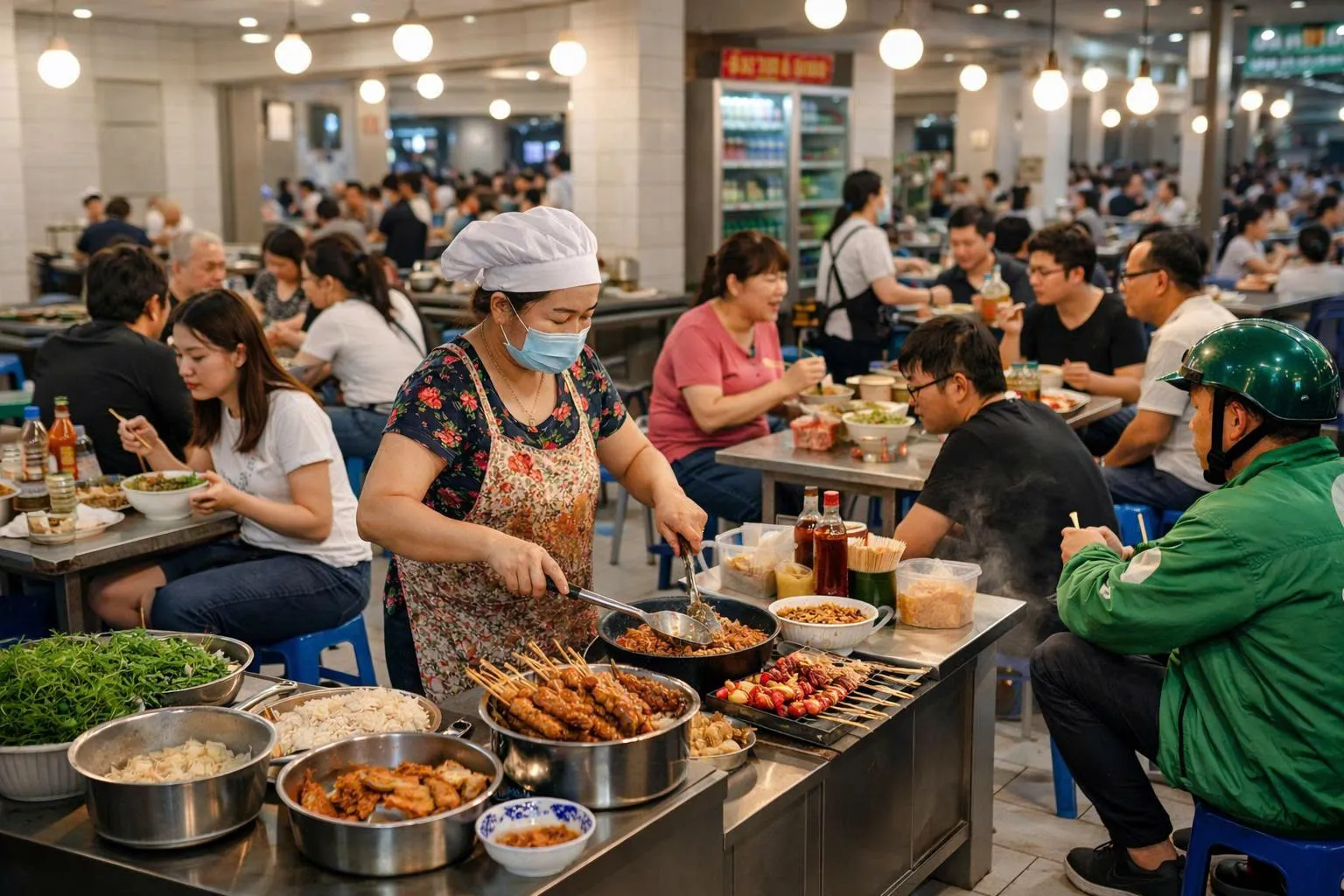
An AI-generated photo shows food being served at a local eatery.
Small sellers now operate everywhere, from home kitchens and pop-up stalls to social media pages. In rushed daily routines, convenience often outweighs caution.
That convenience, however, carries a price.
Over the past year, a series of food safety violations have been uncovered, not as random incidents but as the result of broader and more proactive enforcement efforts by authorities. Taken together, these cases signal a widening inspection net rather than a sudden decline in food safety standards.
One of the most unsettling cases involved Halong Canfoco, among Vietnam’s oldest canned food brands. For decades, its pate and canned meat sat on family tables, woven into daily life.
More recently, the brand resurfaced among younger consumers through products such as Pate Cot Den Hai Phong, blending nostalgia with online appeal.
That long-standing trust was put to the test when authorities, acting on expanded inspections, discovered more than 120 tons of pork infected with African swine fever in company warehouses, along with over a ton of rotten pork slated for processing.
Thousands of canned products were promptly destroyed and nine individuals were prosecuted, reflecting a firm stance that violations would be addressed decisively regardless of brand history or market position. The shock came less from the violation itself than from seeing a long-familiar brand at the center of it.
The fallout spread quickly. At Cho Cot Den, where traditional pate has been handmade for generations, customers vanished almost overnight.
Small sellers linked to the area faced suspicion and online attacks. Many buyers failed to separate industrial canned products from handmade food.
What made the case stand out was not only its scale, but also the fact that enforcement had moved beyond small, obscure sellers to include large, established brands. In recent years, violations were often associated with short-lived online shops or informal producers.
This shift marked a turning point, showing that food safety oversight is becoming more comprehensive and less selective. A quiet assumption collapsed: that size, history and reputation could shield violations from scrutiny.
Once that belief disappeared, confusion followed. If a decades-old company could fail so completely, what did food safety actually mean? How could anyone judge what was safe to eat?
The problem deepens as food circulates faster than regulation can follow.
Online sales, pop-up vendors, consignment models, relabeling and repackaging push products far beyond inspection systems designed for a slower, centralized market. In response, authorities are increasingly adapting their methods, shifting from passive checks to active investigations along supply chains.
That burden grows heavier by the week.
Last week, Hanoi authorities caught a sausage producer using borax, a banned additive, to improve texture and extend shelf life. The owner admitted using it since 2022.
Investigators said the facility had supplied about 300 tons of contaminated sausage to the city.
Beyond this case, Hanoi’s law enforcement agencies have expanded their approach, moving past routine inspections to criminal investigations aimed at intercepting risks before products reach consumers. In recent months, the city’s economic police, working with market management forces, have focused on tracing violations across supply chains rather than reacting only to isolated complaints.
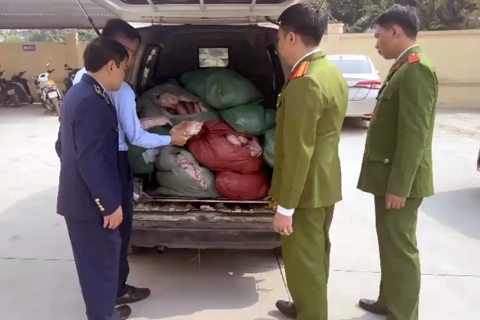
These efforts have resulted in the seizure of large quantities of unsafe food, including around 10 tons of frozen pork, sausages and animal offal stored without valid documentation in Yen So Ward, as well as nearly 1.7 tons of uncertified sausages in Tu Liem Ward. The operations were designed to prevent high-risk products from entering the market.
Rather than signaling a worsening situation, these cases underscore a hard but necessary reality: risks exist across the entire food system, and addressing them requires stronger, more visible intervention. From street vendors and online sellers to licensed facilities, no segment is beyond scrutiny.
Inspection data show that thousands of facilities undergo checks each year, with violations in roughly 10 to 20 percent of cases. These findings usually involve labeling, hygiene, or expired ingredients.
They were common, predictable and quickly forgotten.
Recent high-profile cases feel different because they are the result of deeper, more determined enforcement, challenging the notion that paperwork, price or tradition alone can guarantee safety. Consumers are now asking harder questions, and regulators are responding with stronger tools.
Vigilance has limits.
Most buyers cannot trace supply chains, read inspection reports, or verify testing certificates. This is precisely why enforcement and system-level solutions matter more than individual caution. After one scandal, documents lose meaning. After another, price stops signaling quality.
Fear becomes a rational response, but fear damages everyone.
Honest producers lose customers. Traditional food makers suffer suspicion. Addressing scandals one by one fails to rebuild trust.
Enforcement matters, but it is not enough.
Trust can only be restored through clearer standards, risk-based inspections and simple traceability tools that make safety visible and verifiable. Vietnam needs a system that producers can follow and consumers can understand.
Electronic invoicing offers one starting point. Despite resistance from small businesses and households, it can encourage producers to choose reputable suppliers.
Recent cases show that food safety is no longer treated as a peripheral issue. The exposure of major violations across multiple stages of the supply chain reflects a sustained and expanding commitment by authorities to protect public health and improve daily life for consumers.
At the same time, enforcement works best when reinforced by prevention. Reliable inputs lead to safer products and healthier consumers. Supplier information must become transparent through digital systems that allow regulators and consumers to verify data when needed.
Trust grows from transparency, not brand size. And as oversight becomes stricter and more consistent, consumers can feel more confident that food safety is no longer a matter of chance, but a shared commitment enforced in practice.