Japan provides Vietnam with US$5.7 million to enhance children's resilience to disaster risks
The project will also equip children, parents and communities with knowledge and skills to respond to climate change and natural disasters.
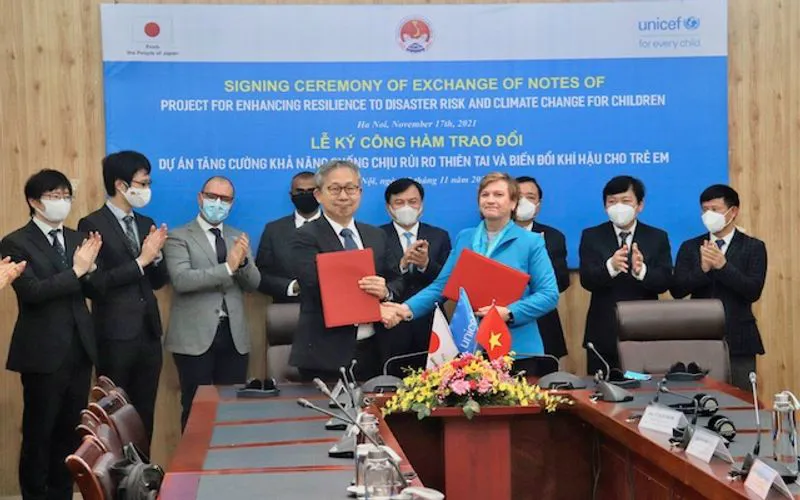
The Embassy of Japan and the United Nations Children's Fund (UNICEF) Vietnam on November 17 inked an exchange of notes for a US$5.7-million-project on “enhancing resilience to disaster risks and climate change for children”.
The exchange of notes was signed by Japanese Ambassador Takio Yamada and UNICEF Representative in Vietnam Rana Flowers under the witness of Vietnamese Deputy Minister of Agriculture and Rural Development Nguyen Hoang Hiep.
The project will run in Vietnam from 2021 to 2026 with a view to building institutional capacity to support child-centered and climate-sensitive activities through policy advocacy to access 27,000 children under 18 years old in central Vietnam and the Mekong Delta, especially southern provinces of Soc Trang, Ca Mau and Bac Lieu.
Representatives of the Japanese Embassy and UNICEF Vietnam signed the exchange note on November 17. Photo: Trong Tung |
The project also equips children, parents, and communities with knowledge and skills to respond to climate change and natural disasters. It will strengthen the resilience of 20,000 people, including 9,000 children with improved water and sanitation services; and 10,000 children under five years old who will undergo screening for severe acute malnutrition to make timely interventions.
At the event, Deputy Minister Hiep expressed his gratitude to the Japanese Government and UNICEF for supporting risk reduction and other fields, including nutrition, healthcare, education, and clean water supply, to meet the basic needs of people in natural disaster-hit areas.
“The signing of the document marked an important milestone in the close partnership among the governments of Vietnam and Japan and UNICEF,” said the deputy minister.
He expressed his hope that the Japanese Government and UNICEF will keep sharing experience and promoting Public-Private Partnership (PPP) in strengthening the resilience of natural disaster response projects and management systems.
Hiep also expected Japan and UNICEF to put forward recommendations for Vietnam, carry out behavior-change campaigns, and raise awareness of people, leaders, and managers in disaster risk reduction to build a disaster-resilient society.
For her part, UNICEF Representative in Vietnam Rana Flowers, said the climate crisis is a crisis of children’s rights.
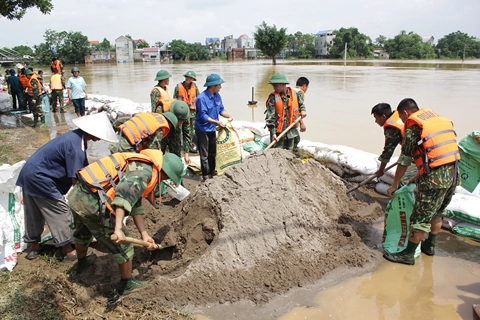
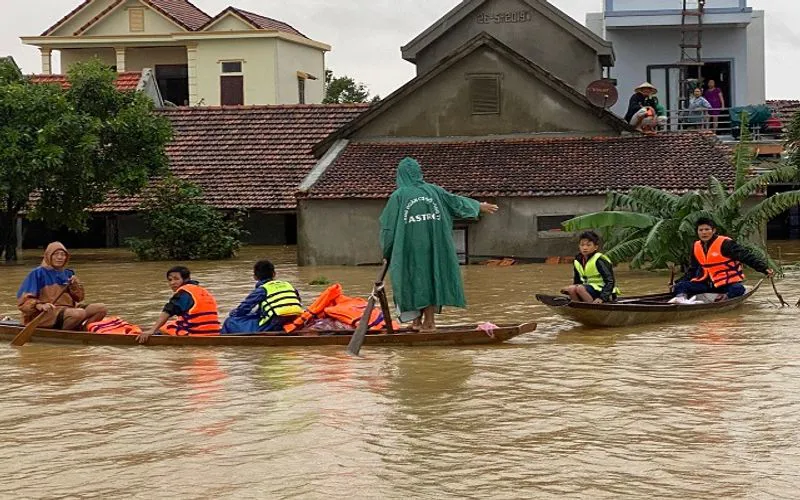
Vietnam is facing climate change-related disasters, like drought and saltwater intrusion in the Mekong Delta, as well as historic floods and landslides in central Vietnam in 2020, the UNICEF official said.
Rescuers take children to safe places amid the historic flood in central Vietnam last year. Photo: Quang Hai |
She noted that many communities hit by natural disasters are suffering adverse impacts from the Covid-19 pandemic and the project will address vulnerable issues in multiple areas, namely clean water, sanitation, nutrition, education, and children’s protection.
Moreover, the project does not only consider children as a vulnerable group but also an agent of change for a green, clean and safe community, Rana Flowers stressed.
According to the UNICEF Children’s Climate Risk Index 2021, Vietnamese children and adolescents are at the highest risk of being affected by climate change.
Climate change is increasing the frequency and intensity of extreme weather events.
Previously, in January, the United Nations Population Fund (UNFPA) provided US$180,000 in flood relief to the Vietnamese elderly.
In particular, over 3,700 UNFPA Dignity Kits worth US$180,000 were provided to the elderly in central Vietnam following a series of storms and tropical depressions that hit the region last year.
Last year, central Vietnam was struck by a series of storms and tropical depressions, triggering heavy rains, flooding, and landslides. Over 200 people were killed and property losses amounted to around VND30 trillion (US$1.3 trillion). Hundreds of thousands of homes were either destroyed or damaged, affecting the lives of at least 7.7 million residents, especially the Vietnamese children and elderly.
The Vietnamese Government has allocated around VND770 billion (over US$34 million) to the region as emergency relief. Many international organizations and countries like the US, the UK, and Australia also provided aid to assist the resumption of normal life.