Kieu Ky gilding craft revives thanks to artisans’ creativity
The gilding traditional craft village has resorted to innovation to make the traditional trade thrive.
Visiting Vietnam’s most popular sites like Hanoi Opera House, Ho Chi Minh Mausoleum, Temple of Literature, Hue Imperial City of Hue, Hoi An Ancient Town, among others, visitors are impressed by the fine interior and decorative items that are mostly created by the talented hands of craftsmen from Kieu Ky gilding craft village. They built up and preserved the traditional unique trade in the past so as to thrive in the modern time.
| The craft of gilding is practiced only in Kieu Ky Village, Gia Lam District, Hanoi. Photo: Danh Lam VNA |
Located in Gia Lam District, Hanoi, Kieu Ky Village is the birthplace of the 300-year-old trade and the only one in the country practicing it because the secret of making gold leaf is taught only to the villagers. There was a time that the trade went down and almost disappeared.
“It was in the 1980s after the war ended and we left the army to come back home and continue our traditional work,” recalled artisan Le Ba Chung who grew up in a family whose three successive generations have been linked to the trade. However, everything changed. The demand dropped and many people turned to the manufacture of leather products.
“Seeing only a few veteran artisans trying to stay with the work and having very low income, I was so sad for our delicate craft of hundreds of years. I felt like I had to do something,” he told The Hanoi Times.
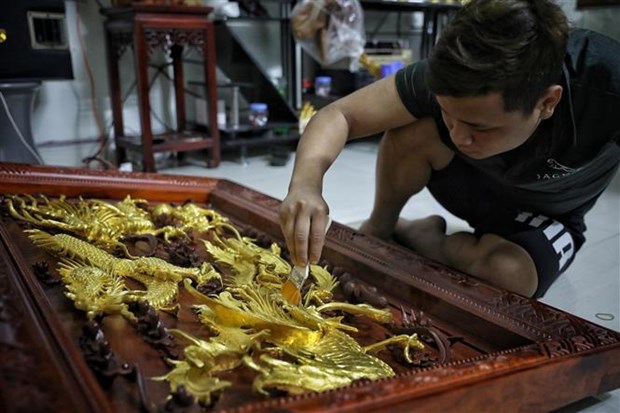
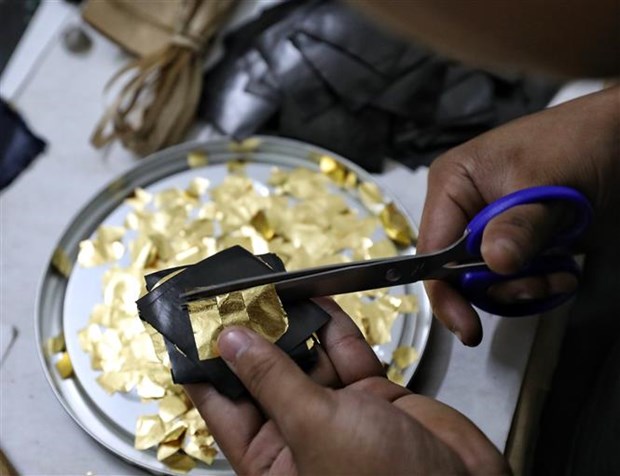
| The gold gilding is meticulous work that cannot be replaced by any machine. With 1/10 tael of gold, the craftsmen can laminate into 980 sheets, covering a surface of nearly one sq.m. |
From that motivation, Chung traveled all over the country to seek contracts with villages of lacquer making, carpentry, carving, and so on. At that time, transportation means were scarce and road conditions were poor. Each trip took him several days. But nothing could stop him.
His effort was compensated. The orders gradually increased in the early 1990s and the echoes of the pounding hammer once again resounded throughout the village. Customers also began to come to the village so that Chung no longer had to go looking for them.
Instead, Chung and other artisans brainstormed on how to improve the production and product quality. One of their most outstanding achievements was the new production process that was reduced from 40 steps to 20, saving a lot of time and work for the artisans.
In addition, they also produced a new kind of paper to reduce the cost as well as creating new designs to diversify their offers, according to artisan Nguyen Anh Chung, Chairman of Kieu Ky Gilding Association.
| The artisans from Kieu Ky Village are paying great attention at work. Photo: VNA |
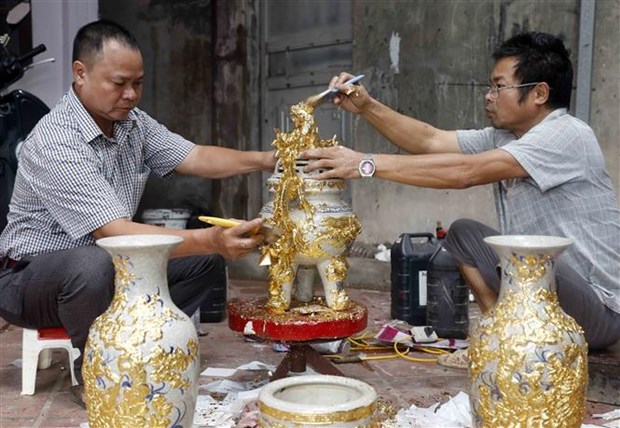
“From decoration items to souvenirs, our products are highly sought after. I also take on large projects such as gold inlays on thousands of buffaloes as gifts on the occasion of the year of the buffalo,” he said.
Meanwhile, artisan Nguyen Van Hiep tweaked existing potteries and wood and lacquer paintings by gilding them and turn them into new products. His 24-year-old son, Nguyen Van Ninh, has also joined the family business since he was 12.
“This work requires a lot of meticulousness and patience. But the job is stable and the income is good so I want to pursue it for the rest of my life,” he told The Hanoi Times, “I just expect that the authority would support young artisans in the village like me to start our own business and expand production.”
| A product of artisan Van Tra from Kieu Ky Village. Photo courtesy of the artisan |
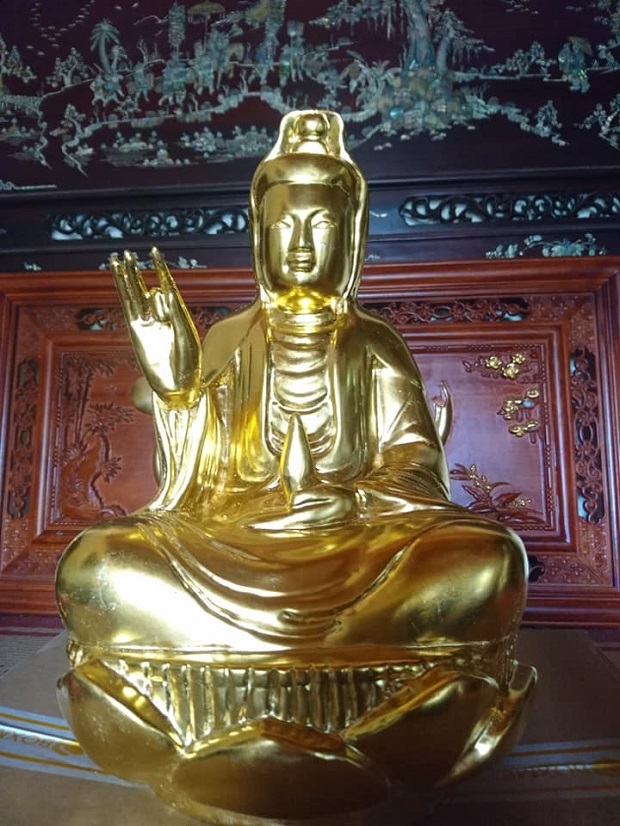
Seeing the passion of the young generation to the trade, Ba Chung has collaborated with the Center for Industrial Promotion and Industrial Development Consulting under the Hanoi Department of Industry and Trade to open vocational training classes for hundreds of people, contributing to preserving and promoting the development of the traditional Kieu Ky gilding craft.
The number of students increases year by year and some of them work with him on projects across the country.
Thanks to Kieu Ky artisans’ efforts, the craft has thrived again and was recognized as intangible cultural heritage by the Ministry of Culture, Sports and Tourism early this year. So far, there are more than ten cooperative groups and some 50 gilding households in Kieu Ky village, with about 300- 400 workers.
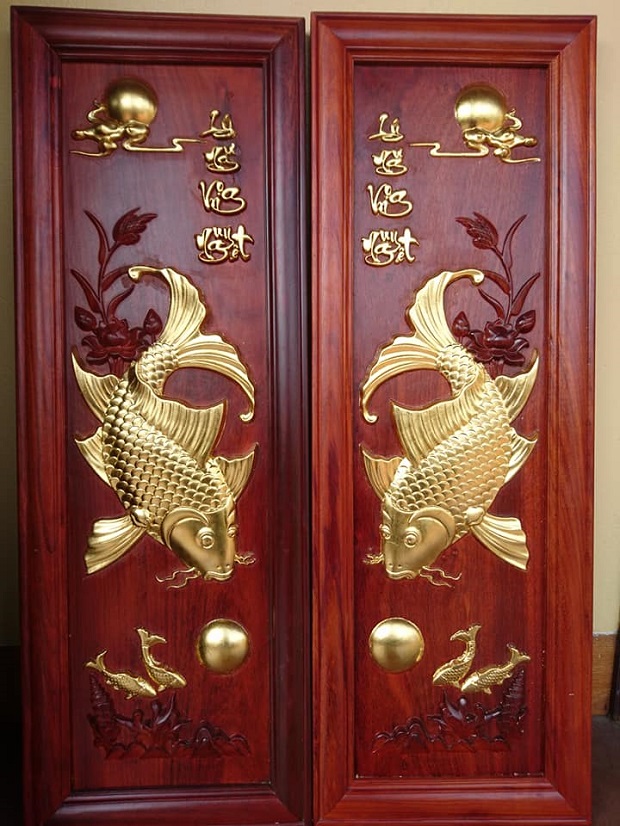
| The wooden pictures with gold gilding by artisan Van Tra from Kieu Ky Village, Gia Lam District. Photo courtesy by the artist |
Not only preserving and developing traditional craft, Kieu Ky artisans are also trying to connect the craft village with tourism.
In 2018, the villagers build a temple to worship the founder of the gilding trade with the total investment VND8.6 billion ($320,000), according to Dinh Van Giang, Chairman of the People’s Committee of Kieu Ky commune.
It is the place to display and introduce products of the craft village as well as the venue for vocational training for children in the village.
“The temple, together with about 15 relics including communal houses, temples, and pagodas in Kieu Ky, are expected to provide an interesting tour for visitors to learn about our traditional craft as well as the local history and culture, contributing to promote the trade development,” he stated.
![[Uniqueness of Hanoi's craft villages] Artisan brings Vietnamese silk to a new height](https://cdn-media.hanoitimes.vn/2021/08/11/Cover_2.png?w=480&h=320&q=100)