Made-in-Bat Trang ceramic replica of imperial seal
The ceramic version of Vietnam's Royal Gold Seal, reproduced in the same size and meticulous detail by artisans from the Bat Trang Ceramic Village, would make a meaningful gift for visitors to Hanoi.
With Tet holiday [the Lunar New Year] less than a month away, artisans in the Bat Trang Ceramic Village in Hanoi's Gia Lam District are up to their ears in perfecting dragon stamps to meet the demand for this special gift in the year of the Dragon 2024.
Dragon images in Vietnamese history have different forms through the dynasties, but all represent the authority of the emperors who ruled the country.
Artisan Pham Viet Khoa shapes a Sacred Dragon Figurine. Photo: Huy Pham/The Hanoi Times |
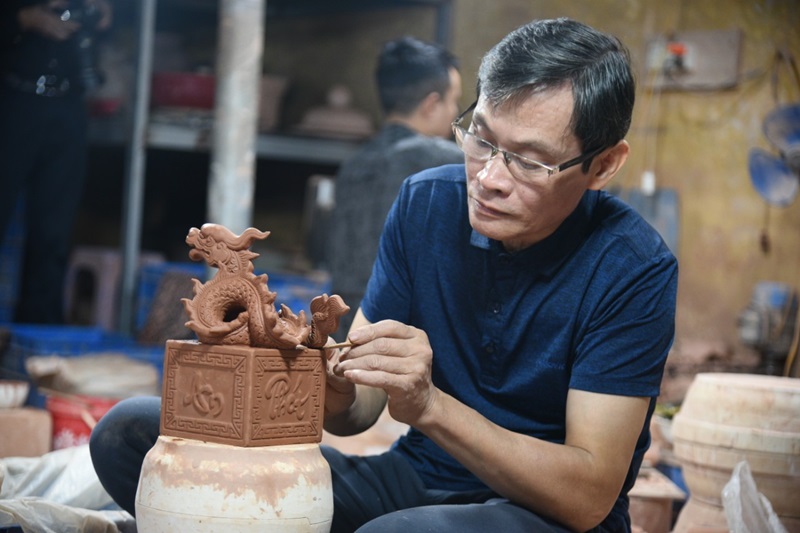
In a small workshop in the village, Pham Viet Khoa, who has 40 years of experience in making pottery, was shaping a product called Ky Linh Giap Thin or Sacred Dragon Figurine.
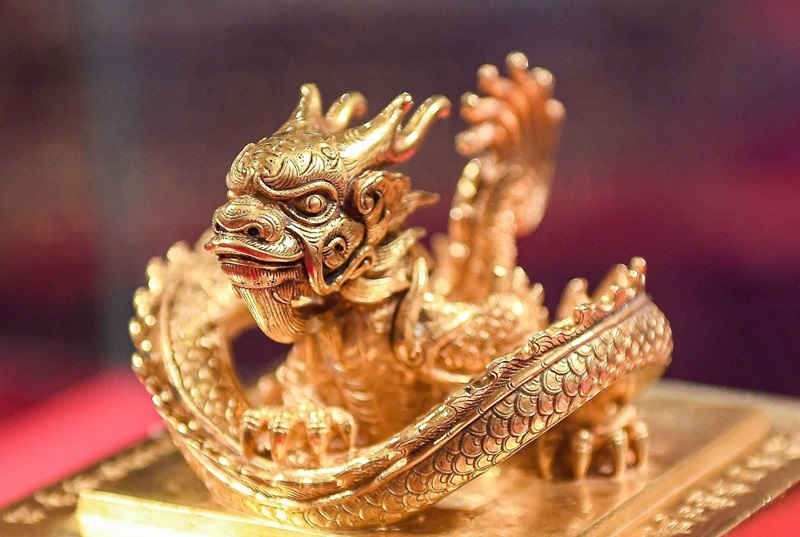
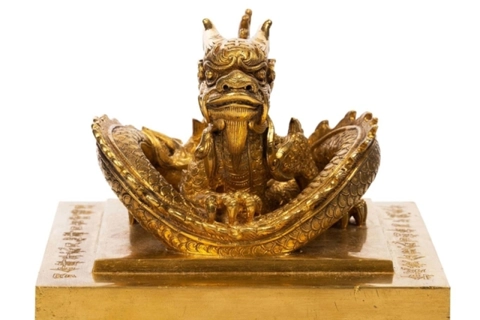
According to the artisan, the inspiration for the ceramic artifact came from Hoang De Chi Bao or Gold Emperor Seal, an 11-kg gold seal made in 1823 under the Nguyen Dynasty (1802-1945), the national treasure recently returned from France.
He also studied the dragon pattern of the Le So or Early Le Dynasty (1428 - 1527), one of which can be seen today in the Kinh Thien Palace in the Thang Long Imperial Citadel, for the product design.
"Various Bat Trang ceramics, including feng shui and cult objects, feature dragons. But the dragon motifs vary from dynasty to dynasty, and the early Le dynasty dragon is very gentle, with no frightening features," the craftsman said.
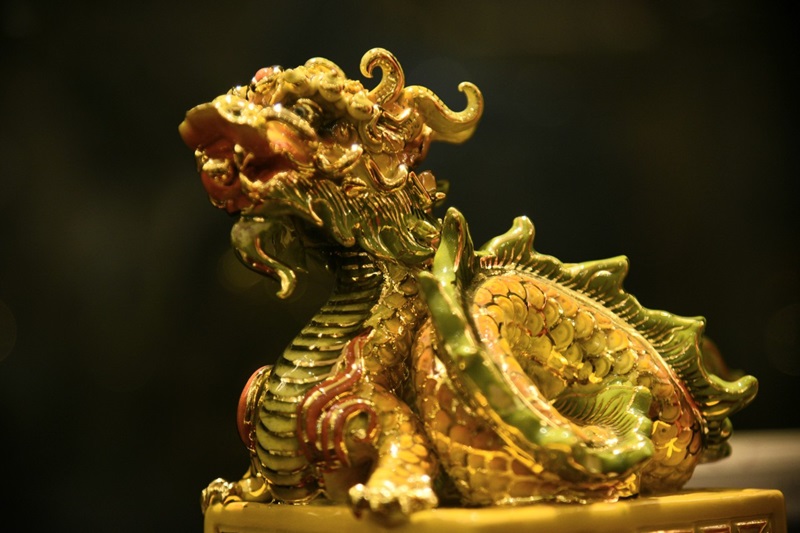
| The 'Ky Linh Giap Thin' or Sacred Dragon Figurine in ceramics was created by artisan Pham Viet Khoa based on the dragon prototype of the early Le Dynasty (1428 - 1527). Photo: Huy Pham |
Every day in his workshop, Khoa and his five artisans take turns meticulously handling different stages of the process.
"On average, each craftsman needs eight to 10 hours of continuous work to paint four to five gold seals. So we have to work overtime, from morning to night, to fulfil orders on time," he said, adding that shaping the clay core is an important step in making the products look like the original and have the characteristics of the Vietnamese dragon, but not those of other countries.
Unlike the seal, there is no mould for the dragon-shaped hilt, so the craftsmen have to make the head, the two body parts, the legs and the tail of the dragon separately and then attach them to the square seal. Khoa's workshop produces 20-30 raw cores a day, which are then coated with the recently restored royal enamel.
The seals are then baked for around five days. Next, instead of gilding the entire seal, the craftsmen use a 24-carat gold plating solution to paint on the dragon, which is made up of up to 1,000 details. Finally, the seals are fired again for six to eight hours to make the lines appear sharp.
| These exquisite dragons from the early Le dynasty have curly whiskers, round eyes, a pearl in their mouths and five clawed feet. |
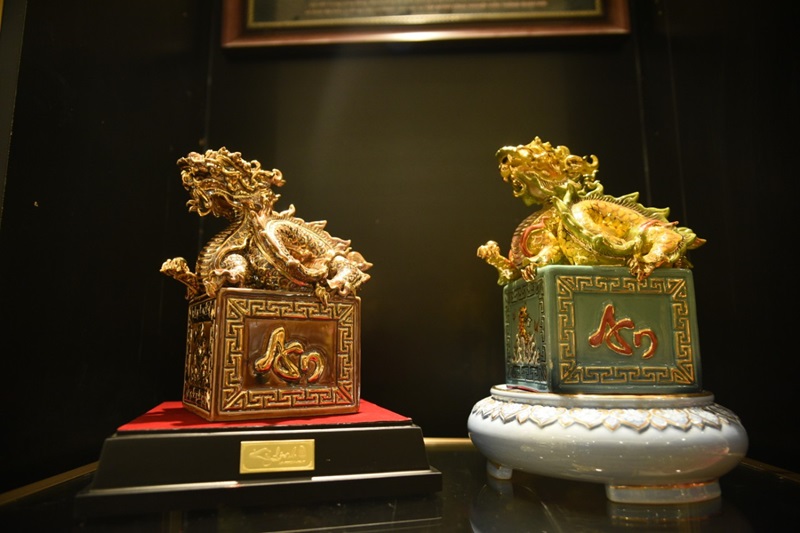
A Sacred Dragon Figurine is the embodiment of excellence in pottery. The clay is extracted from a sacred site in Quang Ninh Province, mixed with water from the Red River, and skilfully kneaded by the hands of artisans born in the year of the Dragon, making the pieces sacred.
"The collection entitled Sacred Dragon Figurines is a milestone that heralds a new era of prosperity. Each product would be delivered to consumers in 99 days, from the first design drawings until it is taken out of the kiln, or 24 stages of elaborate creation," he explained.
The finished products should have a bright, even layer of enamel and clear, shiny gold lines with no burnt spots. Three sides of the cubic seal are embossed with the three Vietnamese words An or peaceful, Thuan or smooth, and Phat or prosperous, while the fourth side has an image of a carp turning into a dragon, symbolizing transformation and transition to a new era. Each seal costs between VND9 million (US$368) and VND12 million ($490).
The 'Hoang De Chi Bao' golden seal was a symbol of political power in the Nguyen dynasty. It consists of a majestic dragon resting on a square base measuring 10.4 cm high, 13.8 cm long and 13.7 cm wide. The royal object was passed down from the second Nguyen emperor, Minh Mang (1791-1841), through 10 more to the last, Bao Dai (1913-1997). His second wife, Bui Mong Diep, brought the seal - along with two imperial swords - to France when Bao Dai's family fled into exile in the mid-1950s. On November 18, 2023, the 'Hoang De Chi Bao' golden seal was returned to Vietnam after Vietnamese businessman Nguyen The Hong, Chairman of the Kinh Bac Antiquities Collection and Research Association, bought the royal treasure for VND153 billion ($6.23 million) from Paris-based Millon Auction House. Vietnam's Ministry of Culture, Sports and Tourism, Ministry of Foreign Affairs, Ministry of Justice, Ministry of Finance, Ministry of Public Security and museum experts were also involved in negotiating the purchase. The seal is currently kept at the Nam Hong Royal Museum in Dinh Bang Ward, Tu Son District, Bac Ninh Province. |