Proposal to extend VAT cut through 2026 receives strong support
The government's commitment to supporting businesses in challenging times is demonstrated by extending the 8% VAT rate through 2026.
THE HANOI TIMES — A government’s proposal to extend the 8% VAT rate through 2026 and expand its coverage is largely well-received by the public.
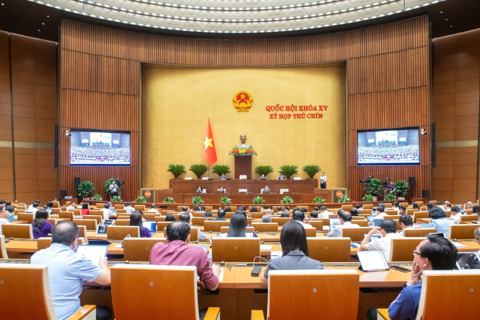
The proposal, presented by Minister of Finance Nguyen Van Thang at the ongoing 9th National Assembly session is set to last 18 months, from July 1, 2025 to December 31, 2026.
It also significantly broadens the range of goods and services that are qualified for the reduction.

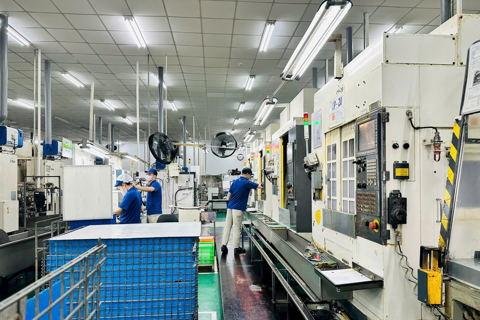
Production activities of businesses at Hoa Lac Hi-Tech Park. Photo: Pham Hung / The Urban and Newspaper
In addition to the categories previously covered, the government now proposes including more goods and services related to production, consumption, and tourism, such as IT products and services, prefabricated metal goods, chemicals, coke, refined petroleum, and fuel for commercial use.
The VAT reduction policy reflects the government's new approach to supporting businesses in the long term, said Dau Anh Tuan, Vice Secretary General and Head of the Legal Department at the Vietnam Chamber of Commerce and Industry (VCCI).
“The policy, which is straightforward and effective, helps lower consumer costs while enabling businesses to reduce production expenses and expand their market reach,” Tuan told a seminar last week.
He also praised the long application period of 18 months, noting that it provides businesses with a solid foundation on which to develop medium- and long-term plans instead of facing policy uncertainty.
"When the government lowers taxes during challenging times, it sends a powerful message that it is supporting businesses as they work to overcome obstacles," he said.
The Ministry of Finance reported that the recent policy of reducing the VAT has helped sustain consumer purchasing power and support business recovery following the pandemic.
From 2022 to mid-2025, the National Assembly has approved five 2% cuts on goods and services subject to the 10% VAT rate, excluding sectors like telecommunications, finance, insurance, real estate, mining, and luxury goods.
Reflecting the impact of this policy, in 2023, total retail sales of goods and consumer service revenues rose by over 9.6% on-year – a notably high growth rate in the regional context.
"Reducing the VAT helps consumers save money, which may stimulate spending, and lead to increasing production and reinvest, thereby contributing to GDP growth,” tax expert Nguyen Ngoc Tu told Kinh te & Do thi (Economic & Urban) Newspaper.
“This aligns with the government's goal of achieving at least 8% growth,” he said.
Since 2022, the government has consistently proposed reducing the VAT rate by 2%, lowering it from 10% to 8%, Tu said.
Despite the reductions, government revenue has increased, he added.
For instance, total state budget revenue surpassed VND2 quadrillion (US$77 billion) for the first time in 2024, marking an annual increase of more than 19%.
Nguyen Thi Cuc, Chairwoman of the Vietnam Tax Consulting Association, said that the value-added tax affects the entire production, distribution, and consumption chain, from input to output.
In addition to saving money for consumers, reducing VAT helps businesses reduce their production costs, boost their competitiveness, and expand their market access, she said.
The Ministry of Finance reported that VAT reductions over the past three years have supported business activity, contributing to economic growth rates of 8.54% in 2022, 5.07% in 2023, and 7.09% in 2024. During this time, the consumer price index (CPI) remained stable at 3.15%, 3.25%, and 3.63%, respectively.
Several households, small traders, and micro-businesses reported that the 2% VAT reduction policy eased some of their financial burden, particularly given their limited incomes and rising living costs.
Nguyen Quang Huy, CEO of the Faculty of Finance and Banking at Nguyen Trai University, said that the reduction of the VAT from 10% to 8% during the period from 2022 to 2024 produced a dual effect.
Essential goods get cheaper by 1.5-2%, which benefited low- and middle-income consumers, he said.
Businesses have gained the flexibility to lower their selling prices, boost their competitiveness, and retain jobs, Huy added.
The specialist recommended that the government expand the policy, and combine it with specific measures such as interest rate support, tax refund reform, and digital transformation of tax administration to encourage long-term, sustainable economic growth.
Fiscal impact needs careful assessment and policy must be fair
While most experts and businesses support the VAT reduction policy, some highlight the need for a cautious and well-calibrated approach during implementation.
If adopted, the tax-cut policy could reduce state budget revenue by nearly VND122 trillion ($4.7 billion) over the second half of 2025 and the entire year of 2026.
That figure includes nearly a reduction of VND40 trillion ($1.5 billion) in the second half of 2025 and VND82 trillion ($3.2 billion) in 2026.
Phan Van Mai, Chairman of the National Assembly’s Economic and Financial Committee, said that most committee members agreed with the government’s proposal to apply the reduced VAT rate for the second half of 2025 and all of 2026.
The committee also called for specific solutions to address implementation challenges, particularly regarding goods and services that are not yet eligible for the reduced rate, he said.
Mai added that the policy must be straightforward and transparent to ensure ease of compliance for taxpayers.
In addition, the committee urged a comprehensive assessment of the policy’s impact on state budget revenue, its chairman said.
He emphasized the need to safeguard medium-term fiscal stability and public debt safety.
Furthermore, the VAT reduction must align with other tax policies, including excise duties and environmental protection taxes, Mai said.
Despite the projected decline, Nguyen Van Hien, Vice Rector of Gia Dinh University, said that the government can still maintain budget balance.
The Ministry of Finance may increase revenues from other activities like property transfers, real estate, cross border e commerce, and individual gold trading to offset the state budget losses, he said.
Tax authorities may also reduce revenue leakage by applying digital tools, while the government seeks to cut inefficient spending, he added.