Provisions on city-within-city model in amended Capital Law need to be more precise
It is important for Hanoi to have mechanisms and policies that are truly groundbreaking and allow Hanoi greater autonomy than those designed for other localities.
The city-within-a-city model, a key part of the draft amended Capital Law, should be clarified with more details and elaboration.
| Deputy Nguyen Thi Hong Hanh from Ho Chi Minh City during the group discussion. Photos: Y Nhi/The Hanoi Times |

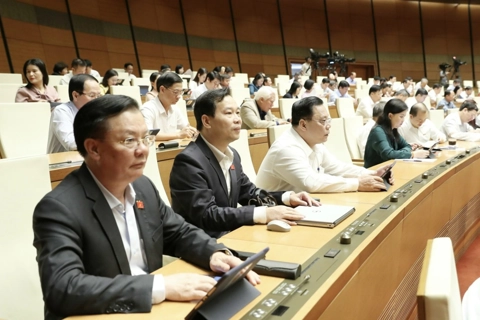
National Assembly deputies shared this view during a group discussion on the law on November 11.
The proposed amended Capital Law outlines the organizational structure of the two cities under Hanoi’s administration. These include a northern city - a logistics and service hub covering Dong Anh, Me Linh, and Soc Son districts, and a western city – a center for education, training, and science spanning Hoa Lac and Xuan Mai.
The proposed structure differs from that of district and town governments, including an increase in the number of Vice Chairmen of the Council and People's Committee, full-time delegates to the People's Council, and the addition of the Urban Committee.
During the discussion session, Deputy Nguyen Thi Hong Hanh from Ho Chi Minh City expressed concern that the provisions on empowerment in the "city within a city" model were unspecific, as they mostly deal only with organizational apparatus. She urged stronger decentralization for this model.
Referring to Ho Chi Minh City's existing "city within a city" model (Thu Duc City), Hanh argued that this experience should be considered when formulating regulations in the amended Capital Law.
“More powers and tasks should be granted to align with this innovative model,” said Hanh.
Sharing a similar view, Deputy Thich Bao Nghiem from Hanoi law should be more specific in defining the tasks and roles of sub-municipal cities.
He pointed out that the draft outlines general principles, lacking specific policies to empower the new government model. For instance, the role of the upcoming city government in selecting investors, signing project contracts, locally adjusting planning, and utilizing public assets needs more explicit coverage.
| Deputy Hoang Van Cuong from Hanoi. |

Necessity for extraordinary policies
Deputy Hoang Van Cuong from Hanoi stressed that the city, as the capital of the country, holds a symbolic and leading role in promoting nationwide development. Consequently, the amended Capital Law should incorporate truly unique and specific mechanisms and policies to attract resources for Hanoi's development.
Cuong agreed with the provisions of Article 4 of the draft Law, which sets the conditions for applying the Capital Law, emphasizing the need for specific and groundbreaking mechanisms and policies tailored to Hanoi's distinct position and role.
The deputy concurred with the provisions outlined in Article 4 of the draft Law, which establishes the conditions for the application of the Capital Law: "In the event of a contradiction between the provisions of the Capital Law and other laws and resolutions of the National Assembly on the same matter, the provisions of the Capital Law shall take precedence, except for cases specified in Clause 2 of this Article."
| Deputy Ta Thi Yen from Dien Bien. |

Additionally, it states, "if a law or resolution of the National Assembly issued after the entry into force of the Capital Law contains provisions differing from those of the Capital Law that need to be applied, such differences must be expressly stated in such law or resolution."
Given Hanoi's particularly crucial position and role, coupled with elevated development requirements, Cuong underscored the need for the mechanisms and policies outlined in the draft Law to be groundbreaking and superior to those designed for other localities.
Deputy Ta Thi Yen from Dien Bien suggested exploring regulations that empower the City People's Council to determine staffing levels based on an approved list of job positions. This approach, she argued, would enable the city to proactively manage its human resources in accordance with the tasks of the city government.
Deputy Le Thi Thanh Xuan from the Dak Lak underscored the profound socio-political significance of the amended Capital Law in creating a legal framework for the breakthrough development of Hanoi.
Stressing that Hanoi is the heart of the country, she advocated for stronger decentralization, linking the content, scope, subjects, and mechanism of decentralization to a responsible regime. Specific provisions, she noted, should ensure Hanoi's proper development as a cultural capital and a city for peace.